
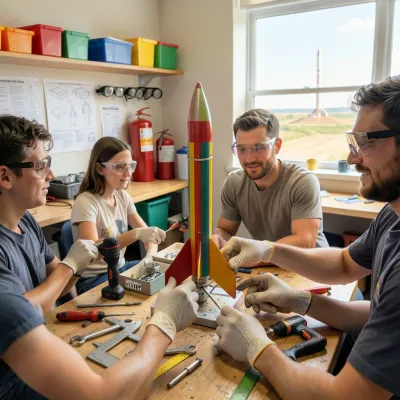
The rocket hung from a length of fishing line, suspended from a ceiling beam in the makerspace. A student nudged it gently. Instead of swinging back to center and settling, the vehicle kept rotating, flopping sideways like a fish on a dock. Around the workbench, three teenagers and their mentor watched in silence. The swing test had just failed.
The Mandatory Ritual
Every team in the program knew the rule: no rocket flies until it passes the swing test. The procedure was almost absurdly simple. Tie a string to the rocket at its balance point — the center of gravity — using a smooth swivel to kill friction. Hang it indoors, away from drafts. Nudge it off vertical. A stable rocket returns to its original orientation and damps out. An unstable one keeps turning, or wobbles without settling. "Entertaining to watch but worrying to fly," the mentor had said during the first safety briefing.
This rocket, a scratch-built vehicle with a phenolic motor mount and plywood fins, had looked perfect on the bench. Its center of gravity, found by balancing the airframe on two fingertips, sat a comfortable distance forward of the estimated center of pressure. The fins were aligned with a laser-cut jig. The motor mount was concentric. But the string told a different story.
The team repeated the test outdoors on a calm afternoon. Same result. The rocket refused to damp. Something was stealing stability.
The Cardboard Cutout
Before cutting into the airframe, they turned to the cardboard cutout technique. One student traced the rocket's full silhouette onto stiff poster board: nose cone, body tube, four trapezoidal fins. Another cut it out with a craft knife. They punched a small hole near the nose, threaded a thread through it, and let the cardboard silhouette hang like a pendulum.
When the cutout stopped swinging, they marked the balance point on the paper. That point, the mentor explained, approximated the center of pressure — the single spot where all aerodynamic forces effectively act. They laid the cutout against the real rocket. The mark fell nearly even with the center of gravity they had marked on the tube days earlier. The stability margin, the distance between the two points, was essentially zero.
The fins were pulling the center of pressure too far forward. The rocket was balanced like a pencil on its tip.
Diagnosis by Elimination
The mentor laid out the usual suspects. Fins not identical? They measured each root chord and span. Identical. Not aligned? The laser jig had held them true. Not secure? Epoxy fillets at every root were solid. Hidden asymmetry? They checked the motor mount for cant, the glue lines for heavy spots. Nothing.
Then a student noticed the nose cone. It was a lightweight plastic ogive, hollow, with no ballast. The motor mount, by contrast, was phenolic — dense and heavy. As the motor burned, the center of gravity would shift forward, but at liftoff the balance point sat too far aft.
"Add weight to the nose," the mentor said. "Small increments. Recheck after each."
They had modeling clay in a ziplock bag. The student packed a few grams into the nose cone tip, tamped it down with a dowel, and retaped the base. They rebalanced on fingertips. The center of gravity moved forward a centimeter. Swing test: the rocket swung back, wobbled twice, and stopped. Another gram of clay. Another test. Clean return. No wobble.
They had their margin: just over one body diameter. The mentor nodded. "Good enough to fly. Not so stiff it kills altitude."
The Low-Friction Pivot
For the final sanity check, they wheeled out the pivot rig — a sheet of plywood, two skateboard bearings pressed into a wooden block, a vertical bolt through the bearings. The rocket sat on the bolt, free to yaw left and right. A fan blew a gentle crosswind. The rocket weathercocked smoothly into the breeze, fins generating lift, nose tracking the flow. No corkscrew. No hunt.
One student filmed it in slow motion on a phone. The video showed the fins doing their job: a clean, damped response. The data matched the swing test. The cardboard cutout had not lied.
Launch Day
The launch field was a soccer pitch behind the school. Wind sock limp. The team ran the standard checklist: motor delay verified, igniter continuity confirmed, recovery wadding packed, parachute folded in accordion pleats. The range safety officer scanned the sky. The launch director called the countdown.
At ignition, the rocket leapt off the rod. No wobble. No corkscrew. A straight, fast climb to apogee, a clean ejection pop, a parachute blossoming white against blue. It landed fifty meters downrange, intact.
Back in the makerspace, they logged the flight: motor type, delay, wind, apogee from the altimeter. The stability margin they had measured — one point two body diameters — went into the notebook beside the clay weight total. The next team would start there.
The swing test string still hangs from the ceiling beam. The cardboard cutout is pinned to the bulletin board, its balance point marked in red ink. Both wait for the next rocket that thinks it can fly without proving it first.
This is one episode in a much longer story. For the full account of educational rocketry, read “Hands-On Rocketry for Students and Clubs” by Andrew Chen on MixCache.com.
Please log in or create an account to leave a comment.
No comments yet. Be the first to say something.