
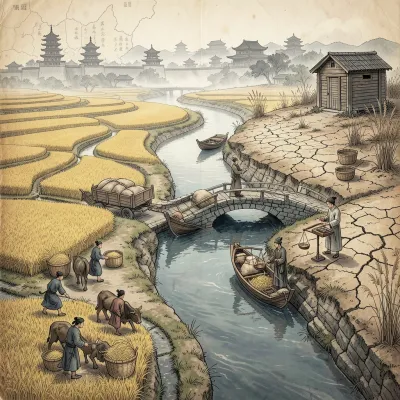
By the light of a single lamp in a mud-walled farmhouse, eighteen men pressed their fingerprints to a sheet of paper. It was late November 1978. Outside, the fields of Xiaogang village lay dormant under the Anhui winter; inside, the air was thick with cigarette smoke and the weight of a crime that could cost them their lives. The document they signed was barely a hundred characters long. It divided the commune's land into household plots, assigned each family a grain quota owed to the state, and — most dangerously — declared that whatever surplus they grew beyond that quota was theirs to keep.
The Calculus of Hunger
The farmers of Xiaogang knew the arithmetic of starvation. Anhui had been one of the provinces hardest hit by the Great Leap Famine two decades earlier, when communal dining halls emptied and cadres seized grain to meet inflated quotas. An estimated one to three million people had died in Henan alone during the 1942–43 wartime famine; the Great Leap's toll nationwide reached into the tens of millions. The survivors carried the memory like a second skin.
By 1978, the collective system had delivered two decades of stagnation. Grain yields had barely budged despite heavy fertilizer use and new irrigation. The commune's incentive structure was famously summarized by a peasant rhyme: "Work hard, work lazy, the result is the same." Caloric intake in rural China hovered around 1,800 calories a day — survival, not sustenance. The eighteen households of Xiaogang had watched their children grow stunted on thin gruel. They had nothing left to lose.
A Pact in Thirteen Strokes
The meeting was convened by Yan Junchang, a wiry man in his forties who had watched his father starve during the Great Leap. He argued that the only way to eat was to link effort to reward. The others agreed, but they also knew the penalty: under Maoist law, "undermining the collective economy" was counter-revolutionary, punishable by imprisonment or death. They wrote the contract in pencil so it could be erased if discovered. Each man added his fingerprint in ink — thirteen strokes total, one for each character of the village name — binding themselves to mutual secrecy.
The pact contained a clause that revealed its desperation: if any signer was arrested, the others would pool their resources to support his family. They were not ideologues. They were fathers who had buried children, husbands who had watched wives waste away, men who had eaten tree bark and boiled leather belts. The contract was a survival strategy, not a manifesto.
The Harvest That Changed Everything
The 1979 harvest stunned even the participants. Xiaogang's eighteen households produced 66,000 kilograms of grain — more than the village had grown in the previous five years combined. Per-capita income jumped from 22 yuan to 400 yuan. The secret could not hold. Neighboring villages noticed the Xiaogang farmers building new houses, buying bicycles, eating meat. By spring 1980, the practice had spread to twenty production teams in Anhui. By 1981, it reached Sichuan, where provincial officials quietly endorsed it.
Deng Xiaoping, recently returned to power after his second purge, recognized the significance. "It doesn't matter if a cat is black or white," he said, "so long as it catches mice." The central leadership, cautious but pragmatic, allowed the experiment to expand. By 1983, more than 90 percent of China's production teams had adopted household contracting. The commune system, the defining institution of Maoist agriculture, dissolved in barely five years.
The Ripple Effect
The consequences cascaded far beyond Xiaogang's fields. Between 1978 and 1984, China's grain output rose by a third — from 300 million to over 400 million tons — the most rapid agricultural recovery in modern history. The increase came not from new technology or expanded acreage but from unlocked human motivation. Farmers who could keep their surplus suddenly had reason to weed more carefully, fertilize more precisely, plant more intensively.
The urban rationing system, which had distributed grain through work units and coupons for three decades, began to atrophy. By the mid-1990s, grain coupons had vanished from most cities. The state repositioned itself from direct provider to strategic reserve manager, maintaining minimum purchase prices and a modernized granary network while allowing markets to handle day-to-day distribution.
The Unfinished Revolution
Yet the transformation carried costs the Xiaogang farmers could not foresee. The initial productivity surge plateaued by the late 1980s as small, fragmented plots hit their natural limits. Chemical fertilizer runoff poisoned waterways. Groundwater in the North China Plain dropped a meter a year. Rural incomes, which had briefly narrowed the gap with urban areas, began falling behind again as industrialization pulled investment and young labor from the countryside. By 1995, China — once a grain exporter — was importing millions of tons of wheat and corn annually.
The eighteen farmers of Xiaogang did not grow rich. Most remained in the village, farming the same plots their grandchildren now work. Their contract, preserved in a Beijing museum, is displayed as a founding document of modern China. But the men who signed it rarely speak of pride. They speak of hunger, and of a winter night when they decided that the risk of execution was preferable to the certainty of starvation. The revolution they began fed a billion people; whether it can feed the next billion remains the question that haunts the fields they tilled.
This is one episode in a much longer story. For the full account of Chinese food systems and famine history, read “Rivers of Grain: Food, Famine, and Statecraft in Chinese History” by Keith Martin on MixCache.com.
Please log in or create an account to leave a comment.
No comments yet. Be the first to say something.