
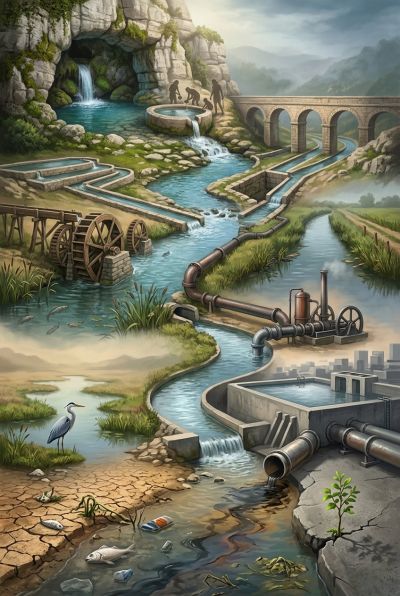
On the edge of what was once a bustling harbor, a rusting trawler sits keel-deep in sand. Its paint peels in the relentless sun, and the only sound is the wind scouring the exposed seabed. There is no water in sight — only a flat, white expanse stretching to the horizon, pocked with the bleached hulls of dozens more vessels. This is Moynaq, Uzbekistan, a port city stranded more than fifty miles from the shore. Until the 1960s, the Aral Sea lapped against its quays, the fourth-largest lake on Earth, an inland ocean larger than Switzerland. Today, the sea is largely gone, and Moynaq survives on the memory of fish.
The Plan for White Gold
The death of the Aral was not an accident of nature. It was a calculated decision made in Moscow during the 1950s, when Soviet planners declared that the union must achieve self-sufficiency in cotton — "white gold" for the textile mills. The arid republics of Central Asia, they reasoned, had the land and the sun; they lacked only water. Two great rivers, the Amu Darya and the Syr Darya, flowed down from the Pamir and Tian Shan mountains and emptied into the Aral. The solution was simple: divert the rivers into the desert.
Starting in the 1960s, a colossal network of canals spread across the steppes. The Karakum Canal alone stretched 840 miles, siphoning water from the Amu Darya to Turkmenistan's cotton fields. Thousands of miles of unlined ditches were dug, so poorly built that up to half the water evaporated or seeped away before reaching a single plant. Engineers knew the arithmetic. They calculated exactly how much the sea would shrink, how fast the salinity would rise, and when the fisheries would collapse. One official reportedly called the Aral a "mistake of nature" now being corrected. The plan proceeded.
A Sea Split in Two
By 1980, the flow reaching the Aral had been cut by ninety percent. The lake, deprived of its inflow and baked by the desert sun, began to evaporate with terrifying speed. The shoreline did not recede by feet but by miles. In 1987, the falling water level exposed a ridge of land that split the sea in two: a smaller North Aral in Kazakhstan and a larger South Aral in Uzbekistan. The water that remained grew hypersaline. Native freshwater species — sturgeon, carp, bream, perch — died off in waves. By the early 1980s, the commercial catch, once 60,000 tons a year, had fallen to zero. The canneries fell silent. The 60,000 people who had worked the fishery lost their livelihoods overnight.
The Toxic Legacy
The exposed seabed did not simply turn to sand. Decades of agricultural runoff — pesticides like DDT, defoliants, heavy metals — had settled in the lakebed sediments. As the water retreated, this chemical cocktail was left behind on a vast salt flat, the Aralkum Desert, one of the newest deserts on the planet. When the wind blew, it lifted the contaminated dust into choking storms that traveled hundreds of miles. The fine particles coated fields, ruined crops, and entered the lungs of the local population.
The health consequences were catastrophic. Rates of respiratory disease, esophageal cancer, kidney failure, and anemia soared. Infant mortality in the region became the highest in the Soviet Union. Drinking water turned brackish and poisoned. The people who had once lived off the sea's bounty were now being poisoned by its corpse. Moynaq's harbor, once alive with trawlers and cannery workers, became a graveyard of ships stranded in the sand, monuments to a vanished ecosystem.
A Partial Rescue
After the Soviet Union collapsed, Kazakhstan, newly independent, decided to try the impossible. With World Bank support, it built the Kok-Aral Dam, completed in 2005, a twelve-mile barrier separating the small North Aral from the dying South Aral. The goal was to concentrate the diminished flow of the Syr Darya into the northern basin, sacrificing the south to save a remnant. It worked. The water level in the North Aral rose by more than twelve feet. Salinity dropped. Freshwater fish returned. A modest fishery revived, and the town of Aralsk, once forty miles from the water, found the shore creeping back toward its piers.
The South Aral, however, continues to shrink. Its eastern lobe has largely disappeared, leaving behind only a seasonal brine pool. Uzbekistan, dependent on the same cotton economy that killed the sea, has not diverted water back. The rusting fleet at Moynaq remains where the water left it, half-buried in toxic sand, a testament to a hubris that rewrote a continent's hydrology in a single generation.
What the Dust Remembers
The Aral Sea's disappearance is not a closed chapter. The dust storms still blow, carrying the chemical memory of the cotton fields into the mountains of the Himalayas and the streets of distant cities. The Kok-Aral Dam proved that a damaged system can heal if given water and time, but it also proved how little water is left to spare. The Aral's fate is a warning written in salt and rust: a water system, no matter how vast it appears on a map, is only as permanent as the inflow that sustains it. When that inflow is sold for a commodity, the sea does not negotiate. It simply vanishes.
This is one episode in a much longer story. For the full account of the history of freshwater, read “A History of Freshwater” by Adrian Voss on MixCache.com.
Please log in or create an account to leave a comment.
No comments yet. Be the first to say something.