
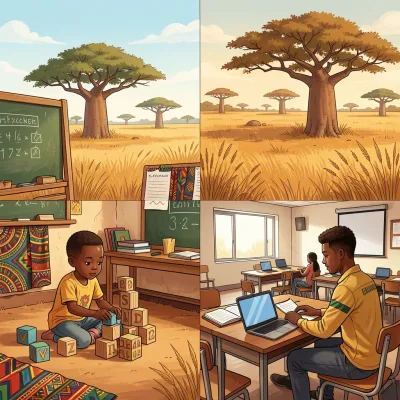
In a dusty village square in northern Burkina Faso, a teacher chalked letters onto a blackboard propped against a mud-brick wall. The students were not children but farmers, market women, and elders — men and women who had spent lifetimes working soil they could not read about. It was 1984, and the revolution had come to the alphabet.
The Revolutionary Context
When Thomas Sankara seized power in 1983, he renamed the country from Upper Volta to Burkina Faso — "Land of Upright People" — and declared that true liberation required more than political sovereignty. The new leader, a charismatic army captain in his thirties, argued that a nation where the majority could not read or write in any language was a nation still colonized in its mind. The statistics were stark: adult literacy hovered below 20%, and the formal school system, inherited from French colonial rule, reached only a fraction of rural children. Sankara's government made literacy a pillar of its revolutionary program, alongside vaccination drives, reforestation, and women's rights.
The approach was deliberately unorthodox. Rather than expand the existing French-language school network, the regime launched mass campaigns targeting adults in their own villages, using the languages they already spoke — Mooré, Dioula, Fulfulde, Gourmantché. The goal was not merely to teach reading but to make literacy immediately useful: lesson materials covered agricultural techniques, health hygiene, cooperative management, and civic rights. Learning was framed as an act of self-reliance, a tool for peasants to negotiate fair prices, understand government directives, and participate in the remaking of their society.
The Campaign Takes Shape
The mobilization was staggering in its ambition. Thousands of volunteer facilitators — many of them secondary school students, teachers, and civil servants — were dispatched to rural areas for intensive campaigns lasting weeks or months. They set up classes in courtyards, under mango trees, in abandoned warehouses. The curriculum was pragmatic: how to read a fertilizer label, how to write a complaint to the local cooperative, how to calculate the area of a field. Women, historically excluded from formal education, were specifically targeted; in some regions they formed the majority of learners.
Logistics were a constant struggle. Transport was scarce, materials ran low, and the rainy season turned dirt tracks into rivers. Facilitators often worked without pay, sleeping in villagers' homes and eating what the community could spare. Yet the campaigns drew on a reservoir of revolutionary fervor. Slogans painted on walls — "Literacy is a weapon" — captured the mood. The government claimed that over a million adults enrolled in the first years, though exact figures remain debated. What is clear is that the effort reached communities the formal system had never touched.
Methods and Mobilization
The pedagogical choice to use national languages was both practical and political. French remained the language of administration and secondary education, but the revolutionaries argued that literacy must begin in the learner's mother tongue. This meant developing primers, training facilitators, and standardizing orthographies for languages that had rarely been written. Linguists and educators worked alongside political organizers to produce materials in Mooré, Dioula, and other languages — a monumental task in a country with over sixty indigenous tongues.
Classes were designed to fit agricultural rhythms. Sessions met early mornings or evenings, avoiding planting and harvest seasons. The content was relentlessly practical: a lesson on reading medicine labels might segue into a discussion on child nutrition; a writing exercise might involve drafting minutes for a village water committee. This relevance kept attendance high even when the novelty wore off. Facilitators reported that learners who had never held a pen began keeping records for their farming cooperatives within months.
Legacy and Lessons
The revolutionary government fell in 1987, and the literacy campaigns lost their central political backing. Subsequent governments returned to a more conventional, French-centered education policy. Yet the episode left an enduring imprint. The idea that literacy could be mass-driven, community-based, and conducted in national languages survived in the country's educational DNA. When Burkina Faso later experimented with bilingual primary schools and adult literacy programs in the 1990s and 2000s, it drew on methodologies and personnel forged during the Sankara years.
Today, as the country grapples with a security crisis that has closed thousands of schools, the memory of those campaigns informs emergency responses. Radio education programs — another Sankara-era innovation — beam lessons to displaced children in camps. Temporary learning spaces in internally displaced persons settlements echo the makeshift classrooms of the 1980s. The conviction that education must reach people where they are, in languages they understand, remains the most tangible inheritance of a revolution that once taught a nation to read.
This is one episode in a much longer story. For the full account of Burkina Faso's 1980s literacy campaigns, read “Education In Burkina Faso” by Lawrence Clark on MixCache.com.
Please log in or create an account to leave a comment.
No comments yet. Be the first to say something.