
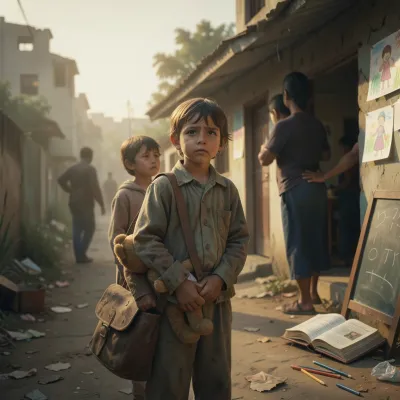
In a clearing in eastern Democratic Republic of the Congo, twenty-three young people stand in a loose line beneath the canopy. Some wear donated clothes that hang awkwardly on thin frames. A few stare at the red dust at their feet. Others scan the tree line, eyes moving with the ingrained rhythm of people who have learned that safety is never permanent. At the front of the group sits a red plastic bucket — the kind used for fetching water or carrying maize. Inside it, machetes, rifles, and ammunition belts lie in a tangled heap, the tools of a trade they are too young to have chosen.
The Ceremony
An official from a demobilization center reads names from a clipboard. One by one, each young person steps forward, places a weapon into the bucket, and receives a handshake, a change of clothes, and a ration card. The entire process takes under two hours. No speeches. No crowds. Just the sound of metal hitting plastic and the rustle of new fabric against skin. When the last name is called, the official loads the bucket into a vehicle and drives away. The young people are left standing in the clearing, lighter by a few kilograms and a lifetime of orders.
The scene is jarring in its simplicity. The popular imagination holds that the release of a child soldier is a moment of dramatic rescue — helicopters, tearful reunions, the flash of cameras. The reality is often this: a bureaucratic exchange in a forest clearing, conducted with the brisk efficiency of a vaccination drive. The Paris Principles, endorsed by more than one hundred countries, mandate that children associated with armed groups be released immediately and treated as victims, not perpetrators. But the principles do not dictate what happens after the bucket is emptied.
The Stranger at Home
For many, the first night back is the hardest. A mother in South Sudan described her son's return after three years with an armed group as "like meeting a stranger who looks like my child." He had grown taller. His face had hardened. His eyes moved constantly, tracking exits. He could not sleep without nightmares. She loved him, but she did not know how to reach him, and he did not know how to accept her care. The boy had spent his adolescence in a world where hypervigilance was survival, where emotional numbing was armor, where trust was a liability. Those adaptations do not vanish with a handshake and a ration card.
Reintegration programs that simply drop a child at a family gate without preparation see high rates of re-separation. The child may flee back to the only structure that ever felt reliable. The family may send the child away, unable to manage the aggression, the silence, or the stigma that follows a former fighter home. In some communities, neighbors refuse to let their children play with a returned boy. Girls who served as "wives" to commanders are shunned as sexually contaminated. A tailor in the Central African Republic who spent two years with an armed group returned to find her marriage prospects erased; she eventually built a business employing other young women, but only after a program combined economic training with community dialogue.
The Long Accounting
The red bucket ceremony is the visible tip of a process that measures in years. Research across Africa shows that former child soldiers who receive holistic support — education, vocational training, psychosocial care, family mediation, and community engagement — fare significantly better than those who receive only short-term assistance. But such programs are chronically underfunded. Donors often prioritize the photogenic moment of disarmament over the unglamorous work of helping a teenager learn to sleep through the night, or a mother learn to parent a son who flinches at a raised voice.
A young man in Liberia, abducted at thirteen and forced to fight for four years, eventually completed secondary school and became a youth counselor for newly released combatants. A girl in the Central African Republic learned tailoring and now employs others. These outcomes are not miracles. They are the result of sustained investment in the messy, nonlinear work of rebuilding a life. The bucket takes two hours to fill. The rest takes a childhood.
This is one episode in a much longer story. For the full account of reintegration of former child soldiers, read “Children and War: Psychological Impact, Education, and Long-Term Recovery” by Carolyn Daniels on MixCache.com.
Please log in or create an account to leave a comment.
No comments yet. Be the first to say something.