
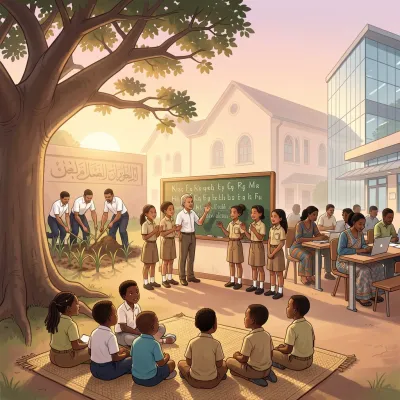
At Shule ya Msingi Ujuzi in Tanzania's southern highlands, the morning bell does not just summon children to rows of desks. It sends Standard III pupils into a vegetable garden behind the classroom block, where they measure bed spacing, test soil moisture, and record germination rates in exercise books stained with red earth. By mid-morning, Standard V students are planing timber in a carpentry shed, the scent of fresh sawdust drifting across a compound where every desk and bench bears the marks of student hands. The headteacher, Mama Zawadi, watches from the doorway of her office — a converted storage room — as the school feeds itself, teaches itself, and slowly rewrites what a rural primary education can look like.
The Garden and the Workshop
When Mama Zawadi took over Shule ya Msingi Ujuzi in the Mbeya region, the school faced the same strangling constraints as thousands of others across Tanzania: classrooms cracked by seasonal rains, a single textbook shared among a dozen children, and a teaching staff stretched thin across overflowing rolls. The government's fee-free policy had swelled enrollment, but resources had not followed. In 2018, rather than wait for allocations that might never arrive, she revived an idea rooted in the nation's 1967 Education for Self-Reliance policy — the principle that schools should be productive units, not passive recipients.
She started with the land. A half-hectare plot behind the latrines, long overgrown, was cleared by parents during a community work day. Standard III, the first year pupils encounter science as a distinct subject, was assigned the garden. The curriculum demanded they learn plant cycles, soil types, and basic nutrition. Mama Zawadi made the garden the textbook. Children planted amaranth, tomatoes, and maize using spacing techniques from the syllabus, then tracked growth against their own charts. They learned to identify nutrient deficiencies by leaf colour, to mulch with grass cuttings, to irrigate with recycled wash-water. The harvest went two ways: a portion fed the school canteen, the rest was sold at the weekly market in Mbeya town, twelve kilometres away.
Standard V took the carpentry shed. The syllabus required geometry — angles, measurement, area — and the subject of vocational skills. The school needed desks; the nearest supplier was a three-hour drive on rutted roads. Under a retired local artisan hired as a part-time instructor, pupils began by repairing broken furniture, then progressed to building new desks from locally milled timber. Each piece was stamped with the class year and the initials of its makers. By the end of the first term, the school had added forty desks without spending a shilling on transport or contractor margins.
Learning by Selling
The commercial element was deliberate. Mama Zawadi insisted that produce and furniture enter the real market, not simply circulate within the school. Standard III pupils calculated costs — seeds, tools, water — against revenue, learning profit and loss before they reached secondary school. Standard V negotiated prices with the market vendors who bought their vegetables, and with the primary school across the valley that ordered ten desks after seeing the quality. The income, modest but reliable, flowed into a transparent fund managed by the school committee: parents, teachers, and two student representatives. In the first year, the fund purchased a duplicating machine for exam papers, repaired the leaking roof of Standard IV, and paid a small monthly stipend to the volunteer garden coordinator — a parent who had lost his casual labour job in town.
The effect on classroom dynamics was immediate. Teachers reported that pupils who had struggled with abstract fractions suddenly grasped them when dividing garden beds or cutting timber to length. Science scores in the Primary School Leaving Examination rose from a 42 percent pass rate to 68 percent in two years. Mathematics pass rates climbed from 38 to 55 percent. Attendance improved, particularly among boys who had previously skipped school to help with family farms; now the farm was the school. Girls, often pulled out for domestic chores, found new leverage: the income they generated for the school gave their families a tangible reason to keep them enrolled.
A Model Reborn
The experiment did not stay contained. By 2021, the district education officer had visited Shule ya Msingi Ujuzi three times. Two neighbouring primary schools adopted adapted versions: one started a poultry unit linked to the Standard IV biology unit on animal husbandry; the other launched a basket-weaving cooperative tied to the art and craft curriculum. The regional education office in Mbeya circulated a case study, and the Tanzania Institute of Education requested the school's lesson plans for integration into the national competency-based curriculum review.
Mama Zawadi resisted pressure to package the model as a replicable "programme." She insisted the core was not the garden or the shed but the shift in mindset — teachers designing lessons around what the school needed and what the community could supply. "The curriculum is not in the book," she told a visiting delegation from Dar es Salaam. "It is in the soil, in the timber, in the market price of tomatoes on a Tuesday." The phrase travelled further than any official report.
The Long Shadow of Self-Reliance
Tanzania's 1967 Education for Self-Reliance declaration had envisioned exactly this: schools as productive hubs, students graduating with calloused hands and critical minds, the boundary between mental and manual labour erased. The policy faded under structural adjustment in the 1980s, when cost-sharing and austerity turned schools into begging bowls. Mama Zawadi's innovation was less a revival than a proof that the architecture still stands beneath the peeling paint. Shule ya Msingi Ujuzi now generates roughly 15 percent of its annual non-salary budget from its productive units — a figure that would be unremarkable in a private academy but is revolutionary in a government primary school where the per-capita grant often arrives months late.
The school still lacks a science laboratory, a library, and reliable electricity. The carpentry shed floods in April. The garden fails in drought years. But the pupils who leave Standard VII carry something rarer than examination certificates: they have negotiated a sale, managed a budget, seen a seed become a meal, and built a desk that a younger sibling will sit at. In a system where the transition to English-medium secondary school still breaks many rural children, that grounding in tangible competence may be the most durable textbook of all.
This is one episode in a much longer story. For the full account of education in Tanzania, read “Education In Tanzania” by Christopher Payne on MixCache.com.
Please log in or create an account to leave a comment.
No comments yet. Be the first to say something.