
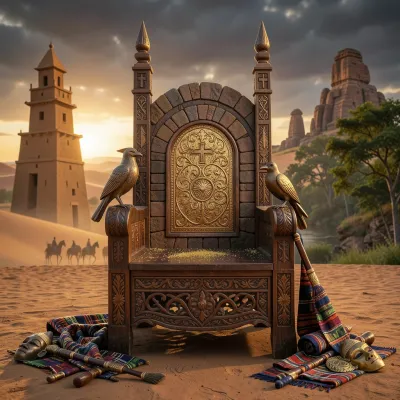
The caravan did not arrive in Cairo so much as flood it. When Mansa Musa's vanguard reached the Egyptian capital in July 1324, the sheer scale of the procession — thousands of soldiers, servants, and slaves, dozens of camels bearing hundreds of pounds of gold dust and nuggets — turned the city's markets upside down. Merchants who had spent lifetimes calibrating the weight of a dinar found themselves recalculating in real time as the Malian ruler and his entourage distributed gold with a liberality that seemed less like charity than like a deliberate unmooring of the local economy.
The Departure from Niani
Musa had inherited an empire already stitched together by his predecessor Sundiata Keita, a polity that drew its strength from the Niger's floodplain grain, the goldfields of Bambuk and Bure, and the salt mines of Taghaza. By the time he set out for Mecca, the mansa commanded a court that blended indigenous Mande traditions with Islamic administration: Muslim scribes kept the treasury's accounts, qadis settled commercial disputes, and the queen mother's influence still weighed on succession. The hajj was a religious obligation, but it was also a calculated projection of power. Musa did not travel light. Chroniclers record a retinue of 60,000 men, including 12,000 slaves each carrying a four-pound gold staff. Eighty camels bore 300 pounds of gold apiece. The caravan stretched so far that its dust rose before its rear guard had left the savanna.
The route followed established trans-Saharan tracks through Walata and Tuat, oases where the empire's influence already secured safe passage. At each stop, Musa's agents distributed gifts — bolts of cloth, handfuls of gold — to local chiefs and governors, converting the journey into a rolling diplomatic offensive. The mansa himself rode in a howdah draped in silk, surrounded by a bodyguard whose armor caught the desert sun. His purpose was never concealed: to demonstrate that Mali's wealth was not a rumor but a force that could be felt in the palm of a hand.
The Flood of Gold in Cairo
Cairo in 1324 was the financial heart of the Mediterranean Islamic world, its markets calibrated to the steady flow of West African gold that arrived in measured caravans. Musa's arrival broke the rhythm. He encamped near the pyramids for three months, and during that time his spending was so prodigious that the price of gold in Egypt fell by as much as 25 percent, a depression that lasted more than a decade according to the historian al-Maqrizi. The mansa bought Turkish slaves, Byzantine silks, Egyptian horses, and Yemeni textiles. He paid poets to sing his praises and funded the construction of a madrasa and a khanqah for Sufis. Every transaction pumped more gold into a system that had no mechanism to absorb it.
The Egyptian sultan, al-Nasir Muhammad, received Musa with ceremony but also with calculation. The two rulers exchanged gifts — the Mamluk sent rare fabrics and a jeweled saddle; the Malian replied with gold in quantities that made the Egyptian court uncomfortable. When Musa requested permission to mint his own coin in Cairo, the request was diplomatically declined. The episode revealed the limits of even imperial generosity: wealth could buy access and admiration, but it could not rewrite the monetary sovereignty of another state. Musa eventually borrowed from Cairo's money lenders at high interest to fund his return journey, a detail that underscores the pilgrimage's economic paradox. The man who had flooded the market with gold left it in debt.
The Return and Its Architectural Legacy
The homeward leg of the journey brought more than the mansa's person back to the Niger. In Mecca, Musa had met the Andalusian architect and poet Abu Ishaq al-Sahili, whose reputation for blending North African and Iberian styles preceded him. The mansa persuaded al-Sahili to return with him, granting him land and a position at court. Under al-Sahili's direction, the mud-brick Djinguereber Mosque rose in Timbuktu, its tapered minaret and rounded buttresses introducing a formal vocabulary that had no precedent in the region. The mosque was not merely a place of worship; it was a statement that Mali could attract the world's talent and set it to work in service of the throne.
Timbuktu itself transformed. Already a commercial node where the Niger bent toward the desert, it became a magnet for scholars, scribes, and students drawn by the mansa's patronage. Manuscripts on law, astronomy, and medicine arrived in caravans alongside salt and cloth. The university — if a network of mosque schools and private libraries can be called that — gained a cosmopolitan character that distinguished it from older centers in Fez or Cairo. Musa's investment in stone and scholarship outlasted the gold dust he had scattered in Cairo. The buildings remained; the inflation faded.
The Map That Remembered Him
Fifty years after the pilgrimage, a Jewish cartographer in Majorca named Abraham Cresques produced the Catalan Atlas, a portolan chart intended for the French king Charles V. On the sheet depicting West Africa, Cresques drew a black ruler seated on a cushion, crowned and sceptered, holding an enormous gold nugget. The caption read: "This Negro lord is called Musse Melly, lord of the Negroes of Guinea. This king is the richest and most distinguished ruler of this whole region on account of the great quantity of gold that is found in his lands." The image was fantasy built on fact — Musa had been dead for decades — but it fixed Mali in the European imagination as a land of inexhaustible treasure. The map guided Portuguese navigators down the coast a century later, their caravels chasing the golden ghost of a pilgrimage that had ended in 1325.
The hajj's consequences rippled beyond economics and cartography. It cemented Mali's integration into the dar al-Islam, giving Muslim merchants and scholars a framework of trust that smoothed trade across the Sahara. It demonstrated that an African ruler could operate on equal footing with the sultans of Cairo and the emirs of Mecca, not as a supplicant but as a peer whose wealth commanded attention. And it left a template for his successors: a throne's legitimacy could be measured not only in the grain stored in its granaries but in the impression it made on distant strangers.
Musa died around 1337, his empire intact but already facing the strains of succession and the slow shift of gold trade toward new coastal routes. The gold nugget on the Catalan Atlas remains the most enduring artifact of his reign — not a crown, not a sword, but a piece of metal that once passed through his fingers and into the fever dreams of mapmakers and merchants. The pilgrimage lasted less than two years. Its echo has sounded for seven centuries.
This is one episode in a much longer story. For the full account of the Mali Empire, read “African Thrones: Kingdoms, Dynasties, and State Formation South of the Sahara” by Rachel Ford on MixCache.com.
Please log in or create an account to leave a comment.
No comments yet. Be the first to say something.