
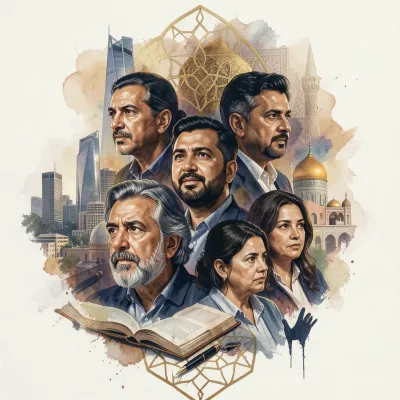
The grainy footage shows a tall man in simple white cloth, moving counterclockwise around a cube draped in black silk. He is surrounded by thousands — Arabs, Africans, Turks, Indonesians, Europeans — all dressed identically, all reciting the same Arabic invocation. For Malcolm X, the Hajj of April 1964 was not merely a religious obligation. It was a collision between the theology he had built his fame upon and a reality he had never imagined.
The gospel of separation
Before Mecca, Malcolm Little — then Malcolm X, national spokesman for the Nation of Islam — had spent twelve years teaching that the white man was a devil, literally and theologically. The Nation's founder, Wallace Fard Muhammad, had declared that the original Black man was God, while the white race was a grafted creation of a mad scientist named Yakub, destined to rule for six thousand years before divine judgment. Elijah Muhammad, Fard's successor, reinforced this cosmology with a program of moral discipline, economic self-reliance, and total separation from white America. By 1963, Malcolm X was the movement's most magnetic voice, drawing crowds with rhetoric that made integration sound like surrender.
His break with the Nation in March 1964, triggered by disputes over Elijah Muhammad's personal conduct and political quietism, left him doctrinally unmoored. He founded Muslim Mosque, Inc., but had no clear theological alternative. When he booked passage to Jeddah on a Hajj visa arranged by an Egyptian diplomat, he carried the Nation's assumptions like baggage: that Islam was the Black man's birthright, and that the global Muslim community was essentially an extension of the struggle against white supremacy.
Seven days in the valley
The Saudi authorities initially detained him, skeptical of an American Muslim with no traditional scholarly lineage. A call to Prince Faisal's office secured his release. What followed were seven days that dismantled his worldview. In letters typed on hotel stationery and mailed to aides in New York, he described praying beside "blue-eyed blonds" and "black-skinned Africans" without a hint of racial tension. He wrote of princes and peasants sharing water from the same cup, of the Persian prince and the Pakistani peasant prostrating in unison. "There were tens of thousands of pilgrims," he recorded, "from all over the world. They were of all colors, from blue-eyed blonds to black-skinned Africans. But we were all participating in the same ritual, displaying a spirit of unity and brotherhood that my experiences in America had led me to believe never could exist between the white and the non-white."
The Arabic word ukhuwwa — brotherhood — kept appearing in his notes. He had encountered it in Nation theology as a racial exclusive. In Mecca, it was universal. The Qur'anic verse he had cited a hundred times — "O humanity! Indeed, We created you from a male and a female, and made you into peoples and tribes so that you may know one another" (49:13) — suddenly read as a description of the courtyard around him, not a metaphor.
El-Hajj Malik El-Shabazz
He returned to New York in May 1964 with a new name, El-Hajj Malik El-Shabazz, and a revised mission. At a press conference, he declared that his Mecca experience had forced him to "rearrange" his thinking. He still condemned American racism as a structural evil, but he no longer attributed it to an essential white nature. Instead, he argued that racism was a learned behavior that could be unlearned — and that orthodox Islam, with its color-blind brotherhood, offered a model for that unlearning. He founded the Organization of Afro-American Unity to pursue Black liberation through pan-African solidarity and human-rights advocacy, explicitly linking the struggle in Harlem to anti-colonial movements in Algeria, Egypt, and Ghana.
The pivot came at a cost. The Nation of Islam branded him a heretic and a traitor. Death threats multiplied. FBI surveillance intensified. On February 21, 1965, as he addressed a rally at the Audubon Ballroom in Manhattan, three gunmen rose from the audience and fired twenty-one shots. He was thirty-nine.
The long conversion
Malcolm X's transformation did not die with him. In the decade after his assassination, thousands of African Americans followed the path he had blazed: from the Nation's racial theology into mainstream Sunni Islam. Warith Deen Mohammed, Elijah Muhammad's son and successor, formally disbanded the Nation's separatist structure in 1975 and guided its members — estimated at two hundred thousand — toward orthodox practice. Mosques sprouted in Newark, Atlanta, Chicago, and Los Angeles, often purchased with funds from the same communities that had once built Nation temples. The Muslim Mosque, Inc. that Malcolm founded became a template for Black-led Islamic institutions that emphasized civic engagement over withdrawal.
Today, the Black Muslim Atlantic he helped shape includes scholars like Sherman Jackson, who argues that the African American experience of slavery and segregation produced a distinct jurisprudential resilience; artists like Lupe Fiasco and Maher Zain, who blend hip-hop and nasheed to articulate a faith that is both culturally rooted and globally connected; and activists who invoke Malcolm's post-Hajj language when they frame police brutality or voter suppression as violations of the maqasid al-Shari'a — the higher objectives of Islamic law that protect life, dignity, and justice for all.
The grainy footage from 1964 still circulates on social media every Dhul Hijjah. Young Muslims share clips of Malcolm circling the Kaaba, captioned with the line from his autobiography: "In the past I permitted myself to be used to make sweeping indictments of all white people. I now realize that some white people are truly sincere, that some are capable of brotherhood toward a Black man." The pilgrimage that remade one man became a reference point for a community still negotiating what it means to be Black, Muslim, and American — all at once.
This is one episode in a much longer story. For the full account of contemporary Muslim thought, read “Contemporary Muslim Thinkers and Movements” by Hannah Henderson on MixCache.com.
Please log in or create an account to leave a comment.
No comments yet. Be the first to say something.