
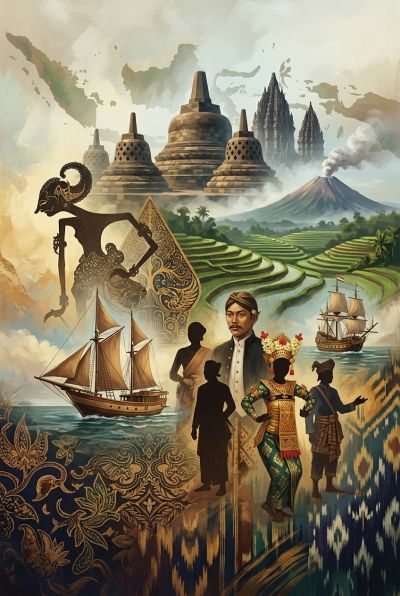
The Banda Islands are barely dots on a map, a volcanic cluster in the Banda Sea so small that a strong wind might blow a ship past them before the lookout cries land. Yet for two centuries these specks of rock were the only place on earth where the nutmeg tree, Myristica fragrans, grew wild. In the kitchens and apothecaries of 17th-century Europe, nutmeg was worth more than its weight in gold. It preserved meat, flavored wine, and was believed to ward off the plague. Whoever controlled Banda controlled the price of that miracle spice.
The Company Man
Jan Pieterszoon Coen arrived in the Indies as a teenage clerk in 1607. By 1618 he was Governor-General of the Vereenigde Oostindische Compagnie (VOC), the Dutch East India Company, a corporate state armed with its own navy, army, and the sovereign right to wage war. Coen was a man of cold arithmetic. He had watched the Bandanese, a confederation of villages led by wealthy elders called orang kaya, sign monopoly contracts with the VOC and then cheerfully ignore them, selling their nutmeg to English, Javanese, and Malay traders who paid better prices in Indian textiles.
To Coen this was not mere breach of contract. It was rebellion against the Company's God-given right to dictate the terms of trade. In a famous letter to the directors in Amsterdam he wrote: "You gentlemen should well know from experience that trade in Asia must be conducted and maintained under the protection and favour of your own weapons... we cannot carry on trade without war, nor war without trade." He resolved to make an example of Banda so terrifying that no other ruler in the archipelago would ever dare defy a VOC contract again.
The Expedition
On February 25, 1621, a fleet of thirteen ships dropped anchor off the main island, Lontor. Aboard were nearly two thousand European soldiers and a contingent of Japanese mercenaries, ronin recruited in Hirado, hardened veterans of Japan's civil wars. The Bandanese had a few cannons and the courage of desperation, but their forts were swept aside in days. Coen's forces landed unopposed on the beaches, and the orang kaya retreated to the hills with their families, hoping to negotiate as they always had.
Coen did not negotiate. He had forty-four of the captured elders brought before a tribunal of his own officers. The charge was treason against the Company. The trial lasted hours; the verdict was predetermined. One by one, the orang kaya were led to a scaffold in the fort's courtyard. Their heads were struck off with a sword. The bodies were quartered and the pieces impaled on bamboo stakes along the waterfront, a warning written in blood for anyone who might consider resistance.
The Depopulation
The killing did not stop with the leaders. Coen ordered his troops to hunt down the rest of the population. Soldiers combed the hills, the nutmeg groves, the caves where families hid. Those who did not die by musket or sword were rounded up and marched to the coast. Many, rather than surrender, threw themselves from the cliffs into the surf. Others starved in the mountains. Of the estimated fifteen thousand people who had lived on the Bandas before the fleet arrived, perhaps one thousand survived the conquest.
The survivors were loaded onto ships and transported to Batavia, the Company's new headquarters on Java, where they were sold as slaves. The islands were empty. The nutmeg trees stood untended in the volcanic soil, their fruit rotting on the branch.
The Plantation System
Coen now faced a practical problem: nutmeg trees take years to mature, and there was no one left to tend them. His solution was the perken system. He divided the arable land of the Bandas into sixty-eight parcels, each about 1.2 hectares, and leased them to former VOC soldiers and company employees, the perkeniers. Each planter received a quota of slaves — men and women captured in other parts of the archipelago, or bought from slavers in Makassar and Bali — to work the groves.
The perkeniers were not free entrepreneurs. They were bound by contract to sell their entire harvest to the VOC at a fixed price set in Amsterdam, a price that bore no relation to the market value in Europe. They could not sell a single nutmeg to anyone else. The Company had achieved what no sultan or Portuguese viceroy had managed: absolute, enforceable control over the world's nutmeg supply.
The Message Received
The Banda massacre was not a secret. Coen wanted it known. Reports of the slaughter circulated through the Malay trading networks within weeks. In the ports of Aceh, Banten, and Makassar, rulers took note: the Dutch did not bluff. When they signed a treaty with the VOC, they were signing away their sovereignty. The Company's monopoly on nutmeg and mace held for a century and a half, financed by the labor of slaves on land cleared by genocide.
Coen himself did not live to see the full fruit of his work. He died in 1629 during a siege of Batavia by the Sultan of Mataram, his body laid to rest in the city he had built on the ruins of Jayakarta. But the system he created on the Banda Islands — the marriage of corporate capitalism and state violence — became the template for the Dutch colonial empire in Asia. The nutmeg trees still grow on Lontor and Run and Ai. The perken walls, built of coral and brick, still mark the boundaries of the parcels. And in the Jakarta neighborhood of Tanah Abang, descendants of the Bandanese slaves still remember the islands their ancestors were stolen from.
This is one episode in a much longer story. For the full account of the history of Indonesia, read “A History of Indonesia” by Rama Gunawan on MixCache.com.
Please log in or create an account to leave a comment.
No comments yet. Be the first to say something.