
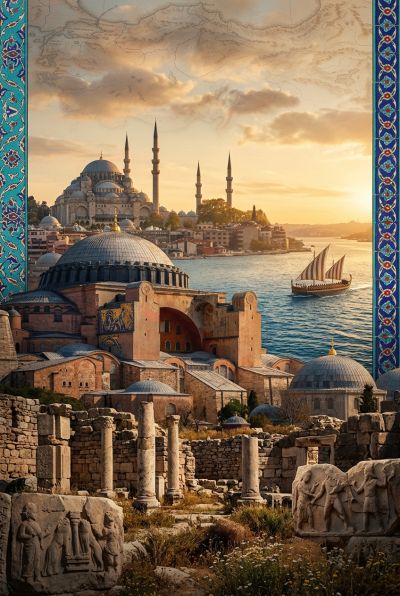
The great chain across the Golden Horn had held for centuries. On the night of April 22, 1453, it ceased to matter. Under cover of darkness, teams of oxen and hundreds of men dragged seventy Ottoman galleys up the wooded slopes of Galata, over a hastily built road of greased logs, and lowered them into the sheltered waters behind the chain. By dawn, the Byzantine defenders awoke to find the enemy fleet floating where no enemy fleet had ever been. The psychological blow was instantaneous; the laws of nature, it seemed, had been suspended for the young Sultan Mehmed II.
The Gun That Changed War
Mehmed had spent two years preparing for this moment. He was twenty-one, fluent in half a dozen languages, and obsessed with a single objective: the city that had defied his great-grandfather, his grandfather, and his father. The triple land walls of Constantinople, built by Theodosius II in the fifth century, had repelled Avars, Arabs, Bulgars, and Rus. They were considered impregnable. Mehmed knew they were not — not against the new chemistry of gunpowder.
He found his weapon-maker in a Hungarian renegade named Orban, a master founder whom the Byzantines had turned away for lack of funds. Mehmed offered four times Orban's asking price and unlimited bronze. The result was the "Basilic," a monster nearly twenty-seven feet long, bored to take a twelve-hundred-pound stone ball. It required sixty oxen and two hundred men to move. When it fired, the recoil shook the ground a mile away. Mehmed deployed it alongside sixty-nine other cannons, the largest artillery concentration the world had yet seen.
The bombardment began on April 6. Day after day, the great stones slammed into the outer wall, turning marble facing into rubble. The defenders — seven thousand men, including two thousand Genoese under Giovanni Giustiniani — worked through each night clearing debris and building palisades behind the breaches. They held. The walls were too thick, the defenders too desperate, the Ottoman powder too inconsistent. A stalemate settled over the siege lines.
The Chain Is Broken
The fleet in the Golden Horn changed everything. Now the defenders had to man the sea walls as well, stretching their numbers to the breaking point. Mehmed pressed the advantage. He ordered a massive assault on the land walls for May 29, the fifty-third day of the siege. That night, in the city's churches, Orthodox and Catholic clergy celebrated a joint liturgy — the schism of 1054 forgotten in the face of extinction. Emperor Constantine XI Palaiologos, last of the Caesars, received communion, then rode to the Lycus Valley sector where the breach was widest.
The attack came in waves. First the irregulars, the bashi-bazouks, thrown forward to exhaust the defenders. Then the Anatolian regulars. For hours the line held. Giustiniani, fighting in the breach, took a crossbow bolt through his cuirass and was carried from the wall. His evacuation triggered a panic among the Genoese. Seeing the waver, Mehmed committed his reserve: the Janissaries, the slave infantry who were the Sultan's household troops. They did not waver. They poured into the gap. Simultaneously, a party discovered an unguarded postern gate, the Kerkoporta, and slipped inside, planting the Ottoman banner on the inner rampart. The cry went up: "The city is taken!"
Constantine XI tore off his imperial regalia and plunged into the melee. He was never seen again. By noon, the resistance had collapsed.
From Constantinople to Istanbul
Mehmed rode to the Hagia Sophia, the great cathedral of Orthodox Christendom. He dismounted, sprinkled dust on his turban in humility, and ordered the building converted into a mosque. The three days of licensed pillage that followed were brutal — thousands killed, tens of thousands enslaved — but Mehmed stopped them on the first day. He wanted a capital, not a graveyard.
His vision was imperial, not merely Turkish. He styled himself Kayser-i Rum, Caesar of Rome. He invited the displaced Greek population to return, guaranteed the autonomy of the Orthodox Church under a new patriarch of his choosing, and brought in Muslims, Jews, and Armenians from across his domains to repopulate the empty quarters. The city that had been Constantinople became Istanbul, a cosmopolitan hub where the call to prayer mingled with church bells and the languages of three continents echoed in the bazaars.
The shockwave rolled across Europe. Pope Nicholas V called for a crusade that never came. The Italian city-states mourned the loss of their commercial gateway. In Moscow, monks began to speak of a "Third Rome." The Ottoman Empire, already the dominant power in Anatolia and the Balkans, now possessed a capital worthy of its ambition. Mehmed would go on to conquer Serbia, the Morea, Trebizond, Bosnia, and the Crimea. He would die at forty-nine, planning an invasion of Italy.
The walls that had stood for a millennium were obsolete the moment the Basilic spoke. But the fall of Constantinople was not merely a triumph of artillery. It was the triumph of a state that could mobilize the resources to cast such guns, the logistics to haul ships over a hill, and the will to sustain a siege through fifty-three days of disappointment. The Roman Empire ended on a Tuesday in May 1453. The Ottoman century had begun.
This is one episode in a much longer story. For the full account of the conquest of constantinople, read “A History of Turkey” by Mehmet Yılmaz on MixCache.com.
Please log in or create an account to leave a comment.
No comments yet. Be the first to say something.