
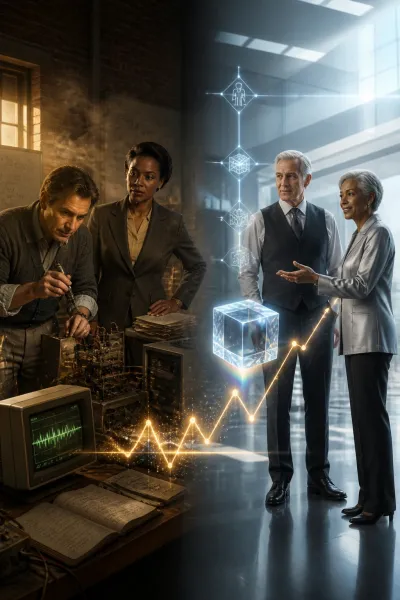
The lab smelled of solder and stale coffee. It was well past midnight on a Tuesday in the company's second year, and the small team of engineers clustered around a benchtop test rig had long since run out of ideas. For weeks, every prototype of their flagship contaminant sensor had failed the same way: after a few hours of continuous operation, the readings would begin to wander, drifting away from the truth they were built to capture. In a startup betting its existence on "unwavering precision," drift was not a bug. It was an existential threat.
The problem that wouldn't yield
Dr. Alistair Finch had co-founded Veralto on the conviction that real-time, in-line detection of microscopic impurities could transform food safety. His partner, Beatrice Sterling, had secured the seed funding and the first pilot customers. But the technology — an advanced spectroscopic sensor coupled with custom analytics — kept betraying them. The sensors calibrated perfectly in the morning. By afternoon, they were reporting phantom contaminants or missing real ones.
The team had tried everything they could think of. They swapped optical materials. They rewrote the calibration algorithms. They added thermal shielding, then removed it when it made things worse. They consulted a professor of optical engineering at a nearby university, who suggested a more stable reference wavelength. That bought them an extra hour of stability before the drift returned. Morale frayed. One senior engineer updated his LinkedIn profile. Finch, usually the calmest person in the room, began sleeping on a couch in the lab.
The core physics were sound. The spectroscopy worked. But something in the system — a subtle thermal shift, a mechanical creep, an electronic aging effect — was introducing a slow, nonlinear bias that no static calibration could correct. The pilots at two food processing plants were due to start in six weeks. If the sensors couldn't hold calibration for a full production shift, the contracts would evaporate, and with them, the Series A round Sterling was negotiating.
The session that changed the trajectory
On the night of the breakthrough, the team had ordered takeout from the same Thai place they'd eaten at three times that week. Around 11 p.m., the conversation had circled back to the same dead ends for the second time. Then the junior engineer spoke up. He had been with the company for four months, hired straight from a master's program in mechanical engineering. He rarely talked in these sessions.
What if, he said, they stopped fighting the drift and started measuring it? His idea was to embed a miniature reference cell directly into the sensor head — a sealed, known sample that the optical path would interrogate every few seconds. Couple that with a temperature compensation circuit that adjusted the gain in real time based on a thermistor mounted millimeters from the detector. The sensor would, in effect, recalibrate itself continuously, using its own internal standard as a compass.
The room went quiet. It was unconventional. It added complexity, cost, and a new failure mode. A senior engineer pointed out that the reference cell would itself age. The junior engineer nodded. Then it ages with the sensor, he said. The differential stays valid.
Finch, who had been staring at a schematic, stood up. "Run it," he said. "Simulate it tonight. If the math holds, we build it Thursday."
From simulation to survival
The simulation took four hours. The junior engineer coded a thermal-drift model in MATLAB, injected synthetic noise, and ran the proposed compensation loop. The virtual sensor held its calibration for two thousand simulated hours — a thousand times longer than their best hardware. By 4 a.m., the team had a parts list: a custom-machined sapphire reference cell, a 0.1°C thermistor, a low-drift operational amplifier, and a firmware rewrite to handle the autonomous recalibration cycle.
Thursday's build was ugly. Wires soldered directly to the board. The reference cell held in place with epoxy and hope. But when they powered it up and left it running on the vibration table, the output line on the monitor stayed flat. They waited. They ran a shift. They ran two. The drift was reduced by two orders of magnitude. By the end of the week, the sensor had held spec for 120 continuous hours — the length of a full production cycle at the pilot plant.
The pilot that proved it
The first real-world test came at a poultry processing facility in the Midwest. The plant had been plagued by intermittent bacterial contamination that triggered costly recalls. Veralto's sensor was installed on a trial basis, mounted over the chiller outflow. For three weeks, it ran without manual recalibration. It caught three contamination events that the plant's grab-sampling missed, each time allowing the affected batch to be isolated before it left the building. The plant manager called it "the first time we've slept through a night shift in years."
That pilot became Veralto's reference account. Sterling used the data to close the Series A. The junior engineer, who had never led a project before, was put in charge of the new self-calibration architecture. Within a year, the feature was standard across every product line.
The culture that made it possible
The episode did more than save a product line. It established a precedent at Veralto: the best solution might come from the person with the least seniority. Finch later formalized "innovation sprints" — dedicated weeks where anyone could propose a high-risk idea and get resources to test it. Sterling revised the hiring criteria to weight intellectual humility alongside technical depth. The company's first employee handbook included a line that survived every revision: "The title on your badge doesn't own the truth."
The original sensor, with its embedded reference cell and temperature compensation, remained in production for nine years. By the time it was retired, Veralto had installed over forty thousand units across six industries. The junior engineer eventually became the company's chief technology officer. He still keeps the first prototype in a shadow box on his office wall — epoxy smudges, solder burns, and all.
This is one episode in a much longer story. For the full account of the history of Veralto, read “A History of Veralto” by John G. Young on MixCache.com.
Please log in or create an account to leave a comment.
No comments yet. Be the first to say something.