
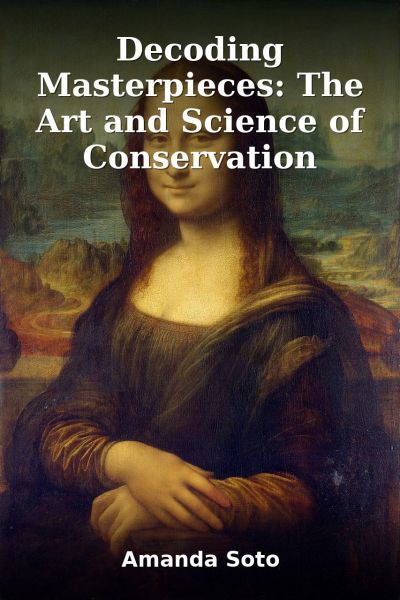
Art conservation is often imagined as a quiet craft of brushes and cotton swabs, but Amanda Soto's Decoding Masterpieces reveals it as something far more dynamic: a high-stakes collaboration between molecular science and humanistic stewardship. The book pulls back the curtain on a discipline where conservators diagnose paintings like physicians, debate ethics like philosophers, and engineer solutions for threats ranging from candle soot to climate change.
What the book is about
Decoding Masterpieces spans 25 chapters that move systematically from the material DNA of artworks—pigments, binders, supports—through the chemistry and physics of their decay, into the laboratory tools that diagnose deterioration (X-radiography, infrared reflectography, Raman spectroscopy), and onward to the ethical frameworks that govern every intervention. The middle sections trace the history of conservation from ancient intuitive repairs through medieval guilds, the birth of professional museum labs, and landmark projects like the Sistine Chapel and Leonardo's Last Supper. The final chapters confront urgent contemporary challenges: climate change, nanotechnology, robotics, the conservation of digital and ephemeral art, and the thorny ethics of repatriation and cultural ownership. Soto writes for a broadly curious reader; no specialized scientific background is assumed, but the book rewards patience with technical depth. It functions as both a comprehensive primer and a reference work, with each chapter building on the last while remaining readable as a standalone case study.
The material is the message
Soto's opening chapters make a deceptively simple point: you cannot conserve what you do not understand at the molecular level. Chapter 1 walks through the "DNA" of artistic media—why lapis lazuli yields a stable ultramarine while copper-based greens darken, how linseed oil polymerizes into a brittle film, why wooden panels warp and canvas slackens. Chapter 2 then shows how these same materials become their own worst enemies: lead white darkens to black lead sulfide, organic lakes fade as UV radiation destroys chromophores, and bitumen never fully dries, cracking forever. The takeaway is a framework Soto calls "inherent vice"—the intrinsic instability baked into an artwork by the artist's own choices. This reframes conservation not as fixing damage but as managing the inevitable consequences of material decisions made centuries ago.
Science as a diagnostic ethic
The book's laboratory chapters (4, 7, 8) are among its most vivid. Soto describes how conservators "peer beneath surfaces, unravel hidden layers, or reveal the ghosts of past alterations" using X-radiography, infrared reflectography, and ultraviolet fluorescence. A passage from Chapter 7 captures the stakes: "Without this ability to 'see the invisible,' conservation would largely be an act of guesswork, with a far greater risk of causing unintended harm." The text gives concrete examples: IRR revealing pentimenti in Northern Renaissance underdrawings, UVF exposing modern retouches as dark patches against fluorescing original varnish, X-radiographs showing a completely different portrait beneath a visible one. Chapter 8 extends this into digital tools—3D scanning for "virtual anastylosis" of fragmented artifacts, GIS mapping for heritage sites, and AI-assisted pattern recognition. The argument is clear: scientific analysis is not a luxury but an ethical prerequisite. Every intervention carries risk; diagnosis reduces it.
Ethics as a moving target
Chapter 10, "Ethics and Decision-Making," anchors the book's philosophical core. Soto lays out the field's guiding principles—minimal intervention, reversibility, respect for original intent, authenticity—but refuses to treat them as settled dogma. She shows how they fracture when applied to contemporary art: "What happens when the artwork is made of inherently unstable plastic, programmed to self-destruct, or exists only as lines of code on a decaying hard drive?" Chapter 23 explores this crisis in detail. For Felix Gonzalez-Torres's candy pile, conservation means documenting decay and establishing replenishment protocols. For software-based art, it means choosing between migration, emulation, or artist-sanctioned re-creation. The conservator's role shifts from preserving material to negotiating intent, often with living artists. This tension—between the Western ideal of static preservation and the reality of art designed to change—runs through the final chapters as a quiet provocation.
Two restorations that changed the field
The Sistine Chapel (Chapter 16) and The Last Supper (Chapter 17) serve as the book's most dramatic case studies, and Soto uses them to illustrate how scientific rigor and public controversy reshape practice. The Sistine project's working theory—that Michelangelo worked almost entirely in buon fresco, so later glue varnishes and overpaint could be removed with solvent gel AB 57—revealed a "riot of vibrant colors" but sparked fierce debate over whether a secco shadows were stripped away. The Last Supper presented a worse dilemma: Leonardo's experimental oil-tempera-on-dry-plaster technique caused flaking within decades, and 20 previous restorations had buried the original under layers of repaint. Pinin Brambilla Barcilon's 21-year project stabilized perhaps 20 percent of Leonardo's paint and used tratteggio—fine vertical lines—to integrate losses visibly. Both cases demonstrate Soto's recurring theme: conservation decisions are never purely technical; they are public, philosophical, and irreversible.
The future is already here—and it's hungry
The closing chapters (21, 22, 25) turn from history to prognosis. Climate change is not a distant threat but a present accelerant: "Longer, hotter heatwaves place immense strain on HVAC systems," and rising seas threaten "the loss of entire landscapes, their cultural context, and their inherent connection to the land." Nanotechnology offers calcium hydroxide nanoparticles that "penetrate deep into the porous material" and reform calcium carbonate, invisibly strengthening frescoes from within. Robotics promises soft grippers that can turn the pages of a manuscript without stress. But Chapter 25 grounds these marvels in human reality: "The future of art conservation… lies not just in the evolution of science and technology, but in the unwavering commitment to education, the strength of a global community, and the passion of the next generation of guardians." The book ends not with a technological promise but with a call for sustained investment in training, cross-cultural collaboration, and the unglamorous work of preventive care.
Who should read this
Decoding Masterpieces will reward readers who want to understand the intellectual and material architecture behind the artworks they encounter in museums. It is particularly valuable for students considering conservation careers, museum professionals seeking a holistic refresher, and scientifically literate art lovers who have wondered why a painting cracks or a photograph fades. Readers looking for a light, anecdote-driven tour of famous restorations may find the technical passages dense; Soto does not shy from explaining polymerization, hydrolysis, or the energetics of UV radiation. But for anyone willing to engage with the chemistry and ethics on their own terms, the book delivers a rare synthesis: a portrait of conservation as a discipline that is simultaneously forensic, philosophical, and urgently contemporary.
Read “Decoding Masterpieces: The Art and Science of Conservation” on MixCache.com →
Please log in or create an account to leave a comment.
No comments yet. Be the first to say something.