
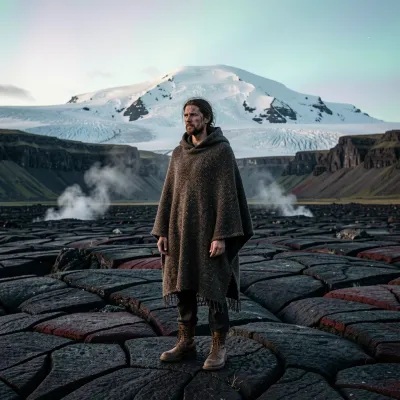
The summer of 1783 began with an ominous quiet across southern Iceland, a stillness that preceded one of the most cataclysmic natural disasters in recorded history. On June 8, the ground split open along a 27-kilometer fissure in the Grímsvötn volcanic system, unleashing a flood of basalt lava and, far more deadly, an invisible cloud of hydrofluoric acid and sulfur dioxide that would blanket the island for eight months. Icelanders called it the Móðuharðindin — the Mist Hardships — and it would kill at least a fifth of the population.
The Fissure Opens
The Lakagígar eruption was not a single explosive event but a prolonged outpouring from a rent in the earth. Over eight months, an estimated 14 cubic kilometers of highly fluid lava flowed across the landscape, filling river valleys and permanently altering the topography. But the lava, destructive as it was to the immediate surroundings, proved less lethal than the gases. The eruption ejected 8 million tons of fluorine and 120 million tons of sulfur dioxide into the atmosphere — quantities that dwarf most modern industrial emissions.
A bluish haze, thick with acid, drifted across the island on prevailing winds. It settled on pastures, seeped into water sources, and scorched vegetation. For a society almost entirely dependent on livestock, the poisoning of the grass was a death sentence. Sheep, cattle, and horses grazing on contaminated forage developed fluorosis: their teeth shattered, bones weakened, and internal organs failed. Approximately 80% of Iceland's sheep, 50% of its cattle, and 50% of its horses perished between 1783 and 1785.
Starvation Winter
With the animal population collapsed, the human food supply vanished. Milk, meat, and cheese disappeared from the diet. The poisonous mist also damaged crops, compounding the crisis. Then came the winter of 1783–1784, exceptionally cold even by Icelandic standards. Sea ice blocked northern fishing grounds, cutting off the traditional fallback when land-based food failed. Contemporary accounts describe people boiling shoe leather for soup, digging up old fish bones from midden heaps, and eating whatever lichens or roots they could find.
Deaths from starvation began in December 1783 and continued well into 1785. Entire families were wiped out; some communities lost half their members. The total excess mortality reached 8,000 to 10,000 people — roughly 20 to 25% of the island's population. A Danish official in Copenhagen, surveying the reports, seriously proposed evacuating the entire remaining population to Jutland. The plan was rejected, but the mere suggestion underscored how expendable Iceland seemed to its distant rulers.
Global Reach, Local Consequences
The Laki haze did not respect borders. Sulfate aerosols in the stratosphere reflected sunlight across the Northern Hemisphere, causing Europe's coldest winter in centuries and widespread crop failures. Benjamin Franklin, then in Paris, documented a "dry fog" that dimmed the sun and caused respiratory distress. Some historians argue the resulting famine and unrest helped ignite the French Revolution. Iceland, a speck in the North Atlantic, had inadvertently reshaped global history.
Yet the political aftermath on the island was equally profound. Denmark's response to the catastrophe was slow and inadequate. The trade monopoly that had constrained Iceland's economy for nearly two centuries remained in force. The contrast between the suffering on the ground and the indifference from Copenhagen became a defining grievance. Icelanders who had survived the Mist Hardships by their own ingenuity and communal support began to question why a distant crown, which could not protect them from a volcano, should govern them at all.
The Long Shadow
The trade monopoly was finally abolished in 1855, and the push for home rule gained momentum through the 19th century, often invoking the Laki catastrophe as proof that Icelanders alone understood their land's demands. When the republic was declared at Þingvellir in 1944, the date chosen was Jón Sigurðsson's birthday — the nationalist leader who had framed the independence argument around historical sovereignty and the lessons of 1783.
Today, the Lakagígar fissure lies quiet, a moss-covered scar in the highlands. But the Móðuharðindin remains a touchstone in Icelandic memory, a reminder that the ground beneath their feet can turn lethal without warning, and that survival depends on self-reliance forged in fire and ice.
This is one episode in a much longer story. For the full account of Iceland's geological history and national identity, read “Volcanic Foundations: How Iceland's Geology Shaped Its National Identity” by Kathleen Ryan on MixCache.com.
Please log in or create an account to leave a comment.
No comments yet. Be the first to say something.