
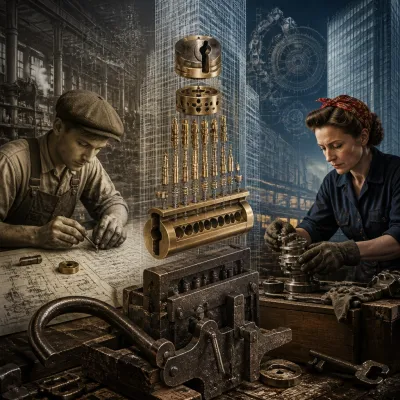
The lock hung in a Piccadilly shop window like a dare. Forged of iron and brass, its mechanism concealed behind a cylindrical keyway, it carried a hand-lettered notice: 200 guineas to anyone who could pick it. The year was 1784. Joseph Bramah, a Yorkshire-born inventor who had already revolutionized the flush toilet and the hydraulic press, stood behind his creation with the confidence of a man who knew he had broken the rules of his craft. For 67 years, the challenge went unanswered. Thieves, locksmiths, and curious tinkerers tried and failed. The lock became a London landmark, a symbol of absolute security in an age when a good lock was the only thing between a family and destitution.
The Unpickable Mechanism
Bramah's lock abandoned the lever tumblers common in English locks since Robert Barron's 1778 double-acting patent. Instead, it used a circular key with longitudinal slots that pushed a series of sliding wafers — Bramah called them sliders — to precise depths. Only when every slider aligned perfectly would the bolt withdraw. The key itself was a marvel: a hollow cylinder, light enough to wear on a watch chain, yet encoding a combination of depths that Bramah calculated offered 470 million possible variations. He patented the design in 1784 and founded the Bramah Lock Company at 124 Piccadilly, where the challenge lock took its place in the window.
The reward was no trifle. Two hundred guineas — £210 — represented roughly three years' wages for a skilled artisan. Yet the money stayed safe. The lock resisted the era's best picks, its sliders refusing to yield to the tension wrenches and feeler picks that made short work of lever mechanisms. Bramah's reputation grew. His locks secured the Bank of England's strongrooms, the Royal Mint, and the private cabinets of aristocrats. The challenge lock became a pilgrimage site for locksmiths, a silent rebuke to their craft.
The American at the Crystal Palace
By 1851, the lock had outlived its maker; Bramah died in 1814. The Great Exhibition opened in Hyde Park's Crystal Palace, a cathedral of glass and iron showcasing industrial might. Among the exhibitors was Alfred Charles Hobbs, a 39-year-old American locksmith from Boston. Hobbs had made his name picking American bank locks for security demonstrations, but he hungered for the European prize. He arrived with a set of tools he had refined himself: delicate picks, tension devices, and a microscope for reading the faintest feedback from a lock's innards.
Hobbs did not attack the Bramah lock immediately. He spent days at the exhibition picking other manufacturers' locks, building momentum and credibility. When he finally requested the Bramah challenge lock, the company's representatives hesitated. The lock had become a corporate talisman. But the exhibition's spirit of open competition prevailed. The lock was brought to Hobbs at a designated table in the American section, under the gaze of judges and spectators.
Sixteen Days in the Light
Hobbs worked in public, a condition he insisted upon. He sat for hours each day, the lock clamped in a vise, his picks moving with surgical slowness. The sliders gave no click, no audible feedback — only the faintest resistance transmitted through the tool's shaft. Hobbs later described the process as "feeling for shadows." He developed a new technique: applying minute rotational tension while mapping each slider's resting position, then lifting them in sequence to a shear line he could not see. On the sixteenth day, the bolt withdrew.
The crowd erupted. Hobbs had not forced the lock; he had deciphered it. The Bramah company, honor bound, paid the 200 guineas. But the victory was more than financial. Hobbs had proven that no mechanism was theoretically unpickable — only unpicked. The revelation shattered the industry's complacency. British lockmakers, stung by an American's triumph on their soil, rushed to develop new designs. The era of security by obscurity ended; the era of security by tested resistance began.
The Lock's Second Life
The challenge lock did not retire. Bramah's company reissued it with modified sliders and a new challenge: 500 guineas. It hung in the Piccadilly window for another generation. Hobbs returned to America, founded the Hobbs Lock Company, and applied his insights to a new generation of American bank locks that would dominate the post-Civil War boom. The original Bramah mechanism, meanwhile, entered the Science Museum's collection, its sliders still bearing the microscopic scratches of Hobbs's picks — the fingerprints of the moment absolute security became relative.
Modern pin-tumbler locks, the descendants of Linus Yale Jr.'s 1861 patent, owe a debt to that 16-day duel. The principle that a lock must withstand sustained, knowledgeable attack — not merely casual tampering — became the standard by which all security hardware is judged. The 200-guinea challenge did more than enrich one American locksmith; it forced an industry to stop trusting in secrecy and start engineering for resilience. The lock in the window was never just a product. It was a question. Hobbs answered it, and the world's doors have never been the same since.
This is one episode in a much longer story. For the full account of the history of lock innovation, read “A History of Allegion” by Aaron Murphy on MixCache.com.
Please log in or create an account to leave a comment.
No comments yet. Be the first to say something.