
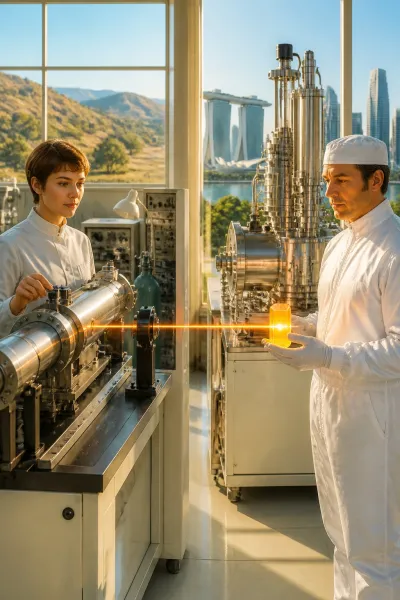
The prototype didn't look like a device that would change manufacturing, medicine, and global communications. It looked like plumbing. In the summer of 1966, physicist James Hobart and five co-founders crowded into the laundry room of a Palo Alto house, hunting for the only 220-volt outlet in the building. They had $10,000 in pooled savings, a vision for commercial lasers, and a length of rain gutter that would serve as the vacuum envelope for their first prototype.
The Laundry Room Lab
Coherent Radiation, as the company was first named, had no office, no lab, and no venture capital. Eugene Watson, a former Spectra-Physics sales manager and one of the co-founders, offered his home. The laundry room was the only space with enough power for the high-voltage supply the laser required. Hobart, who had been captivated by the industrial potential of lasers since their invention at Bell Laboratories in 1958, led the technical effort. The team worked through the summer, machining parts, aligning mirrors, and sealing that rain gutter into a vacuum-tight tube.
Four months after incorporation, they loaded the device into a station wagon and drove it to the Westcon trade show. The rain gutter was gone, replaced by a sleek, telescope-like housing. Inside, however, the physics remained the same: a carbon-dioxide gas mixture excited by electrical discharge, producing an invisible infrared beam of unprecedented power for a commercial product.
Power Meters and First Customers
The laser's output was so strong that no existing instrument could measure it accurately. Coherent Radiation's second product became a power meter built specifically to quantify their own creation — a device that would stay in the catalog for decades. The market response was immediate. The Boeing Company placed an order, recognizing that a precise, high-power infrared beam could cut and drill materials that conventional tools could not touch.
First-year sales reached roughly $500,000. The Rockefeller family invested $250,000 in 1967, followed by another $250,000 from private investors a year later. By 1970, with a second-generation model on the market, annual revenue hit $6 million and the company went public. The laundry room era was over, but the DNA of improvisation and application-driven engineering had been set.
From Prototype to Platform
That first CO2 laser established a pattern. Coherent Radiation (renamed Coherent, Inc. in 1977) would spend the next decades turning laboratory curiosities into industrial workhorses. The CO2 line evolved into tools for welding automotive parts, cutting fabric for clothing manufacturers, and drilling holes in turbine blades. Medical divisions adapted the same wavelengths for surgery. Scientific divisions built tunable dye and titanium-sapphire lasers for spectroscopy. Every new product traced its lineage to the imperative Hobart set in 1966: make the laser useful enough that someone will write a check for it.
Parallel to this, a separate thread began in 1971 when Carl Johnson and James Hawkey founded II-VI Incorporated to grow cadmium telluride crystals — the lenses and windows that could withstand the intense heat of CO2 beams. The two companies, born five years and 3,000 miles apart, would eventually supply each other: II-VI optics guiding Coherent photons.
The Long Arc
Fifty-six years after the laundry room, the merged entity — Coherent Corp. — joined the S&P 500. Its lasers pattern the chips that run artificial intelligence, its optics carry the internet's backbone traffic, and its medical systems perform millions of eye surgeries a year. The rain gutter is long gone, preserved only in corporate lore. But the constraint that forged it — build something that works, with what you have, right now — still shapes the engineering culture. The first customer, Boeing, still buys Coherent lasers today.
This is one episode in a much longer story. For the full account of the history of Coherent Corp, read “A History of Coherent Corp.” by Jacob A. Vasquez on MixCache.com.
Please log in or create an account to leave a comment.
No comments yet. Be the first to say something.