
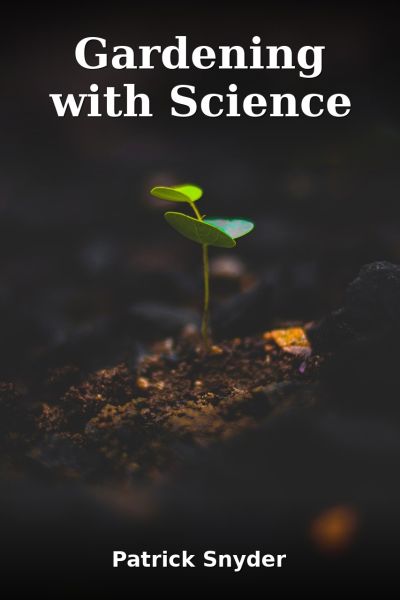
Gardening is often romanticized as intuition and green-thumb luck, but beneath every thriving bed lies a stack of biochemical reactions, ecological relationships, and physical laws. Gardening with Science by Patrick Snyder systematically unpacks those hidden mechanisms, turning the garden into a readable, manageable system rather than a guessing game. The result is a reference that feels less like a how-to manual and more like an owner's manual for the living machinery outside your door.
What the Book Is About
The book spans 25 chapters organized in a logical progression: soil foundations (Chapters 1–5), plant anatomy and physiology (6–10), environmental factors (11–15), sustainable practices (16–20), innovative growing methods (21–23), and forward-looking case studies and trends (24–25). It assumes no prior scientific training but does not oversimplify; terms like cation exchange capacity, photoperiodism, and allelopathy appear alongside plain-language explanations. The intended reader is a gardener who wants to move beyond folklore — someone willing to run a soil test, adjust pH gradually, or calculate a carbon-to-nitrogen ratio for compost. Horticulture students, serious hobbyists, and small-scale growers will all find the depth useful without feeling alienated.
Soil as a Living System, Not Just Dirt
The opening chapters reframe soil from a static medium into a "bustling metropolis of mineral particles, organic matter, water, air, and an astonishing array of microscopic life." Snyder devotes five chapters to the physical, chemical, and biological dimensions of that metropolis. He explains how sand, silt, and clay proportions fix texture but how organic matter transforms structure — turning concrete-like clay into friable aggregates and helping sand hold water. The nutrient-cycling chapter walks through nitrogen fixation, nitrification, and denitrification with the clarity of a microbiology lecture stripped of jargon. A standout passage on cation exchange capacity describes soil particles as "tiny magnets that attract and hold onto positively charged cations," making the chemistry tangible. Practical soil testing gets its own chapter, complete with sampling protocol, lab selection advice, and amendment recipes keyed to test results.
Plant Physiology as an Operating Manual
Chapters 6 through 9 treat the plant as a machine whose specs are worth knowing. Root zones, stem architecture, leaf cross-sections, and vascular plumbing are diagrammed in words. Photosynthesis and respiration are framed as a battery metaphor: "Think of photosynthesis as charging the plant's battery with sunlight, and respiration as discharging that battery to power all of life's activities." The hormone chapter (auxins, gibberellins, cytokinins, abscisic acid, ethylene) reads like a control-panel guide — pinching a seedling removes auxin dominance, spraying cytokinin delays senescence, storing apples with bananas exploits ethylene. Water and nutrient uptake (Chapter 8) connects root-hair osmosis, xylem tension-cohesion, and phloem pressure-flow in a single narrative, showing why overwatering starves roots of oxygen even as it drowns them.
Environmental Mastery: From Macro Climate to Microclimates
Snyder distinguishes between the climate you inherit and the microclimates you can engineer. Chapter 11 covers hardiness zones, frost dates, and precipitation patterns; Chapter 12 shows how a south-facing brick wall, a pond, or a permeable windbreak can shift temperatures by several degrees. The light chapter (13) introduces Photosynthetically Active Radiation, phytochromes, and the red-to-far-red ratio that triggers shade-avoidance stretching. A memorable line captures the design mindset: "If the macro environment is the symphony, microclimates are the carefully arranged solos and duets that add richness and complexity." Chapter 15 on environmental stress catalogs heat-shock proteins, antifreeze compounds, osmotic adjustment, and aerenchyma — then translates each into mulching, row covers, or variety selection.
Ecological Pest Management Over Chemical Warfare
Chapters 19 and 20 build a case for biodiversity as the primary defense. The food-web logic is explicit: diverse plantings feed beneficial insects, which suppress pests, which reduces pesticide need, which preserves the beneficials. The Integrated Pest Management hierarchy — prevention, monitoring, identification, thresholds, then cultural, physical, biological, and finally chemical controls — is presented as a decision tree, not a slogan. A key sentence sets the tone: "The first principle of ecological pest and disease management is understanding that not all insects are pests, and not every plant imperfection signifies a catastrophic disease." Companion planting gets a mechanism-based treatment (volatile organic compounds masking host scent, umbel flowers feeding parasitic wasps, legumes fixing nitrogen for neighbors) rather than a list of folklore pairings.
The Cutting Edge: Soilless Systems and Future Tech
The final third of the book surveys hydroponics, aeroponics, aquaponics, and vertical farming with the same rigor applied to soil. Deep Water Culture, Nutrient Film Technique, and high-pressure aeroponics are compared on oxygen delivery, water use, and failure modes. The aeroponics chapter notes that roots "are completely exposed to air" and a pump failure can kill a crop in hours — a useful reality check. Chapter 25 looks ahead: AI-driven sensor networks that prescribe nitrogen boosts per plant, speed-breeding under tailored LEDs, microbiome inoculants customized to a garden's metagenome, and the ethical questions around synthetic biology. The tone remains grounded; Snyder notes energy demands and digital divides alongside the promise.
Who Should Read This
Gardening with Science rewards readers who treat their garden as a system worth understanding at the mechanism level. It is not a picture-heavy beginner's guide, nor a collection of quick tips. A gardener who wants to know why their iron chelate fails at pH 7.5, how to read a soil test's CEC number, or what misting cycle maximizes aeroponic root growth will find precise, cited explanations. Casual growers seeking only planting calendars or cultivar lists may find the depth excessive. For anyone ready to replace habit with evidence — and willing to keep a garden journal alongside a pH meter — this book is a durable, reference-grade companion.
Read “Gardening with Science” on MixCache.com →
Please log in or create an account to leave a comment.
No comments yet. Be the first to say something.