
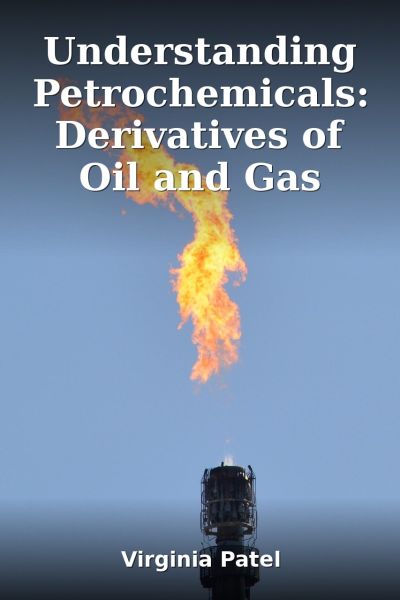
Petrochemicals are the unseen scaffolding of contemporary civilization — present in the IV bag at a hospital bedside, the polyester blend in a winter coat, the fertilizer that grew your breakfast, and the smartphone in your pocket. Virginia Patel's Understanding Petrochemicals: Derivatives of Oil and Gas pulls back the curtain on this vast industry, tracing the molecular journey from wellhead to waste stream with a scope that is both technically rigorous and remarkably accessible.
What the Book Is About
The book spans 25 chapters organized as a logical progression: foundations and history (Chapter 1), feedstock geology and the shift toward bio-based alternatives (Chapter 2), core production chemistry like cracking and reforming (Chapter 3), deep dives into olefins (Chapter 4), aromatics (Chapter 5), and methanol/ammonia (Chapter 6), followed by sector-specific applications — plastics (Chapter 7), synthetic fibers (Chapter 8), agrochemicals (Chapter 9), medicine (Chapter 10), automotive (Chapter 11), construction (Chapter 12), electronics and renewables (Chapter 13), and household goods (Chapter 14). The second half widens to economics (Chapter 15), global industry dynamics (Chapter 16), technological innovation (Chapter 17), supply chains (Chapter 18), regulation and sustainability policy (Chapter 19), environmental footprint (Chapter 20), health impacts and environmental justice (Chapter 21), the plastic waste crisis and circular economy (Chapter 22), bio-based pathways (Chapter 23), emerging trends (Chapter 24), and a concluding synthesis of challenges ahead (Chapter 25). Patel writes for students, professionals, policymakers, and curious generalists — anyone who wants to grasp how hydrocarbon chemistry became the substrate of modern material life.
The Double-Bond Engine: Olefins as Industrial Keystones
If the book has a chemical protagonist, it is ethylene — "the most widely produced organic compound globally" — and its three-carbon sibling propylene. Chapter 4 shows how these simple unsaturated hydrocarbons, distinguished by a carbon-carbon double bond, become the reactive handles for an staggering product tree. Ethylene alone yields polyethylene (in HDPE, LDPE, and LLDPE grades), ethylene oxide (precursor to polyester fibers and PET bottles), vinyl chloride monomer (for PVC), and even agricultural ripening agents. Propylene mirrors this versatility: polypropylene for automotive parts and food containers, propylene oxide for polyurethane foams, acrylonitrile for ABS resins and acrylic fibers. The chapter makes clear that feedstock choice — ethane vs. naphtha cracking — dictates not just economics but the entire product slate a region can produce, shaping global trade flows in ways that persist for decades.
Medicine's Plastic Backbone
Chapter 10 delivers a striking inventory of healthcare's dependence on petrochemical polymers. PVC's "flexibility, durability, chemical resistance, and excellent compatibility with blood and bodily fluids make it ideal for blood bags, IV solution bags, tubing for infusions and drainage, catheters, and respiratory masks." Polypropylene's autoclave tolerance makes it the standard for reusable syringes and instrument trays. Polycarbonate's impact resistance protects surgical instrument housings and blood oxygenators. Even the active pharmaceutical ingredients themselves often trace back to benzene, toluene, or methanol as molecular scaffolds. The chapter doesn't romanticize this reliance; it notes the waste burden of single-use plastics and the regulatory scrutiny around leachables and extractables, but the takeaway is unambiguous: modern medicine as practiced today cannot exist without these materials.
Environmental Justice at the Fence Line
Chapter 21 moves beyond aggregate emissions data to the lived reality of communities adjacent to petrochemical complexes. The book describes "Cancer Alley" in Louisiana — "a corridor along the Mississippi River densely packed with petrochemical plants and oil refineries" where "predominantly African American communities… have lived in the shadow of these industrial facilities, experiencing significantly higher rates of cancer and other chronic diseases compared to national averages." Patel introduces the concept of cumulative impact: residents face not one pollutant but a mixture from multiple sources, compounded by socioeconomic stressors that regulatory frameworks rarely account for. The chapter argues that permitting processes focused on individual facility compliance miss the synergistic toxicity of co-located plants, and that meaningful community engagement must become a prerequisite for industrial expansion, not an afterthought.
Chemical Recycling and the Circular Ambition
Chapter 22 distinguishes between mechanical recycling — limited by contamination and polymer mixing — and chemical recycling technologies that "break down plastic polymers into their original monomers or other valuable chemical feedstocks." Pyrolysis converts mixed plastic waste into oil for steam crackers; gasification yields syngas for methanol or ammonia; depolymerization targets specific polymers like PET or polystyrene for monomer recovery. The chapter is sober about hurdles: energy intensity, economic viability against cheap virgin feedstock, and the need for massive collection and sorting infrastructure. Yet it frames chemical recycling as the only pathway to handle the mixed, contaminated waste streams that mechanical systems cannot, making it essential to any credible circular economy.
The Biorefinery Pivot
Chapter 23 maps the transition from fossil to renewable carbon. Bio-ethanol from sugarcane or corn dehydrates to bio-ethylene, a "drop-in replacement" for fossil ethylene that can enter existing crackers. Bio-naphtha from hydrotreated vegetable oil offers another direct substitute. Further out, renewable electrosynthesis aims to produce chemicals from CO2 and water using renewable electricity at room temperature — "near-zero or even negative lifecycle greenhouse gas emissions." The chapter candidly addresses the "green premium": bio-naphtha can be "two to three times more expensive than fossil naphtha," and biomass supply competes with food, fuel, and land-use constraints. The path forward is portrayed as a portfolio approach — efficiency gains, carbon capture, bio-based feedstocks, and electrification advancing in parallel rather than a single silver bullet.
Who Should Read This
This book serves professionals needing a cross-sectoral view — chemical engineers tracking feedstock shifts, sustainability officers mapping circular economy strategies, policy analysts weighing regulation against industrial competitiveness. It also rewards the intellectually curious non-specialist who wants to understand why the periodic table's simplest hydrocarbons underwrite so much of daily life. Readers seeking advocacy or polemic will not find it; Patel's tone is analytical, her evidence drawn from industry data and peer-reviewed sources. The density of technical detail (catalyst chemistries, process conditions, market figures) may slow a casual reader, but the chapter structure allows selective deep dives. For anyone serious about the material basis of the modern world — and its plausible futures — this is a reference worth keeping within reach.
Read “Understanding Petrochemicals: Derivatives of Oil and Gas” on MixCache.com →
Please log in or create an account to leave a comment.
No comments yet. Be the first to say something.