
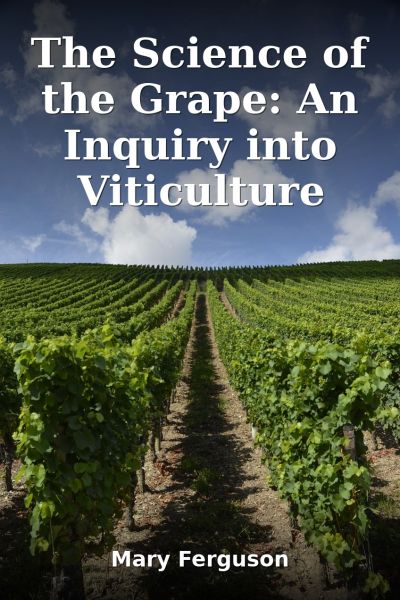
Great wine begins long before fermentation, in the quiet interplay between vine physiology and the grower's decisions. The Science of the Grape: An Inquiry into Viticulture treats that interplay as a discipline worthy of rigorous study, not received wisdom. Mary Ferguson has built a reference that connects the cellular mechanics of Vitis vinifera to the strategic choices that define a vintage.
What the book is about
The book spans 25 chapters organized as a logical progression from foundations to frontiers. The first four chapters establish the vine's biology: anatomy, annual growth cycle, photosynthesis, and water relations. Chapters five through eight turn to the vineyard environment — soil composition, nutrient cycles, soil health monitoring, and irrigation systems. Chapters nine through eighteen cover the management toolkit: rootstock genetics, canopy architecture, pruning systems, fruit development, ripening chemistry, quality assessment, and the full spectrum of diseases, pests, viruses, and trunk diseases, concluding with integrated pest and disease management. The final seven chapters address modern viticulture's leading edge: precision technologies, data analytics, sustainable and organic/biodynamic frameworks, climate adaptation, harvest logistics, and future research directions. The tone is technical but accessible, written for professional growers, enologists, viticulture students, and serious enthusiasts who want to understand why a practice works, not just how to execute it.
The vine as a biological machine, not a romantic symbol
Ferguson refuses to let the grapevine remain a picturesque backdrop. Chapter One dissects the vine's vascular system — "The vine's vascular system, composed of xylem and phloem, is responsible for long-distance transport" — and explains how turgor pressure drives shoot elongation. Chapter Three traces the photosynthetic pathway from photon capture to sugar translocation, noting that "Photosynthesis is, in essence, the conversion of light energy into chemical energy in the form of sugars." Chapter Four reveals water not as a passive input but as a dynamic signal: stomatal closure conserves moisture but throttles carbon dioxide uptake, directly linking irrigation decisions to sugar accumulation. Together these chapters reframe vineyard work as the management of a living factory whose outputs — sugar, acid, phenolics — are governed by physical laws the grower can measure and influence.
Soil as a living ecosystem, not a medium
Chapters Five through Seven elevate soil from inert substrate to active partner. Ferguson writes, "The soil is a living, breathing ecosystem, a complex tapestry of mineral particles, organic matter, water, air, and a vast microbial community." Chapter Five details how texture, structure, depth, and drainage dictate root exploration and water availability. Chapter Six catalogs the 16 essential nutrients, distinguishing macronutrients that build canopy from micronutrients like boron and zinc that govern fruit set. Chapter Seven makes monitoring actionable: pH, cation exchange capacity, and organic matter percentage become diagnostic levers, while compost, cover crops, and reduced tillage become interventions that feed the microbiome. The through-line is clear — healthy soil buffers the vine against stress and reduces the need for corrective inputs later.
Rootstocks as strategic levers, not just insurance
Chapter Nine transforms the rootstock from a phylloxera solution into a design tool. "Rootstocks offer a suite of benefits that extend far beyond pest resistance, acting as powerful tools to influence vine vigor, adapt to challenging soil conditions, and even modulate fruit ripening and quality," Ferguson explains. The chapter walks through drought-tolerant lineages (110 Richter, 1103 Paulsen), lime-tolerant selections (41B, Fercal), and vigor-controlling options (3309C, 420A), showing how each reshapes the scion's behavior. The discussion of marker-assisted selection and genomic sequencing signals where breeding is headed: rootstocks engineered for specific stress profiles, not just broad resistance.
Precision viticulture and the shift from uniform to zonal
Chapters Nineteen and Twenty document the move from block-level averages to vine-level resolution. "PV champions the principle of 'doing the right thing, in the right place, at the right time,'" the text states, describing how GPS, GIS, multispectral drones, and soil electrical-conductivity mapping delineate management zones. Chapter Twenty goes further: "The modern vineyard is no longer solely a domain of green thumb intuition and ancient wisdom; it has evolved into a sophisticated data laboratory." Yield monitors on harvesters, sap-flow sensors on trunks, and AI-driven prescriptive models turn seasonal observation into continuous feedback. The implication is profound — irrigation, fertilization, canopy work, and even harvest timing can now vary row by row, matching the vineyard's inherent heterogeneity.
Climate adaptation as the defining challenge
Chapter Twenty-Three frames climate change not as a future scenario but as a current distortion of ripening physiology. "This decoupling is a persistent challenge, particularly in a warming world," Ferguson notes, referring to the divergence between sugar accumulation and phenolic maturity. The chapter catalogs adaptation strategies: heat-tolerant varieties, drought-efficient rootstocks, altitude migration, canopy shading, soil carbon building, and precision irrigation guided by real-time sensors. The final chapters extend this thread into regenerative viticulture, digital twins, and gene-edited vines, positioning the vineyard as an ecosystem that must be actively redesigned for a climate that no longer matches its history.
Who should read this
This is a textbook-scale reference for people who make or advise on vineyard decisions — vineyard managers, winemakers, viticulture students, consultants, and advanced hobbyists running commercial-scale blocks. It assumes familiarity with basic chemistry and plant biology; readers looking for a narrative history of wine, tasting guides, or tourism essays will not find them here. For its intended audience, the book delivers a coherent framework that connects molecular mechanisms to vintage outcomes, backed by current research and field-tested practices. It belongs on the shelf where daily vineyard questions are answered, not on the coffee table.
Read “The Science of the Grape: An Inquiry into Viticulture” on MixCache.com →
Please log in or create an account to leave a comment.
No comments yet. Be the first to say something.