
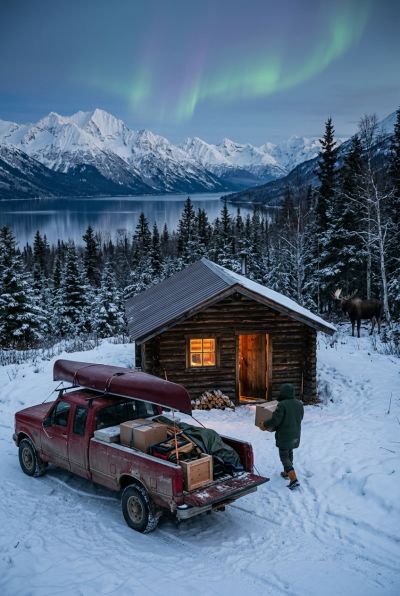
The blue seven-gallon Aquatainer jug weighs nearly sixty pounds when full. You learn this the first time you hoist one from the bed of your truck onto the kitchen counter, water sloshing against your forearms, the plastic handle biting into your fingers. By the fourth jug, your shoulders burn. By the end of the first week, you know exactly how many jugs your household burns through in forty-eight hours — and the precise hour the last one will run dry.
This is the arithmetic of the dry cabin: no tap, no shower, no flush. Just you, the jug, and the walk to the outhouse at three a.m. when the thermometer reads forty below.
The Listing That Sounds Too Good to Be True
You spot it on a bulletin board or a Facebook rental group: a cozy cabin, woodstove heat, mountain views, rent half what you'd pay for an apartment in town. The ad says "dry cabin" in the fine print. You think: rustic charm, off-grid romance, a story to tell. You don't think: I will become my own municipal water system.
In Alaska, "dry" doesn't mean no alcohol. It means no plumbing. No pressurized water lines, no septic tank, no drain pipes. The cabin is a shell — insulated walls, a roof, a door that locks. Everything liquid is on you.
The water source varies. Some areas have coin-operated fill stations outside grocery stores or laundromats. Others rely on a friend's outdoor spigot, paid for in six-packs and reciprocity. In the Bush, you might chip a hole in river ice with an axe, dip your jugs, and haul them home on a sled behind a snowmachine. Every drop you drink, cook with, wash dishes in, or sponge-bathe with has been carried by hand.
The Outhouse at Forty Below
The outhouse is a small wooden box over a hole in the ground. In summer, it's a battle with mosquitoes that seem to materialize from the tundra the moment you sit down. You master the one-minute visit.
Winter is different. At thirty below, the seat is a curve of solid ice. Your breath freezes in a cloud around your head. The snow squeaks under your boots — that high, styrofoam sound only extreme cold produces. You've layered up: boots, parka, hat, mittens, headlamp. The walk from the cabin door to the privy takes ninety seconds. The return trip feels longer.
You learn strategic dehydration before bed. You learn to hold it. You learn that the outhouse is not a place for scrolling on your phone.
Maintenance is its own curriculum. Lime or wood ash goes down the hole to cut odor. When the pit fills — and it will — you either move the structure over a new hole or pay a pumper truck, if one reaches your road. The honey bucket, a five-gallon pail with a toilet seat snapped on top, is the indoor alternative for those who can't face the night walk. When it's full, you carry it to a designated disposal site. There is no service that comes for it. You are the service.
The Sponge Bath and the Laundromat Circuit
Bathing becomes a project. Heat a pot on the woodstove. Washcloth, soap, quick pass over the essential parts. A full hair wash means a trip to the community rec center or the laundromat showers — quarters in the slot, three minutes of hot water, toweling off in a fluorescent-lit stall while your clothes tumble in the dryer next door.
Laundry is a weekly pilgrimage. You learn which machines at the laundromat run hot, which eat socks, which have the best spin cycle. You time your visit to avoid the Sunday rush. Two hours, a pile of quarters, and you're done until next week.
Why Anyone Chooses This
The rent. A dry cabin outside Fairbanks might go for $600 a month. A comparable wet apartment: $1,400. Over a year, that's nearly ten thousand dollars — enough for a down payment on land, a good used truck, a winter's heating oil, or a chest freezer the size of a coffin.
For seasonal workers, students, and anyone building a stake, the math is brutal and clear. You trade convenience for capital. Some stay a year. Some stay a decade. A few never leave.
There's pride in it, too. The morning you haul water in a blizzard and the stove is roaring and the coffee is hot — you've provided for yourself in a way most Americans never have to. You know the weight of water. You know the cost of a flush. You've met the ground on its own terms.
The Damp Compromise
Some cabins split the difference. A holding tank inside, fed by jugs you still haul, with an electric pump to a kitchen sink. Gray water drains to a pit or bucket. You get running water at the sink — dishes, handwashing, a trickle for the coffee pot — but the toilet stays outside or moves to a holding tank that needs pumping every few weeks at $150 a visit.
Others install a composting toilet. It works, if you manage it: peat moss, ventilation, patience. The learning curve is steep and the mistakes are memorable.
Reading the Signs
After a month, you stop asking "wet or dry?" You read the listing. "Rustic" means dry. "Secluded" means dry. No mention of washer hookup, dishwasher, or shower? Dry. The photos show a woodstove and a propane lamp but no sink? Dry.
You ask the landlord anyway: Where's the water source? Is there a fee? How far is the outhouse? What's the winter trail like? They've heard it all. The good ones tell you straight. The bad ones say "it's not that bad" and you sign a lease for a winter of surprises.
The first time you walk into a friend's wet house and turn on the tap — clear, hot, endless water — you stare. You fill a glass and drink it slow. You flush the toilet just to hear the rush. It feels like a miracle of engineering, a cathedral of convenience. You never take it for granted again.
When you finally move to a place with pipes, you still keep a few Aquatainers in the garage. Just in case. The habit doesn't wash off with the first hot shower. It stays in your shoulders, in the way you measure water, in the quiet certainty that you can live without the grid if you have to. You've hauled the weight. You know what it costs.
This is one episode in a much longer story. For the full account of Alaskan dry cabin living, read “Moving to Alaska” by Alex Bugeja on MixCache.com.
Please log in or create an account to leave a comment.
No comments yet. Be the first to say something.