
The Emir of Bukhara was a man accustomed to getting what he wanted. In the 19th century, his domain stretched across the oases and caravan routes of Central Asia, his word law from the walls of the Ark fortress to the farthest desert outpost. But there was one thing he could not command: the taste of Samarkand bread.
The bread worth stealing
In the hierarchy of Central Asian staples, non sits at the summit. Round, golden, stamped with intricate patterns that differ from town to town, it is more than food. It is placed under a newborn's head for long life, broken to seal a marriage contract, never cut with a knife, never placed upside down. A meal without it is no meal at all. And for centuries, the non of Samarkand — dense, chewy, weighing as much as a kilogram, its crust etched with a baker's signature stamp — has held a reputation that borders on the mythical. Travelers wrote of loaves that stayed edible for months, hardening into something like ceramic but reviving with a soak in tea or broth.
The Emir, ruling from Bukhara just 160 miles west, wanted that bread on his own table. He did not merely send for a recipe. He orchestrated a full-spectrum transfer: master bakers (nonvoy) were summoned from Samarkand, their flour and water sourced from the same wells and mills, even their tandyr — the clay ovens that give non its signature blistered crust — dismantled and rebuilt in Bukhara's courtyards. Every variable the Emir could think of was controlled. The dough was mixed by the same hands, slapped against the same superheated clay walls, baked in the same few minutes of furious heat.
The result was a failure. The loaves emerged golden and patterned, but they lacked the depth, the lingering sweetness, the particular chew that made Samarkand non a legend. The Emir's kitchen had reproduced the method, the ingredients, even the hardware. What it could not reproduce was the invisible factor the bakers finally named: the air.
Fire and fingerprint
To understand why air might matter, you have to understand the tandyr. It is not an oven in the Western sense — no doors, no thermostats, no convection fans. It is a vertical drum of clay, often sunk into the ground or built into a courtyard wall, fired with wood or cotton stalks until its walls glow white-hot. The baker, wearing thick gloves and wielding a long padded pole, presses the raw dough directly onto that scorching inner surface. The bread bakes in two to three minutes, stuck fast to the curve of the clay, steaming from within while its bottom chars in contact with the wall.
The process is violent and delicate at once. The dough must be stretched just so — thick at the rim, paper-thin in the center — so that the fierce heat creates a crisp, cracker-like middle and a soft, cloud-like edge. Before it goes in, the center is stamped with a chekich, a wooden block studded with metal pins that leaves a starburst or geometric pattern. Those holes are functional: they prevent the center from ballooning into a hollow dome, forcing the bread to bake flat and even. Every bakery's chekich is unique, a fingerprint pressed into each loaf.
In Samarkand, the nonvoy work before dawn, their ovens glowing through the night. The bread emerges steaming, stacked in pyramids at the Siab Bazaar near the Bibi-Khanym Mosque, where buyers tear off chunks still warm enough to burn the fingertips. The texture is specific: a resistance that yields, a sweetness that comes not from sugar but from the slow fermentation of dough made with nothing but flour, water, yeast, and salt.
The terroir of a loaf
When the Emir's replicated bakery produced bread that was technically correct but spiritually hollow, the Samarkand bakers did not blame the flour, the water, the wood, or even the clay. They blamed the atmosphere. Samarkand sits in the Zeravshan River valley, its air shaped by mountain snowmelt, by the particular humidity that rises from irrigated fields and ancient canals, by the dust of a city that has stood for two and a half millennia. Bukhara, though fed by the same river system, lies in a different basin, its air drier, heavier with the salts of the Kyzylkum fringe.
The bakers' diagnosis — "Samarkand air" — sounds like folklore, but it aligns with what modern food science calls microbial terroir. Wild yeasts and bacteria colonize every surface in a working bakery: the wooden troughs, the cloths, the bakers' hands, the very pores of the tandyr clay. In a centuries-old bakery, that microbiome is a stable ecosystem, a living starter culture distributed through the air itself. Move the bakers and their tools, and you leave the microbial cloud behind. The new bakery in Bukhara would develop its own microbiome in time, but it would be a Bukhara microbiome, shaped by Bukhara's air.
The Emir, pragmatic beneath his autocracy, accepted the verdict. Samarkand non remained a Samarkand product, imported by caravan when the court demanded it. The legend of the failed replication spread, reinforcing the idea that some flavors are not portable — that they are rooted in a place as deeply as the mulberry trees that line the old streets.
A geography of crust
The episode illuminates a broader pattern. Across Uzbekistan, non changes with the map. Tashkent prefers a lighter, softer loaf, enriched with milk or oil, its crust pale and yielding. In the Ferghana Valley, bakers fold butter or sour cream between paper-thin layers to create katlama, a flaky, laminated bread that shatters like pastry. Khorezm, in the arid west, bakes zogora non from corn and millet flour, and pomidorli non kneaded with tomato water. Each variation reflects local grain, local fuel, local taste — and, the bakers would insist, local air.
The tandyr itself adapts. In some villages it is a communal asset, fired once a week for the whole neighborhood; in cities, commercial bakeries run continuous shifts, their ovens never cooling. The wood changes — cotton stalks in the river valleys, saxaul shrubs in the desert — and the smoke perfumes the crust differently. Even the stamp varies: a Bukhara baker might favor a deep, radial sunburst; a Samarkand master, a tight geometric lattice. The pattern is not decoration. It governs how the bread expands, how steam escapes, how the crust sets.
The loaf that outlasted the Emir
The Emirate of Bukhara fell to the Red Army in 1920. The last Emir fled to Afghanistan, his court dispersed, his palaces repurposed. But the nonvoy of Samarkand kept baking. Through Soviet collectivization, through the industrial flour mills and standardized recipes imposed from Moscow, through the post-independence revival that saw artisanal methods reclaimed and celebrated, the ovens in the Zeravshan valley never went cold.
Today, at Siab Bazaar, you can still buy a loaf stamped with a pattern that might have been pressed by a baker who knew the Emir's agents. It weighs heavy in the hand, dense and fragrant, its crust scored with the signature holes. Tear a piece, and the interior stretches like warm honey. The flavor is nutty, faintly sour, sweet in a way that has nothing to do with sugar. It tastes of the valley, of the snowmelt water, of the hands that have tended these ovens for generations — and, the bakers will tell you, of the air that no caravan can carry.
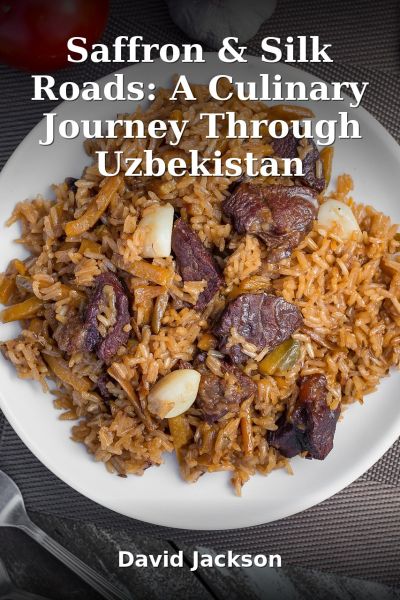
This is one episode in a much longer story. For the full account of Uzbek culinary traditions, read “Saffron & Silk Roads: A Culinary Journey Through Uzbekistan” by David Jackson on MixCache.com.
Please log in or create an account to leave a comment.
No comments yet. Be the first to say something.