
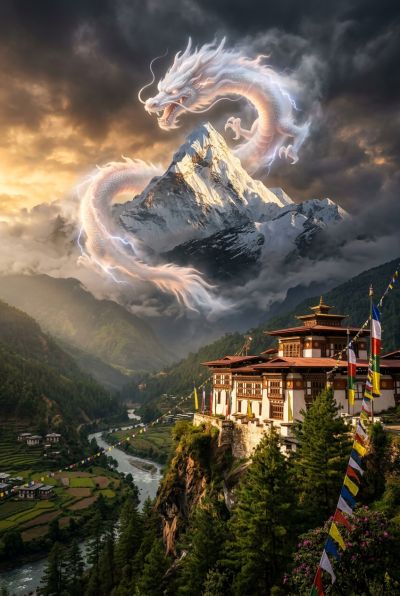
Few countries have attempted what Bhutan has: writing a national philosophy into its constitution, then using it as a filter for every policy decision. Bhutan: Kingdom of the Thunder Dragon by Alex Bugeja doesn't just describe this experiment — it takes the reader inside the machinery of Gross National Happiness, showing how a concept born from a teenage king's offhand remark became a working governance framework with nine measurable domains and a screening tool that can veto a factory for damaging 'community vitality' or 'time use.'
What the book is about
The book spans 25 chapters, moving from Bhutan's geological birth in the Himalayan collision zone to its 21st-century pivot toward a digital economy and the Gelephu Mindfulness City. It covers geography, history, the monarchy's transition to democracy, Vajrayana Buddhism's daily presence, the thirteen traditional arts (Zorig Chusum), dzong architecture, cuisine, national dress, rural life, education, healthcare, conservation, biodiversity, festivals, archery, foreign relations, tourism policy, hydropower economics, and looming challenges. The structure is encyclopedic but readable, aimed at travelers, policy watchers, and anyone curious about a society that constitutionally mandates 60 percent forest cover 'for all time' and measures progress through a GNH Index where 48.1 percent of citizens were classified as 'extensively' or 'deeply' happy in 2022.
Gross National Happiness as operational philosophy, not slogan
Chapter Six reveals how GNH moved from a 1970s royal quip — "Gross National Happiness is more important than Gross Domestic Product" — into a quantifiable system. The Centre for Bhutan & GNH Studies runs nationwide surveys (11,000+ respondents in 2022) across nine domains: psychological well-being, health, time use, education, cultural diversity, good governance, community vitality, ecological diversity, and living standards. Citizens are scored on "sufficiency" thresholds, not feelings. The GNH Policy Screening Tool, overseen by the Gross National Happiness Commission chaired by the Prime Minister, forces every proposal to assess impacts across all nine domains. A hydropower project isn't judged on revenue alone; it's weighed against ecological resilience and community vitality. This is governance by spreadsheet, but the spreadsheet measures what most governments ignore.
The monarchy's deliberate gift of democracy
Chapters Three, Four, and Twenty-Four trace a rare political arc: a dynasty that unified a fragmented land by force, then voluntarily dismantled its own absolute power. The Zhabdrung's 17th-century dual system (Chhoesi) split spiritual and temporal authority between the Je Khenpo and the Druk Desi — a balance the Wangchuck kings inherited and eventually replaced with hereditary monarchy. The Fourth King, Jigme Singye Wangchuck, introduced a constitutional mechanism allowing parliament to force his abdication with a two-thirds vote, then abdicated himself in 2006 to let democracy take root under his son. The 2008 Constitution enshrines a two-round election system designed to produce a stable two-party parliament, and the first three elections (2008, 2013, 2018) each produced a peaceful transfer of power. As the book notes, this was "a change gifted from the throne downwards," not demanded from below.
Culture as daily practice, not museum piece
The book's cultural chapters (Seven, Eleven, Eighteen) show how Bhutan keeps tradition alive through obligation and celebration. The Driglam Namzha — a code of conduct codified by the Zhabdrung — governs everything from how to fold a gho's cuffs to the color of a kabney scarf denoting rank. A 1989 royal decree made national dress mandatory in public during daylight hours. The tshechu festivals, held in dzong courtyards, are simultaneously religious rituals (the cham dances "channel the power and presence of the deities they represent"), social reunions, and fashion showcases where families picnic from bangchung baskets. Even the national sport, archery (Dha), blends 145-meter target shooting with ritualized heckling, celebratory dances, and prodigious ara consumption. Culture here is a verb, not a noun.
Environmental stewardship written into supreme law
Chapters Sixteen, Seventeen, and Twenty-Two demonstrate that Bhutan's green reputation rests on enforceable law, not aspiration. Article 5, Section 3 of the Constitution mandates "a minimum of sixty percent of Bhutan's total land shall be maintained under forest cover for all time" — currently over 70 percent. A network of nine national parks is connected by biological corridors preventing genetic isolation of tigers and elephants. The country is carbon-negative, its forests absorbing more CO2 than the nation emits. Hydropower — "white gold" — provides clean energy and 75% of export revenue, but the book doesn't sanitize the costs: the Punatsangchhu-I dam has been crippled by massive landslides in "weak, sheared rock," and Glacial Lake Outburst Floods (GLOFs) threaten both villages and billion-dollar infrastructure. The Bhutan Trust Fund for Environmental Conservation, one of the world's first environmental endowments, funds conservation from interest alone, never touching principal.
The friction of modernization: youth, screens, and a mindfulness city
Chapters Thirteen, Fourteen, Twenty-Three, and Twenty-Five confront the contradictions success creates. Free education produced a graduate surplus the civil service can't absorb; youth unemployment drives rural-urban migration, hollowing out villages. The 1999 lifting of the TV/internet ban — the last nation to do so — brought "breathtakingly rapid" adoption: 87% online, smartphones ubiquitous, social media rewiring communication. The Fourth King's warning that these tools could "undermine traditional values" now reads prescient. The 13th Five-Year Plan targets a "High-Income GNH Economy" by 2034, and its centerpiece is the Gelephu Mindfulness City: a 1,000-square-kilometer Special Administrative Region on the Indian border, designed with "inhabitable bridges" housing a university, spiritual center, and hospital, aiming to create knowledge-economy jobs that keep talent home. It's a bold bet that economic dynamism and GNH can coexist.
Who should read this
This book rewards readers who want a single, authoritative volume on Bhutan's systems — political, cultural, environmental, economic — and how they interlock. Policy analysts will appreciate the GNH implementation details; travelers will gain deeper context for what they see; development scholars will find a rare case study in alternative metrics. Readers looking for a personal travel narrative or spiritual memoir should look elsewhere. Bugeja's tone is explanatory, not experiential. But for understanding how a small nation attempts to modernize on its own terms — measuring progress in "sufficiency" across nine domains while building a mindfulness city on the Indian border — this is the definitive English-language reference.
Read “Bhutan” on MixCache.com →
Please log in or create an account to leave a comment.
No comments yet. Be the first to say something.