
The sun hammered the valley floor. No trees, no shade, no water — only rock and sand stretching to the horizon. A woman stood alone with an infant at her breast, watching a man walk away without looking back. He had left them there by divine command, or so he said. She asked once, twice, three times: had God ordered this? Each time he answered yes. Then she said the words that would echo through centuries: "Then He will not abandon us."
The Abandonment in the Valley
The year is lost to antiquity, but the place would become Makkah. The man was Ibrahim, known to Jews and Christians as Abraham. The woman was Hajar, his second wife. The child was Ismail, their son. Ibrahim had brought them from the fertile lands of Canaan to this desolate hollow between barren mountains, leaving them with a bag of dates and a water skin. When the water ran out, he was gone.
Hajar nursed Ismail until her milk dried up in the heat. The boy cried, his body shrinking, his tongue swelling. A mother's instinct overrode despair. She set out to find help, climbing a small hill she would later call Safa. From its summit she scanned the horizon — nothing. She ran to the opposite hill, Marwah, and scanned again. Nothing. She ran back to Safa. Then to Marwah. Seven times she crossed the scorching valley floor, her feet blistering, her breath tearing at her throat, her eyes wild with a mixture of hope and terror.
The Desperate Search Between Two Hills
Each crossing was roughly 450 meters. Seven circuits meant more than six kilometers of running in desert heat, carrying nothing but dread. The Quran would later describe Safa and Marwah as "among the symbols of God." In that moment they were simply two rises of ground that offered a slightly better view. Hajar was not performing a ritual. She was fighting for her child's life.
On the seventh arrival at Marwah — or just after, accounts differ — she heard a sound. A scratching, a rushing. She turned to see water gushing from the sand near Ismail's feet. In one version the angel Jibreel struck the earth with his wing. In another the spring simply burst forth where the infant's heel had kicked the ground. Hajar scrambled to contain it, crying "Zam! Zam!" — "Stop! Stop!" — fearing the precious liquid would disappear back into the sand. The name stuck. Zamzam.
The Miracle at Marwah
The water was sweet, abundant, and inexhaustible. Hajar and Ismail drank until they could drink no more. The spring attracted birds, and birds attracted travelers. A tribe called the Jurhum, passing through the valley, saw the birds circling and knew water lay below. They asked Hajar's permission to settle. She agreed, on condition they would not claim ownership of the spring. The valley became a waystation, then a town, then a city. The Kaaba, which Ibrahim and Ismail would later build on God's command, rose nearby. The well remained at its heart.
Centuries passed. The pure monotheism of Ibrahim corroded into idolatry. Three hundred sixty idols eventually ringed the Kaaba. The pilgrimage continued but its meaning twisted. Then, in the seventh century, a man born in that same city returned at the head of an army. His first act was to smash every idol, reciting: "Truth has come, and falsehood has vanished. Indeed, falsehood is ever bound to vanish." The Prophet Muhammad restored the rites, and in his Farewell Pilgrimage of 632 CE he codified the running between Safa and Marwah as Sa'i, an obligatory pillar of Hajj and Umrah.
From Spring to Sacred City
Today the hills of Safa and Marwah are enclosed within the Grand Mosque, their slopes carpeted and air-conditioned. Pilgrims walk the same 450-meter corridor seven times, often in climate-controlled comfort, following green lights that mark the zone where men are encouraged to jog — a vestige of Hajar's frantic pace. Millions drink from Zamzam each year, carried away in plastic bottles by the truckload. The spring has not stopped flowing in four millennia.
What began as a mother's desperate sprint across hot sand became a ritual performed by billions. The valley that nearly killed her now hosts the largest annual gathering on earth. Every runner between those two hills reenacts not just a historical event but a theology: that human effort, pushed to its limit, meets divine provision. Hajar did not wait passively for rescue. She ran. And in her running, she made a city holy.
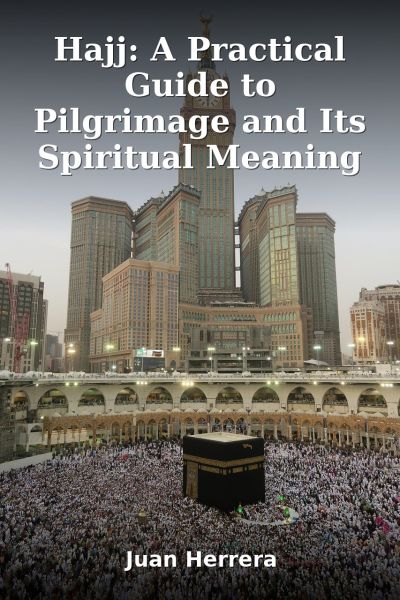
This is one episode in a much longer story. For the full account of the origins of the Hajj pilgrimage, read “Hajj: A Practical Guide to Pilgrimage and Its Spiritual Meaning” by Juan Herrera on MixCache.com.
Please log in or create an account to leave a comment.
No comments yet. Be the first to say something.