
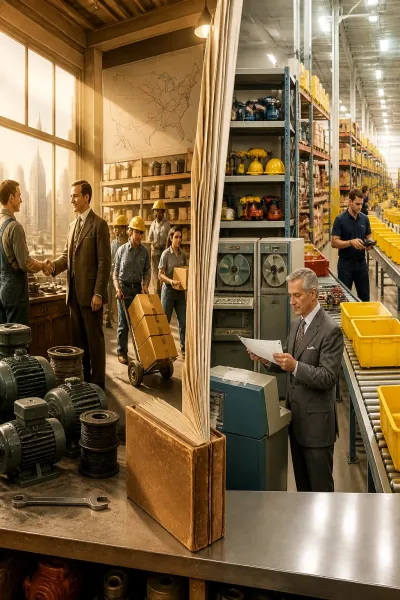
The warehouse should have been half-empty. Every business textbook, every instinct, every panicked competitor in 1930 said the same thing: cut inventory, preserve cash, survive. But William W. Grainger walked the aisles of his Chicago operation and saw something different — he saw the customer who would walk in tomorrow needing a motor to keep a production line running, the engineer who couldn't afford a week's delay, the plant manager whose overtime costs dwarfed the price of the part.
Grainger doubled down. While the Great Depression erased half the nation's industrial output, his fledgling company maintained a comprehensive stock of electric motors, fans, and pumps. The decision looked like suicide at the time. It became the foundation of a distribution empire that would eventually join the S&P 500 and serve millions of customers across the globe.
The Bet
William W. Grainger had incorporated his company in 1927 with a modest investment and a clear thesis: industrial buyers needed a single, reliable source for electrical components instead of navigating a fragmented web of specialized suppliers. By 1929, the model was working. The catalog was growing. The Chicago location was strategic. Then the crash hit.
October 1929 didn't just rattle Wall Street — it froze the real economy. Factories idled. Construction stopped. Orders evaporated. Grainger's peers in the electrical wholesale trade began liquidating stock, canceling supplier contracts, laying off staff. The conventional wisdom was brutal and unanimous: a distributor carrying broad inventory in a contracting market would drown in carrying costs.
Grainger, then in his early forties, had lived through the 1920-21 recession and understood something his competitors missed. Maintenance doesn't stop when production slows. A burned-out motor in a ventilation system still halts a factory. A failed pump still floods a basement. The *frequency* of purchases might drop, but the *urgency* of each one rises. The customer who needs a part at 2 PM on a Tuesday in 1932 needs it more desperately than the same customer in 1928, because there's no budget for downtime.
He kept the inventory. He kept the catalog current. He kept the supplier relationships intact, paying on time when others defaulted, earning preferential treatment that would prove crucial when allocation systems returned during the war years.
The Catalog as Lifeline
The printed catalog — a hefty, meticulously organized volume — became the company's silent sales force. With travel budgets slashed and sales calls reduced, the catalog sat on drafting tables and in maintenance offices across the Midwest. It was more than a price list; it was an engineering reference. Grainger invested in detailed specifications, clear illustrations, and logical organization so a purchasing agent could identify the exact replacement part without calling a salesman.
This was a deliberate strategy. Grainger understood that in a depression, the customer's time is scarcer than money. The catalog let them bypass the friction of inquiry and negotiation. An order placed by mail or phone could be shipped the same day from Chicago stock. The company's promise — "We have it" — became its most valuable asset.
Suppliers noticed. Manufacturers struggling with their own order books prioritized the distributor who paid reliably and moved volume, even reduced volume, consistently. Grainger's warehouse became a buffer in the supply chain, absorbing factory output when demand dipped and releasing it when maintenance cycles peaked. This intermediary role, invisible to most, stabilized relationships on both sides.
The Pivot Point
By 1935, the strategy's genius was evident. Industrial production had begun a slow, uneven recovery. Competitors who had liquidated inventory faced months of lead times to restock. Grainger's shelves were full. His catalog was current. His supplier relationships were deeper than ever. The company captured a disproportionate share of the returning demand.
More importantly, the depression years forged a culture. The employees who stayed — and Grainger fought to keep them — learned that the company's value proposition wasn't price or breadth alone. It was *certainty*. When a customer called, the answer was yes. When a part was needed, it shipped. This operational discipline, born of necessity, became a competitive moat that no catalog or pricing model could replicate.
The numbers bore it out. While comprehensive financial records from the private company's early years are sparse, the trajectory is clear: Grainger entered the 1930s as a small Chicago wholesaler and emerged positioned for the explosive demand of the defense buildup. The branch network that would eventually span the continent had its roots in the credibility earned during those lean years. Customers who survived the depression with Grainger's help became the advocates who welcomed the company into new markets.
The War Test
The ultimate validation came on December 7, 1941. Overnight, American industry converted to war production. The demand for electrical motors — for aircraft factories, shipyards, ammunition plants — skyrocketed. The government imposed priority ratings, allocation controls, price ceilings. Chaos reigned in supply chains.
Grainger's depression-era discipline proved tailor-made for wartime. The inventory systems, the supplier trust, the catalog infrastructure, the branch logistics — all scaled rapidly. The company opened new branches in industrial centers, hired women to replace drafted men, and navigated the Byzantine wartime regulations with the same meticulous attention that had kept the catalog accurate through the 1930s.
By 1945, W.W. Grainger Inc. was no longer a regional distributor. It was a national infrastructure provider, its network hardened by a decade of doing the hard thing when the easy thing was to quit.
The depression gamble didn't just save a company. It established a template: invest in availability when others retreat, build systems that reduce customer friction, treat suppliers as partners. Nearly a century later, the company that began with electric motors in a Chicago storefront operates automated mega-distribution centers, a global e-commerce platform, and an omnichannel network serving millions. But the core promise remains what William Grainger bet everything on in 1930: we have it, you get it, no excuses.
This is one episode in a much longer story. For the full account of the history of W.W. Grainger, read “A History of W. W. Grainger” by Linda Q. Sanchez on MixCache.com.
Please log in or create an account to leave a comment.
No comments yet. Be the first to say something.