
The Belgian barque Belgica did not intend to make history. When it slipped its moorings at Antwerp in August 1897, its mission was straightforward: survey the coast of the Antarctic Peninsula, conduct scientific observations, and return before the austral winter locked the sea. The ship was a converted whaler, sturdy but underpowered, its crew a polyglot mix of Belgians, Norwegians, Romanians, and Poles. Among them were two men who would later become famous in their own right: a quiet, intensely observant Norwegian first mate named Roald Amundsen, and an American doctor, Frederick Cook, whose later claim to have reached the North Pole would make him one of exploration's most controversial figures.
The Trap Closes
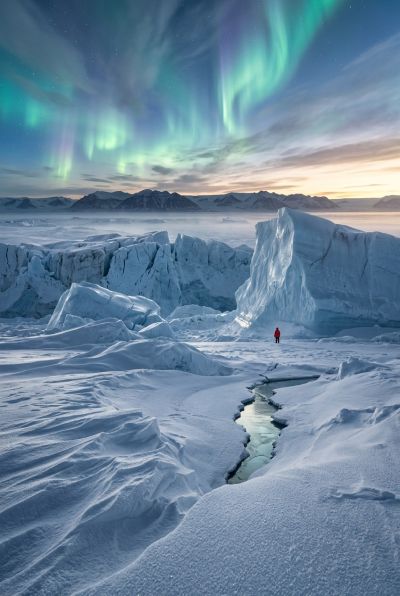
By January 1898, the Belgica had reached the Bellingshausen Sea, pushing further south than any vessel since James Cook. Captain Adrien de Gerlache, determined to earn a place in the annals, drove his ship deep into the pack ice, hoping to find a navigable channel toward the Pole. Instead, the ice closed around them. On March 3, the ship shuddered to a final halt, frozen fast in a grip that would not release it for thirteen months. They had become the first humans to winter in the Antarctic, not by choice but by the continent's indifferent decree.
The realization settled slowly. The sun, already low, began its long descent. By mid-May, the polar night fell in earnest—seventy days without a glimpse of the sun. The temperature dropped to -40°C. The ship groaned under the pressure of the ice, its timbers screaming like living things. The crew, unprepared for such an ordeal, faced a winter of confinement in a space barely larger than a tennis court, breathing air thick with soot from the stove, the stench of unwashed bodies, and the constant, maddening creak of the ice.
The Long Night
The darkness did more than chill the body; it unmoored the mind. One sailor, a young Belgian named Jan Van Mirlo, slipped into madness, convinced the crew planned to murder him. He had to be restrained in a bunk, raving for weeks. Another, the ship's carpenter, died of a heart condition exacerbated by the conditions, his body committed to a hole cut through the ice. The official language aboard was French, but as discipline frayed, men retreated into their native tongues—a babel of Flemish, Norwegian, and Romanian that only deepened the isolation.
Scurvy, the ancient curse of polar travel, appeared with a vengeance. Gums blackened, old wounds reopened, legs swelled into useless pillars. The expedition's stored lime juice had lost its potency, and the canned vegetables offered no protection. De Gerlache, himself weakening, refused the fresh penguin and seal meat that the hunters brought back, finding the dark, oily flesh revolting. The crew followed his lead, starving amid plenty.
It was Frederick Cook who broke the death spiral. Recognizing the symptoms, he ordered the men to eat the meat, raw if necessary, insisting that the vitamin C in fresh flesh was their only salvation. Slowly, painfully, the swollen limbs shrank, the bleeding gums healed. Amundsen watched everything. He noted the failure of the official rations, the superiority of fur clothing over wool, the psychological necessity of routine and purpose. He watched a commander lose control and a doctor save the expedition through sheer empirical will. In his cabin, he filled notebooks with observations that would one day guide his own assault on the South Pole.
The Way Out
Spring brought no relief. The ice did not break; it only thickened. By January 1899, the Belgica was still fast, drifting helplessly in the gyre. De Gerlache, desperate, ordered a last attempt: the crew would cut a channel to open water. For weeks, men labored in shifts with hand saws, axes, and blasting charges, hacking a trench 75 meters long and two meters deep through ice that refroze each night. The work was brutal, the progress measured in centimeters. On February 14, a sudden shift in the pack opened a lead ahead. The Belgica, its engines coughing back to life after a year of cold, surged into the gap and broke free.
When they reached Punta Arenas, Chile, in late March, the world had given them up for dead. The survivors—twenty men returned from twenty-three—were gaunt, bearded, moving with the careful gait of those who had learned to walk on a moving floor. They had endured the first Antarctic winter and lived to tell of it.
Legacy
The Belgica's winter proved that humans could survive the Antarctic night, but its true significance lay in the lessons extracted from the suffering. Cook's insistence on fresh meat rewrote the medical playbook for polar travel. Amundsen, the silent student, carried the hard-won knowledge into his own expeditions: the efficiency of dogs and skis over ponies and motor sledges; the vital importance of ventilation and hygiene in winter quarters; the discipline required to keep a crew sane in darkness. When he stood at the South Pole in 1911, the ghost of the Belgica stood with him.
The ship itself had a quieter afterlife. Sold, renamed, pressed into service as a freighter, it was finally scuttled by its crew off the coast of Norway in 1940 to prevent capture by German invaders. But the winter of 1898 remains the crucible in which the Heroic Age was tempered—a long night that broke men and made legends, all in the service of a continent that had not invited them.
This is one episode in a much longer story. For the full account of Antarctica, read “Antarctica” by Dr Alex Bugeja, PhD on MixCache.com.
Please log in or create an account to leave a comment.
No comments yet. Be the first to say something.