
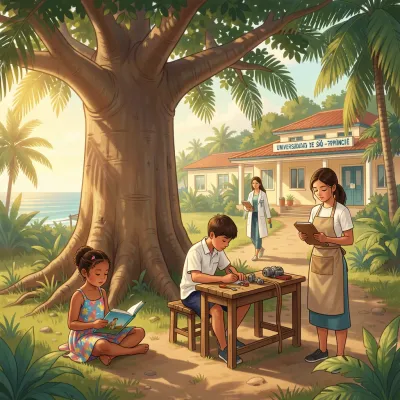
On the smaller island of Príncipe, in villages tucked between cocoa plantations and steep volcanic ridges, six-year-olds arrive at primary school speaking only Principense Creole. The language of their homes, their games, their grandmothers' stories — it is the only tongue they know. But the moment they step through the classroom door, the official curriculum demands Portuguese. For generations, that collision has left children silent, confused, and failing to read.
Then a handful of teachers tried something radical: they wrote the first storybooks in Principense Creole and taught reading in the language the children actually spoke.
The Silent Classroom
The problem was not new. Since independence in 1975, São Tomé and Príncipe had kept Portuguese as the sole medium of instruction, a legacy of five centuries of colonial rule. The logic was pragmatic: Portuguese opened doors to the Lusophone world, to university in Lisbon or Rio, to civil service jobs. But the reality on the ground was different. In rural Príncipe, where Principense Creole — a Portuguese-based creole shaped by African substrates — is spoken in every household, children entered primary school with zero exposure to formal Portuguese. They were expected to decode a new language and learn to read simultaneously.
Teachers watched the same pattern repeat year after year. Children memorised syllables by rote but could not comprehend a simple sentence. By third grade, many had fallen irreversibly behind. The national examinations at the end of primary school became a filter that rural, creole-speaking children rarely passed. The system called it a language deficit; the teachers called it a tragedy.
The Language Bridge
In the early 2010s, a local educational think tank partnered with the Ministry of Education to design a pilot they called the "Language Bridge." The premise was straightforward: build foundational literacy in the child's mother tongue, then transfer those skills to Portuguese. It contradicted decades of policy that treated creoles as obstacles to be overcome.
The team started by standardising an orthography for Principense Creole — no small feat for a language that had never been officially written. They then created a set of slim, illustrated storybooks: folk tales about the trickster figure Tchiloli, songs about the sea, descriptions of the cocoa harvest. The vocabulary was controlled, the sentences repetitive, the topics unmistakably local. Teachers received training in bilingual pedagogy: how to introduce a concept in Principense, reinforce it through games and chants, then gradually layer in the Portuguese equivalent.
The pilot launched in a cluster of schools in the Principense interior. A control group continued with the standard Portuguese-only approach. Both sets of children came from similar backgrounds: subsistence farming families, limited books at home, no preschool.
Results That Spoke Volumes
By the end of the first year, the differences were stark. Children in the Language Bridge classrooms could read simple texts in Principense with fluency and, crucially, with comprehension. They could retell stories, answer questions, invent new endings. When Portuguese was introduced in the second year, they transferred decoding skills with surprising speed. By the end of primary school, their Portuguese literacy scores significantly outpaced the control group — not just in reading, but in writing and oral expression too.
The data forced a conversation that had been avoided for decades. Using creole had not confused the children; it had given them a cognitive foothold. The mother tongue became a scaffold, not a barrier. One teacher, who had taught for twenty years under the old system, put it simply: "They finally understand that reading is about meaning."
The Hard Part
Success, however, has not translated into nationwide policy. Scaling the Language Bridge requires more than storybooks. It needs teachers fluent in both the creole and the pedagogy of bilingual transition — a rare combination. It needs sustained funding for materials that must be recreated for each of the country's three main creoles: Forro, Angolar, and Principense. And it needs political will to confront the lingering stigma that creoles are "broken Portuguese" unfit for the classroom.
For now, the Principense storybooks sit in a few school cupboards, their pages worn by small hands. The children who learned to read with them have moved on to secondary school, where Portuguese reigns unchallenged. But they carry something the system did not give them before: the certainty that their language, their stories, their voices belong in the world of letters. That shift — from shame to ownership — may be the most durable outcome of all.
This is one episode in a much longer story. For the full account of education in São Tomé and Príncipe, read “Education In Sao Tome and Principe” by Jennifer Gardner on MixCache.com.
Please log in or create an account to leave a comment.
No comments yet. Be the first to say something.