
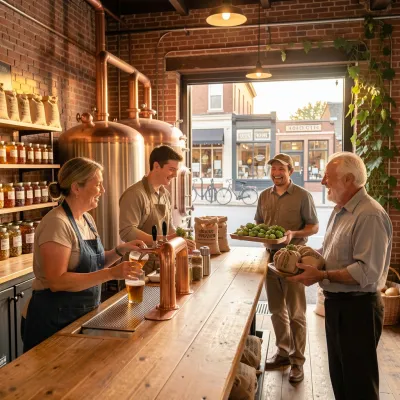
The old clock tower in Chelsea, Michigan, had kept time for a town that seemed to be running out of it. By the early 1980s, the Midwest's industrial heartbeat had grown arrhythmic — factories shuttered, Main Streets quieted, young people left. Into this stillness walked Ted Badgerow, a cook and choir director, and Gordon Averill, a dairy farmer watching his livelihood sour. They carried $12,000 in seed money, a handful of repurposed dairy tanks, and a notion that seemed, at the time, faintly absurd: they would brew beer.
The Wrong Turn in Chelsea
Badgerow's epiphany arrived in a glass. A friend handed him a homebrew so rich and alive he mistook it for an import. In 1982, that was a radical experience. The American palate had been flattened by decades of light lager; flavor was not on the menu. But Badgerow tasted possibility. Averill tasted survival. His dairy farm was struggling, and the equipment — pasteurizers, cooling jackets, stainless vessels — sat idle. Beer, they realized, was just milk with a different biography.
They incorporated the Real Ale Co. in early 1982. No playbook existed. The federal paperwork moved smoothly enough, but the state of Michigan stared at their application like a riddle. Nearly a quarter-century had passed since anyone sought a brewery license. Clerks shuffled forms, uncertain which ones applied. The bureaucracy had forgotten how to say yes.
Undeterred, they moved into the clock-tower building. The tower itself became their signature: a brick sentinel above a brewhouse cobbled from dairy gear. They bought yeast, malt, and hops. They brewed English-style bitters — pale, hoppy, alive — and bottled them by hand in washed Bass, Guinness, and Harp bottles, the only suitable glass they could find. Each bottle carried the ghost of its previous life.
Dairy Tanks to Fermenters
The conversion was more metaphor than machinery. A pasteurizer became a wort boiler. Milk cooling jackets became fermentation temperature control. The logic was sound: both liquids demanded sanitation, temperature precision, and gentle handling. But the learning curve was vertical. Badgerow had never brewed commercially. Averill had never sold a pint. They drove to Colorado to pick the brains of Boulder Brewing Co., one of the few pioneers then operating, and came home with scribbled notes and a deeper respect for the craft.
By mid-1983, the improbable had happened. Time magazine dispatched a reporter to Chelsea. The piece marveled at a brewery in a clock tower, at English ales in Michigan, at the audacity of two men betting on flavor in a land of fizz. The phone rang. Distributors called. Bars asked for kegs. Demand outstripped the dairy tanks' capacity. Expansion was urgent. Capital was not.
They had proven the market. They had proven the product. They had even proven the location — a small town could sustain a brewery if the beer was good enough. But the $12,000 was long gone. Banks saw risk, not revolution. Investors wanted scale, not craft. The dairy equipment had reached its limit. In 1986, four years after the first mash, Real Ale Co. closed its doors. The clock tower fell silent again.
The Bellwether Visit
One visitor, however, had already taken the measure of the place. Larry Bell, a Chicago native then running a homebrew supply shop in Kalamazoo, drove the hour to Chelsea in 1983. He walked the brewhouse, tasted the bitter, and saw his future. "It was the first time I'd seen a small brewery operating," he later recalled. "It made it real."
Bell incorporated Kalamazoo Brewing Co. weeks later. By August 1985, he was brewing test batches in an old plumbing warehouse. Within a year, Bell's Brewery stood as the oldest microbrewery between the East Coast and the Rockies. Today, it produces over 600,000 barrels annually. The clock tower's shadow falls long.
Bell was not alone. The Real Ale Co. sparked a chain reaction. In Milwaukee, Randal Sprecher opened Sprecher Brewing Co. in 1985, the city's first craft brewery since Prohibition. In Iowa, Carroll Zuber launched Millstream Brewing Co. in the Amana Colonies. Each founder carried a similar story: a taste that changed them, a community that needed them, a system that resisted them.
A Short Life, A Long Shadow
The clock tower still stands on Main Street in Chelsea. Its upper floors now hold apartments; the ground floor has housed a succession of restaurants. No plaque marks the brewery. The Bass and Guinness bottles are gone. But the logic that Badgerow and Averill improvised — that a town's abandoned assets could become its next economy, that flavor could be a business model, that small could be viable — rewrote the Midwest's story.
By 2026, Michigan alone hosted more than 400 craft breweries. The three-tier distribution system that once baffled Real Ale's founders has bent to accommodate them. Taprooms anchor downtowns from Traverse City to Grand Rapids. Spent grain feeds cattle on the same farms that once supplied Averill's dairy. The dairy tanks are gone, but the conversion they proved possible — industrial past to artisanal future — plays out daily across the heartland.
Badgerow and Averill never saw it. Their brewery lasted four years. But the first sip poured in that clock tower still echoes in every pint raised in a Midwestern taproom today.
This is one episode in a much longer story. For the full account of the rise of midwestern craft beer, read “The Rise of Microbreweries in the American Midwest” by Alice Wilson on MixCache.com.
Please log in or create an account to leave a comment.
No comments yet. Be the first to say something.