
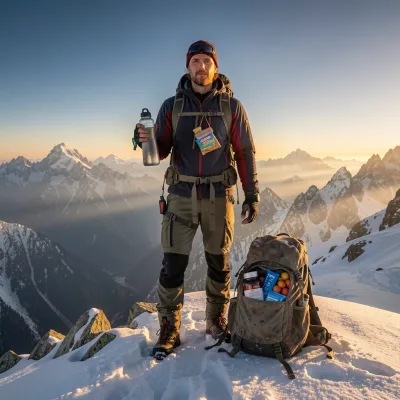
At 21,000 feet on Everest's upper slopes, the air holds barely half the oxygen of sea level. A seasoned climber, weeks into her expedition, stared at the dehydrated meal she had loved at base camp and felt her throat close. The smell alone — savory, familiar — triggered a violent gag reflex. She had not eaten properly in days. Her energy had collapsed, weight falling away in the brutal arithmetic of altitude. Every calorie deficit now threatened not just her summit bid but her ability to descend alive.
The Anorexia of Ascent
The phenomenon has a clinical name: the anorexia of ascent. Hypoxia triggers a cascade of hormonal shifts — corticotropin-releasing hormone surges, ghrelin plummets, cortisol and adrenaline flood the system — all conspiring to shut down hunger signals. The body, desperate for oxygen, diverts blood from the digestive tract to the brain and muscles. Gastric emptying slows. Foods that digest easily at sea level sit like stones. For this climber, the result was a complete aversion to solid food. "The thought of her carefully packed dehydrated meals, which she loved at sea level, made her gag," the account notes. She was burning thousands of calories a day just to exist, yet could not force down a bite.
Weight dropped fast. Strength followed. Cognitive fog thickened — a dangerous companion on technical terrain where a misplaced step or a muddled decision can be fatal. The climber's meticulous meal plan, tested and refined for months, had become useless. Her gut had simply gone on strike.
A Radical Prescription
Her team leader recognized the spiral. Instead of coaxing her to eat — the standard advice of "force small bites" — he ordered the opposite: abandon all solid food for 48 hours. The protocol was stark. She would consume only warm, sweetened electrolyte drinks and small sips of a high-calorie liquid supplement. No oatmeal. No pasta. No nuts or bars. Nothing that required chewing or digestion.
It sounded like starvation. In reality, it was a calculated reset. The inflamed, hypoxic gut needed a pause from the mechanical and chemical work of processing solids. Liquid calories — simple sugars, maltodextrin, electrolytes — could be absorbed with minimal gastric effort, stabilizing blood sugar while the digestive lining recovered. The warmth of the drinks countered the core cold that further suppressed motility. "She abandoned all solid food for 48 hours and relied solely on warm, sweetened electrolyte drinks and small sips of a high-calorie liquid supplement," the record states.
The Reset
By the end of the first liquid-only day, the gagging subsided. Nausea, constant for days, faded. On the second day, she felt a flicker — not hunger, exactly, but the absence of revulsion. The team leader authorized a cautious reintroduction: tiny portions of instant oatmeal and plain crackers. Minimal fiber. Minimal fat. Maximum digestibility. She ate a few spoonfuls. They stayed down. A few hours later, a few more.
The system had rebooted. Blood glucose stabilized. The catabolic crisis eased. Within days she was tolerating a modified version of her original plan — softer textures, blander flavors, liquid-heavy meals — and climbing again. The summit push, once unthinkable, went forward. She stood on the roof of the world having survived not the mountain, but her own metabolism.
What the Episode Reveals
The case illustrates a counterintuitive truth of extreme altitude: sometimes the best way to fuel the body is to stop feeding it in the conventional sense. The anorexia of ascent is not mere pickiness; it is a physiological rebellion. Pushing solids into a shut-down gut worsens inflammation, deepens the energy hole, and prolongs the crisis. A short, deliberate fast — replaced by targeted liquid nutrition — can break the cycle.
It also underscores that no meal plan survives first contact with the death zone unaltered. The climber had done everything right: trained her gut, tested her foods, packed redundancies. Yet altitude rewrote the rules in ways no sea-level simulation could replicate. The team leader's willingness to discard the plan — to prescribe what looked like starvation — saved the expedition. In the thin air above 8,000 meters, flexibility is not a luxury. It is the last line of defense.
This is one episode in a much longer story. For the full account of high-altitude mountaineering nutrition, read “Peak Fuel: Nutrition, Hydration, and Supplement Strategies for High Mountain Performance” by Teresa Chavez on MixCache.com.
Please log in or create an account to leave a comment.
No comments yet. Be the first to say something.