
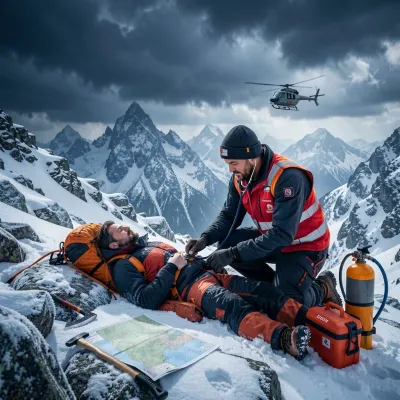
At 14,000 feet on a wind-swept slope, a climber paused to adjust his crampons. The glacier glasses came off. Minutes later, they went back on. By evening, he could barely open his eyes.
The grit sensation arrived first, like sand poured under the lids. Then came the burning, the tearing, the spasms that clamped his eyelids shut. When the expedition medic examined him in the dim tent light, both eyes were bloodshot, swollen, streaming. The diagnosis was photokeratitis — snow blindness — essentially a sunburn on the corneas from ultraviolet radiation amplified by snow and thin air.
The mistake that costs vision
Fresh snow reflects up to 80 percent of ultraviolet radiation. At altitude, the atmosphere strips away much of the remaining filter. Even on overcast days, UV penetrates cloud cover. The climber had known this. He had worn his glacier glasses faithfully — side shields, UV 400 filtration, dark lenses. But the crampons had iced up, and he needed both hands and clear vision to clear them. Just a minute, he thought. Maybe two.
Photokeratitis does not announce itself immediately. The corneal epithelium absorbs the UV damage silently. Symptoms typically erupt six to twelve hours later, often after the expedition has settled into camp. By then, the damage is done. The climber's eyes were already inflamed, the nerve endings raw. Light became agony. He was functionally blind, dependent on a teammate to find his sleeping bag, to eat, to navigate the tent.
Patching the dark
The medic's kit held no anesthetic eye drops — deliberately so. In the field, numbing the pain can delay healing and mask worsening injury. Instead, the medic administered oral NSAIDs for pain and reached for the simplest tool available: eye patches.
Two patches, applied gently over closed lids. Total darkness. The climber would wear them for twelve hours. A designated teammate became his sighted guide, a role that required constant proximity — leading him to the latrine, handing him water, monitoring for nausea or rising panic. The medic briefed the team: no light, no peeking, no exceptions. The corneal epithelium regenerates rapidly when left undisturbed, but any photon exposure resets the clock.
The long night
Twelve hours in a tent at 14,000 feet is a long vigil. The patient dozed fitfully, the pain dull but persistent. The guide slept in shifts. The wind scoured the tent fabric. Outside, the mountain was indifferent. Inside, the only treatment was time and darkness — no drops, no ointments, no technology beyond a strip of adhesive gauze.
At dawn, the patches came off. The climber winced at the first gray light but kept his eyes open. The tearing had stopped. The grit sensation had faded to a dull ache. By mid-morning, he could tolerate full daylight with his glacier glasses on. The cornea had healed. The expedition continued.
The lesson written in UV
Snow blindness is rarely permanent. But in remote terrain, temporary blindness is a crisis — a navigator lost, a rope team broken, a medic distracted. The case is recorded not for its drama but for its banality: a routine task, a momentary lapse, a consequence disproportionate to the error. The medic's notes read simply: Removed eyewear <5 min to adjust crampons. Bilateral photokeratitis. Treated with bilateral patching x12 hrs, PO analgesia. Resolved without sequelae.
Every climber on that expedition now checks their partner's face before the first step. A white patch on the nose, a fogged lens, a missing frame — the buddy catch is the last line of defense. The mountain does not forgive shortcuts. It does not even notice them.
This is one episode in a much longer story. For the full account of high-altitude wilderness medicine, read “Wilderness Mountain Medicine: First Aid and High Altitude Medical Care for Climbers” by Bradley McDonald on MixCache.com.
Please log in or create an account to leave a comment.
No comments yet. Be the first to say something.