
On a hillside above the Roman theater, where tourists now sip coffee beside 2,000-year-old columns, the first Circassian families pitched their tents in the 1870s. They had walked hundreds of kilometers from the northwestern Caucasus, driven out by the final, brutal campaigns of the Russian Empire. The city they chose — Amman — had been empty for centuries, its ancient stones given over to goats and wild herbs. Within a generation, the refugees had turned those ruins into the capital of a future kingdom.
Exile from the Mountains
The Circassians, who call themselves Adyghe, had lived for millennia in the valleys and forests of the northwestern Caucasus, a region of stubborn independence and intricate clan codes. In the 1860s, after decades of resistance, the Russian army completed its conquest of the western Caucasus. Entire villages were burned; families were given the choice of deportation to the Ottoman Empire or annihilation. Hundreds of thousands boarded ships at Black Sea ports, many dying of disease and starvation before they reached Ottoman shores. Those who survived were scattered across the empire's Arab provinces — some to the Balkans, some to Anatolia, and several thousand to the sparsely populated districts of what is now Jordan.
Ottoman authorities, eager to settle loyal Muslim populations near the volatile desert frontier, directed groups of Circassians to the ruins of Amman, Jerash, Wadi al-Seer, Naour, and Sweileh. Amman, known in antiquity as Philadelphia of the Decapolis, had been abandoned since the early Islamic period, its theaters and temples collapsing into the red dust. The newcomers found shelter in the cavernous Roman cisterns and the vaulted chambers of the theater itself.
Building on Roman Bones
The first winters were punishing. The Circassians, accustomed to the damp forests of the Caucasus, had to adapt to a semi-arid climate where water came from a single spring and the nearest grain market was days away. They brought with them a tradition of collective labor — *th'ymate* — in which the entire village worked each family's land in rotation. Using stones pried from the Roman ruins, they built low, flat-roofed houses clustered around a central courtyard, each oriented toward Mecca. They dug irrigation channels to the spring, planted wheat and barley in the red soil, and grazed their flocks on the surrounding hills.
By the 1890s, a distinct Circassian quarter had taken shape along the slope descending from the Citadel. The community maintained its language, Adyghe, and its customs: the strict code of hospitality (*khabez*), the reverence for elders, the martial dances performed at weddings. They also learned Arabic, the language of the surrounding Bedouin and peasant communities, and adopted the dress and diet of the region. When the Hejaz Railway reached Amman in 1903, linking Damascus to Medina, the Circassian farmers were among the first to ship produce to the coast, binding the settlement to the wider economy.
Guardians of the Throne
The decisive turn came in 1921. Abdullah, second son of Sharif Hussein of Mecca, arrived in Amman with a small force of Hejazi tribesmen, intent on marching north to reclaim his brother Faisal's throne in Damascus. The British, anxious to contain French ambitions and secure the route to Iraq, intercepted him. Winston Churchill, then Colonial Secretary, met Abdullah in Jerusalem and offered a compromise: Abdullah would rule a new British mandate, the Emirate of Transjordan, with Amman as its capital.
Abdullah needed a loyal core for his nascent administration and army. He found it among the Circassians. Their reputation for discipline, their lack of local tribal entanglements, and their gratitude to the Ottoman state — now transferred to its Hashemite successors — made them ideal recruits. Circassian cavalry formed the nucleus of the Arab Legion, the force that would become the Jordanian Armed Forces. For decades, the royal guard at Basman and Raghadan palaces was drawn almost entirely from Circassian families, a tradition that persists in ceremonial units today.
A Community Within a Nation
The Circassians never sought a separate state. They identified as Jordanian from the mandate's first days, and their leaders fought in the 1948 and 1967 wars alongside Bedouin, fellahin, and urban volunteers. In return, the Hashemite monarchy recognized them as a distinct communal entity. The 1952 constitution guaranteed the Circassian (and Chechen) communities two seats in the lower house of parliament — a quota that remains in force. The Circassian Charity Association, founded in 1932, runs schools, a hospital, and cultural centers in Amman, Wadi al-Seer, and Sweileh, teaching Adyghe language and the *kafa* dance to children who have never seen the Caucasus.
Today, the Circassian population in Jordan numbers between 40,000 and 170,000 — estimates vary because the census does not record ethnicity. They are doctors, engineers, officers, parliamentarians, and shopkeepers. In the old quarter near the Roman theater, a few families still live in houses built from Roman ashlars, their doors marked with the distinctive Circassian symbol of the twelve stars and three crossed arrows. Every May 21, the community gathers at the association's hall to commemorate the exile, reading the names of villages that no longer exist on any map. The ceremony ends with a feast of *shish kebab* and *haliva* — fried pastries stuffed with potato and cheese — served on plastic tables beneath the floodlit columns of a city their great-grandparents pulled from the dust.
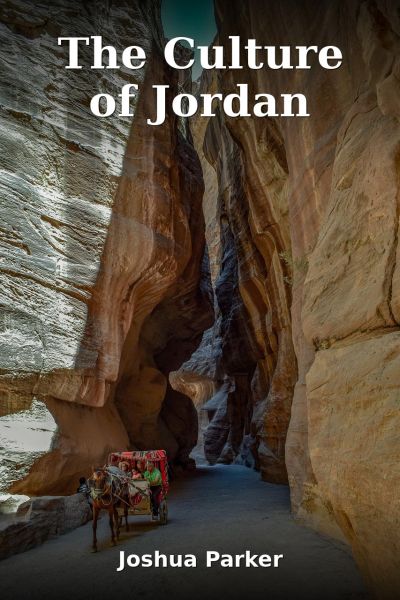
This is one episode in a much longer story. For the full account of the Circassian founding of Amman, read “The Culture of Jordan” by Joshua Parker on MixCache.com.
Please log in or create an account to leave a comment.
No comments yet. Be the first to say something.