
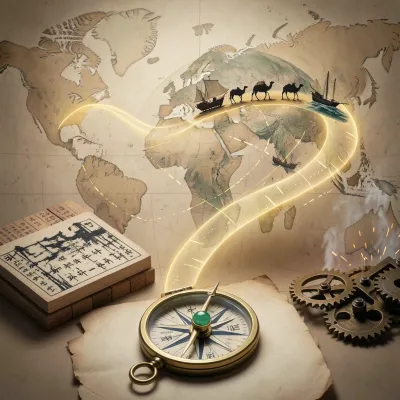
In a Han dynasty tomb, archaeologists found a bronze plate the size of a tea tray, its surface polished to a mirror sheen and inscribed with the twenty-eight lunar mansions, the four directional animals, and the twelve earthly branches. Resting at its center lay a spoon cast from lodestone, its handle slender, its bowl perfectly balanced. When set free to rotate, the spoon did not wobble toward the nearest wall or the warmth of a hearth. It settled, every time, with its handle pointing due south.
The Sinan: A Spoon on a Plate
The device was called a sinan, literally "south-governor." Its form was deliberate: a ladle shaped like the Big Dipper, the constellation that wheels around the celestial pole and has guided travelers for millennia. The bowl represented the dipper's cup; the handle, its pointer. Craftsmen cast the spoon from magnetic iron ore, then polished its convex base until it could spin on the plate with the friction of a breath. The plate itself was a map of the Chinese cosmos — not a chart of coastlines but a diagram of celestial and terrestrial correspondences, where each direction carried moral, medical, and meteorological significance.
Texts from the first century BCE describe the sinan in use at court. Diviners employed it to site tombs, palaces, and capital cities, aligning foundations with the flow of qi that the spoon revealed. The Huainanzi, a compendium compiled around 139 BCE, notes that "the lodestone attracts iron; the sinan points south." The phrasing is matter-of-fact, as if the miracle had already become routine. By the Eastern Han, the instrument appears in burial goods, suggesting it had passed from state ritual into aristocratic habit.
Cosmic Order on a Plate
Why south? In Chinese cosmology, the emperor faced south to receive the light of heaven; south was the direction of yang, of warmth, of authority. The sinan did not merely indicate a cardinal point — it enacted a worldview. The plate's markings fused geography, astronomy, and geomancy into a single circle. The Green Dragon of the east, the White Tiger of the west, the Vermilion Bird of the south, the Dark Warrior of the north: these were not decorative. They anchored the spatial logic of feng shui, the art of situating human dwellings in harmony with invisible currents.
When a diviner set the spoon spinning, he was not checking a bearing for a journey. He was asking the earth whether a proposed tomb site would bring prosperity or ruin to the descendants. The spoon's verdict — the final stillness of its handle — carried the weight of cosmic law. A misaligned foundation could doom a lineage; a correctly oriented one could secure it for generations. The sinan thus stood at the intersection of politics, spirituality, and proto-science, a tool that made the invisible visible and the subjective objective.
From Ritual to Navigation
For centuries the spoon remained a creature of the court and the cemetery. Its plate demanded a level surface, a windless room, a steady hand — conditions rarely met on a rolling deck. Yet the principle it embodied, that a magnetized object aligns itself with the planet's hidden field, refused to stay confined. By the Song dynasty (960–1279 CE), scholars were describing magnetized needles suspended on silk threads or floated on water in bowls. These needles were smaller, hardier, and indifferent to the tilt of a ship.
The transition was gradual. Early maritime texts still treat the magnetic needle as one cue among many: the position of the sun, the color of the water, the flight of birds, the taste of the wind. A needle that pointed south (or, in later practice, north) was a hedge against overcast skies, not a replacement for celestial navigation. But the logic of the sinan had already done its work. It had taught a civilization that direction could be captured in a piece of metal, that the earth itself possessed a measurable grain, and that this grain could be trusted more than the memory of landmarks.
Arab and Persian mariners encountered the floating needle in Chinese ports along the Indian Ocean. They adopted it, refined the mounting, and passed it westward. By the late twelfth century, European sailors in the Mediterranean were using a dry-pivot needle in a box, marked with a compass card. The spoon had become a needle; the bronze plate, a card; the cosmic diagram, a ring of thirty-two points. Yet the lineage was unbroken: every compass that has ever guided a ship across an ocean descends from that ladle spinning on a polished disk in a Han tomb.
The Legacy of the South-Pointing Spoon
The sinan's preference for south left a subtle trace on the history of navigation. Chinese charts long placed south at the top, a convention that persisted even after the needle became standard equipment. When the compass card migrated to Europe, it was reoriented to privilege north — the direction of the Pole Star, the fixed point around which the heavens appeared to turn. The shift from south to north was more than a cartographic choice; it reflected a different astronomy, a different imperial imaginary, a different way of imagining the world's center.
Today, the surviving sinan plates sit in museum cases, their inscriptions faded, their spoons frozen in display mounts. No one spins them anymore. But the gesture they crystallized — the decision to trust a sliver of magnetized metal over the evidence of the senses — remains the foundation of modern navigation. Every GPS satellite, every inertial guidance system, every smartphone map ultimately answers the same question the sinan answered: which way lies the path I intend to follow? The spoon had no satellites, no atomic clocks, no radio signals. It had only the earth's slow, invisible heartbeat, and a bronze plate polished smooth enough to let that heartbeat turn a ladle into a verdict.
This is one episode in a much longer story. For the full account of the magnetic compass and its origins, read “From Compass to Printing: Chinese Innovations and Global Impact” by Michael Price on MixCache.com.
Please log in or create an account to leave a comment.
No comments yet. Be the first to say something.