
In the shallow waters of Lake Texcoco, a civilization built its dinner table from reeds and mud. Starting around the twelfth century, the Aztecs faced a crisis familiar to modern cities: a booming population and almost no arable land. Their capital, Tenochtitlan, sat on an island in the middle of a lake, hemmed in by water and volcanoes. Rather than wait for dry ground, they manufactured it.
Weaving Islands from the Lake Bed
The solution was the chinampa — a rectangular raft woven from branches and reeds, anchored to the lake floor by willow trees planted at its corners. Workers dredged nutrient-rich muck from the bottom of the lake and piled it onto the rafts, layering it with decaying vegetation until a fertile mound rose above the waterline. The roots of crops planted on top grew downward through the lattice, tapping directly into the lake's natural fertilizer.
Each chinampa measured roughly thirty by two and a half meters, separated by narrow canals that allowed canoes to slip between them for planting and harvest. The system was modular, expandable, and intensely productive. Because the water table remained constant, crops never suffered drought. The lake itself regulated temperature, protecting plants from frost. And the sediment, continuously replenished by the surrounding watershed, delivered a steady stream of nitrogen, phosphorus, and potassium — no synthetic inputs required.
A City Fed by Water
At its height, the chinampa zone covered an estimated twelve thousand hectares along the southern shores of Lake Texcoco. Spanish chroniclers who arrived in the early sixteenth century described a landscape so densely cultivated it resembled a checkerboard of green. The yields were staggering: up to seven harvests a year of maize, beans, squash, amaranth, tomatoes, and chili peppers. This surplus fed a city of perhaps two hundred thousand people — larger than any in Europe at the time — and supported the armies and bureaucracy of an empire that stretched across central Mexico.
The labor organization was equally sophisticated. Chinampas were assigned to families, temples, or the state, with tribute payments often made in produce. Construction and maintenance required coordinated effort: dredging canals, repairing rafts, planting willows. The system turned a geographic constraint into an ecological engine, integrating aquaculture (fish and waterfowl thrived in the canals) with horticulture in a closed loop that anticipated modern aquaponics by seven centuries.
Collapse and Erasure
The conquest of 1521 broke the system. Spanish authorities, unfamiliar with lacustrine agriculture, saw the lakes as obstacles to European-style urbanism. They began draining the Valley of Mexico's lakes to control flooding and create pasture. By the seventeenth century, Lake Texcoco had largely vanished. The chinampas that survived were relegated to the margins, their canals clogged or converted to irrigation ditches. Today, only a fragment remains in the Xochimilco borough of Mexico City, where tourists ride trajineras through channels that once fed an empire.
The Pattern Repeats
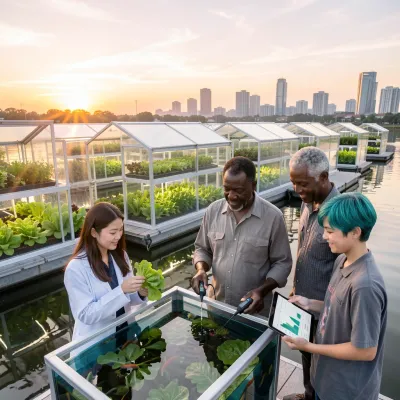
Modern floating farms — pontoon-mounted greenhouses in Rotterdam, modular rafts in Singapore, brackish-water trials in Gaza — echo the Aztec logic: use the city's water to grow its food. The materials have changed (high-density polyethylene replaces reeds; solar pumps replace canoes), but the principle holds. Where land is scarce, expensive, or degraded, the surface of the water offers a platform that is level, well-watered, and thermally stable. The Aztecs did not have sensors or automated feeders. They had observation, iteration, and a willingness to build soil where none existed. Their chinampas remain the proof of concept that floating agriculture is not a futuristic gamble but a recovered heritage.
This is one episode in a much longer story. For the full account of the history of urban aquaponics, read “The Rise of Floating Farms” by Dennis Black on MixCache.com.
Please log in or create an account to leave a comment.
No comments yet. Be the first to say something.