
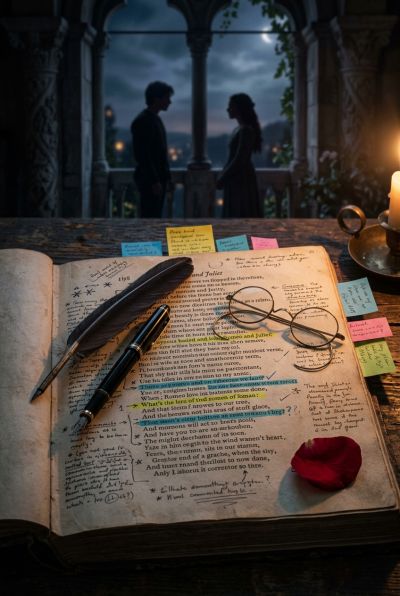
The dream had been sweet, almost cruel in its kindness. Romeo woke in Mantua with the taste of Juliet's kisses still on his lips, his spirit so light he felt he could walk on air. He had dreamed she found him dead and breathed life back into him, making him an emperor. Then his servant arrived from Verona with news that shattered everything: Juliet's body lay in the Capulet monument, her immortal part with angels. Romeo did not weep. He cursed the stars and ordered horses for the journey home.
The Apothecary's Shop
He remembered a shop he had passed days earlier, tucked away in a poor quarter of Mantua. The apothecary was a skeleton of a man, his cheeks hollowed by famine, his eyes burning with need and oppression. His shop was a museum of desperation: a stuffed alligator hung from the rafters, a tortoise shell gathered dust, empty green pots and bladders lined shelves alongside remnants of packthread and old cakes of roses. The man culling simples in tattered weeds had looked like death itself.
Romeo found the door shut — it was a holiday — but he hammered until the apothecary appeared. Forty ducats, he offered, for a dram of poison swift enough to race through the veins and discharge the breath as violently as powder from a cannon's womb. The apothecary had the drugs, but Mantua's law made selling them a capital offense.
A Bargain Struck in Misery
"Art thou so bare and full of wretchedness, / And fear'st to die?" Romeo asked. He read the man's poverty like a text: famine in the cheeks, starvation in the eyes, beggary hanging on his back. The world offered no law to make him rich, so why obey the law that kept him poor? The apothecary hesitated, then took the gold. "My poverty, but not my will, consents."
Romeo weighed the coins in his hand and made a judgment that has echoed for centuries: "There is thy gold, worse poison to men's souls, / Doing more murders in this loathsome world, / Than these poor compounds that thou mayst not sell." He handed over the ducats, took the vial, and called it not poison but cordial — a medicine for the heart that would carry him to Juliet's grave.
The Point of No Return
No letter came from Friar Lawrence. The friar's messenger had been sealed in a plague house, unable to reach Mantua. Romeo had no way of knowing Juliet's body was not a corpse but a vessel waiting for waking. He rode through the night with a single purpose: to break open the monument, embrace his wife one last time, and drink the apothecary's "cordial" beside her.
The transaction in that shuttered shop was the hinge on which the tragedy turned. Had the apothecary refused, had Romeo's gold run out, had the plague not trapped the messenger — any break in the chain might have saved them. Instead, two desperate men made a bargain in a holiday silence, and the poison that cost forty ducats bought a double death in a Verona tomb.
This is one episode in a much longer story. For the full account of Romeo and Juliet, read “Romeo and Juliet: A Commentary” by Dr Alex Bugeja PhD on MixCache.com.
Please log in or create an account to leave a comment.
No comments yet. Be the first to say something.