
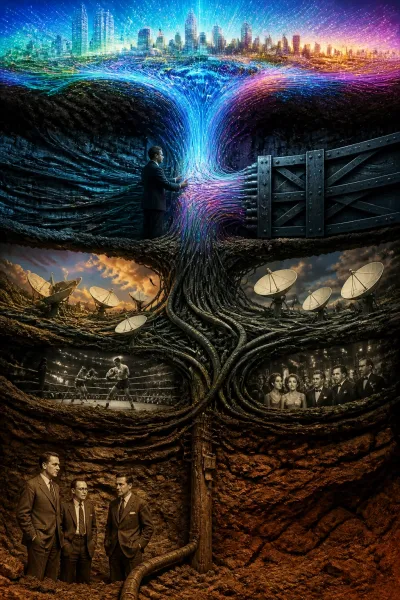
In July 2001, Comcast was a respected but second-tier cable operator with 6.5 million subscribers. AT&T Broadband, by contrast, was the colossus of the industry—14 million customers, a sprawling national footprint, and the backing of the most storied name in American telecommunications. It was also a disaster. The division had bled money since AT&T stitched it together from the $48 billion purchase of TCI and the $58 billion acquisition of MediaOne. Customer service was abysmal. The network was a patchwork of incompatible systems. AT&T's board wanted out.
The Setup: AT&T's Troubled Empire
AT&T's foray into cable had begun with grand vision. CEO C. Michael Armstrong believed the future belonged to "bundling"—local phone, long distance, cable TV, and broadband all on one bill. To get there fast, AT&T bought the two largest cable companies in the country in back-to-back years. But integrating TCI and MediaOne proved far harder than the spreadsheets predicted. The two systems used different billing platforms, different headend equipment, different management cultures. Technicians in one region couldn't read the schematics in another. Call centers were overwhelmed. By early 2001, AT&T Broadband was losing subscribers and burning cash, and Armstrong was under intense pressure to reverse course.
Comcast watched from Philadelphia. Under Brian Roberts, who had succeeded his father Ralph as CEO in 2002 but was already running day-to-day operations, the company had spent the 1990s methodically assembling regional clusters—Maclean Hunter, Scripps Howard, dozens of smaller systems—while quietly building a broadband business that was already the industry's most advanced. Roberts saw AT&T's misery as a once-in-a-generation opening. The assets were flawed, but the scale was irreplaceable. Owning AT&T Broadband would instantly make Comcast the largest cable company in America, with unmatched leverage over programmers and a coast-to-coast broadband platform.
The Audacious Bid and Bidding War
On July 25, 2001, Comcast fired a shock across the industry: an unsolicited, all-stock offer valued at $40 billion for AT&T Broadband. It was a bold move for a company half the target's size. AT&T's board initially rebuffed the approach, preferring to explore a spin-off or a sale to a more "natural" buyer. But the list of natural buyers was short. Cox Communications kicked the tires. AOL Time Warner, itself in the midst of a historic merger, circled. The Wall Street Journal called it "the most coveted damaged asset in corporate America."
Comcast refused to walk away. Roberts and his longtime financial architect, Julian Brodsky, structured successive bids that addressed AT&T's concerns about tax treatment and shareholder value. The negotiations stretched through the summer and fall, played out in proxy filings and press leaks. AT&T's advisors ran a formal auction process. In December, after months of brinkmanship, Comcast prevailed with a final offer of approximately $72 billion including assumed debt—an all-stock transaction that made AT&T shareholders the largest holders of Comcast stock.
The deal closed in November 2002 after regulatory review. Overnight, Comcast's subscriber base tripled to 22 million video customers and 3.3 million broadband users. It became the undisputed leader in both cable and high-speed internet, with a footprint covering 38 states and the District of Columbia.
The Integration Nightmare
Signing the agreement was the easy part. What followed was, in the words of one Comcast executive, "the hardest operational challenge any telecom company has ever faced." AT&T Broadband's 14 million homes were served by a chaotic mix of legacy TCI and MediaOne systems, layered atop AT&T's own botched integration attempts. Billing platforms didn't talk to each other. Network maps were incomplete or wrong. Customer service metrics were among the worst in the industry. Comcast inherited 30,000 employees from a culture defined by bureaucratic inertia and deployed them alongside its own entrepreneurial, engineering-driven workforce.
The integration plan was ruthless and methodical. Comcast froze new feature development on AT&T systems and poured capital into a "rebuild" program: replacing outdated amplifiers, pulling fiber deeper into neighborhoods, standardizing on a single billing platform, and retraining every call-center agent. Technicians were given tablets with unified diagnostics. A centralized "network operations center" in Denver began monitoring the entire footprint 24/7. The company spent billions—on top of the purchase price—over three years. Customer satisfaction scores, initially plummeting from the disruption of conversion, began a slow, steady climb.
Cultural friction was equally real. AT&T veterans accustomed to multi-layered approval processes clashed with Comcast managers who expected decisions in hours. Roberts held town halls across the combined territory, repeating a simple message: "We are not AT&T. We are Comcast. Here is how we operate." Key AT&T leaders were retained where they added value; others were gently moved out. By 2005, the integration was substantially complete. The combined company was leaner, faster, and—critically—profitable.
What It Built
The AT&T Broadband acquisition did more than double Comcast's size. It gave the company the scale to negotiate programming contracts that smaller rivals couldn't match, the density to justify massive broadband upgrades, and the cash flow to fund the next wave of bets: the NBCUniversal purchase in 2011, the Sky acquisition in 2018, the launch of Peacock. It turned a regional cable operator into the platform that would define the broadband era.
Today, when a customer in Seattle streams a 4K movie over an Xfinity connection, or a family in Philadelphia bundles mobile service with gigabit internet, they are using infrastructure whose national reach was forged in that 2001 gamble. The deal was risky, expensive, and grueling. It also worked. Comcast bet the company on a broken giant—and built the industry's backbone from the pieces.
This is one episode in a much longer story. For the full account of the history of Comcast, read “A History of Comcast” by Brenda S. Howard on MixCache.com.
Please log in or create an account to leave a comment.
No comments yet. Be the first to say something.