
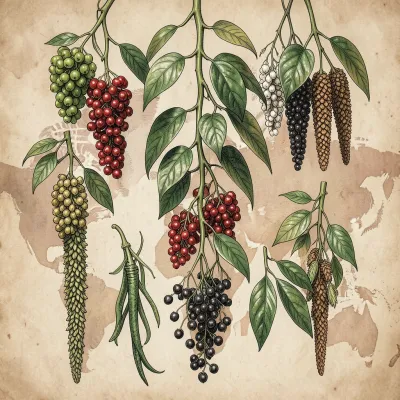
In 1968, a single government notice made a centuries-old spice vanish from American kitchens. The Food and Drug Administration had flagged a compound called herculin, a cousin of the molecule that gives Sichuan pepper its signature electric tingle, as a potential toxin. Overnight, the rust-colored husks known as huājiāo — flower pepper — became contraband. For 37 years, the numbing heart of Sichuan cuisine was legally absent from the United States.
The ban did not merely restrict an ingredient; it severed a culinary lineage. Sichuan pepper had seasoned Chinese dishes for at least two millennia. It appears in Tang dynasty tribute records and anchors the málà flavor profile — the interplay of numbing (má) and spicy (là) — that defines the region's cooking. In the humid subtropics of Sichuan province, the tingling sensation was traditionally believed to balance the heaviness of garlic and chili. But American regulators saw only a chemical structure that resembled a neurotoxin.
The Shrub Behind the Sensation
The spice comes not from a vine but from a thorny deciduous shrub, Zanthoxylum piperitum (and its close relatives Z. simulans and Z. bungeanum), a member of the citrus family Rutaceae. The plant bears tiny fruits that split open at maturity to reveal a single black seed. The seed is discarded; the dried husk is the prize. When crushed, it releases hydroxy-alpha-sanshools, compounds that activate mechanoreceptors — nerves that normally respond to touch and vibration — creating the illusion that the tongue is buzzing. It is not heat, not pain, not cold. It is a tactile phantom, a paraesthesia that fades in minutes, leaving a floral, citrusy aftertaste.
European cooks encountered the spice without restriction. In Paris, London, and Berlin, Chinese communities and specialty shops kept it in stock through the decades of the American ban. But in the United States, the prohibition was absolute. The FDA's 1968 import alert detained every shipment at the border. No exceptions were made for culinary use, no threshold established for safe consumption. The spice simply ceased to exist in the legal American food supply.
A Cuisine Muted
Without huājiāo, authentic Sichuan food could not be replicated. Cooks substituted black pepper or omitted the numbing element entirely, producing dishes that were spicy but lacked the dimensional counterpoint that defines the regional style. The málà balance collapsed into simple là. For a generation of American diners, Sichuan cuisine arrived pre-muted, its most distinctive voice silenced by a regulatory decision made before most of them were born.
The ban also stalled scientific curiosity. The sanshools' unique action on mechanoreceptors offered a rare tool for neuroscience — a way to stimulate touch pathways chemically. But with the spice illegal, American researchers had no easy access to the compound. European labs, unbound by the restriction, advanced the study of tactile perception while their U.S. counterparts waited.
The Long Road Back
Pressure to reconsider mounted slowly. By the 1990s, Sichuan restaurants were proliferating in American cities, and a growing cohort of chefs and food writers demanded the real thing. The FDA commissioned a comprehensive toxicological review. Studies showed that herculin and the sanshools, at the concentrations found in culinary portions, produced no adverse effects in animal models. The estimated human exposure from even heavy culinary use fell orders of magnitude below any observed threshold of toxicity.
In 2005, the FDA quietly lifted the import alert. No press conference, no fanfare — just a Federal Register notice rescinding the 1968 decision. The husks could once again cross the border legally.
The Resurgence
The return was immediate. Within months, Sichuan peppercorns appeared in high-end grocers, then mainstream supermarkets. Chefs who had memorized the flavor from trips abroad or contraband stashes began deploying it openly. The spice rode the wave of a broader American embrace of regional Chinese cooking, moving from restaurant kitchens into cocktail bars, chocolate shops, and ice cream parlors. Bartenders muddled it into old fashioneds; pastry chefs folded it into ganache. The electric tingle became a trend.
Neuroscientists, too, returned to the compound. Sanshool became a standard probe in studies of somatosensory processing, its ability to induce a reliable, reversible tingling making it invaluable for mapping how the brain interprets touch.
A Footnote in the Spice Cabinet
Today, a jar of Sichuan peppercorns sits unremarkably on spice shelves across the country. Few buyers know it was once forbidden. The ban left no plaque, no museum exhibit, only a 37-year gap in the American palate — a generation that grew up tasting Sichuan food without its defining note. The spice itself never changed. The shrubs in Sichuan, Chongqing, and Yunnan kept flowering, fruiting, and splitting their husks. The tingling molecule kept binding to mechanoreceptors. Only the law had mistaken a sensation for a threat, and only science, belatedly, corrected the error.
This is one episode in a much longer story. For the full account of the global history and trade of pepper, read “For the Love of Pepper” by Peter Ferguson on MixCache.com.
Please log in or create an account to leave a comment.
No comments yet. Be the first to say something.