
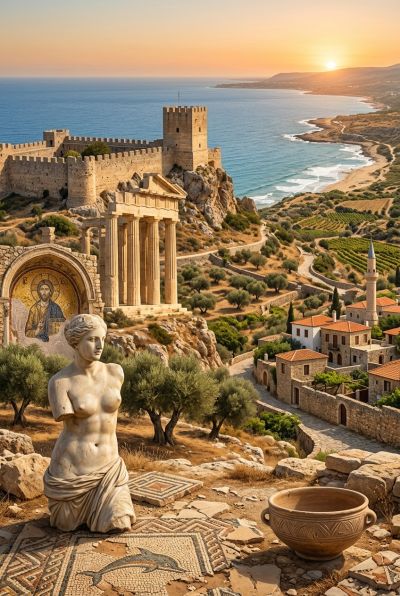
There are places where history isn't past at all — it's the ground you walk on, the checkpoint you cross, the cheese you eat. Cyprus is one of them. Giorgos Ioannou's Cyprus: A History doesn't just recount events; it demonstrates how ten millennia of conquest, migration, and adaptation have produced a society where every political argument is also an argument about identity.
What the book is about
The book spans 25 chapters, moving chronologically from the pygmy hippos of the Pleistocene to the reopening of Varosha's beachfront in 2020. Ioannou structures the narrative around the island's shifting relationships with the powers that surround it — Assyria, Egypt, Persia, Rome, Byzantium, the Crusader states, Venice, the Ottomans, Britain, Greece, Turkey, and the European Union. Each chapter blends archaeological evidence, literary sources, and diplomatic records. The intended reader is someone who wants to understand not only what happened but why the island's present — its divided capital, its suspended EU acquis, its competing national narratives — looks the way it does. No prior knowledge is assumed, but the density of detail rewards close attention.
Geography as a recurring protagonist
Ioannou returns repeatedly to the idea that "geography, as the saying goes, is destiny." The introduction frames Cyprus as a "maritime crossroads of Europe, Asia, and Africa," and every subsequent era illustrates the claim. In Chapter 2, the Late Bronze Age kingdom of Alashiya leverages its copper to correspond with Pharaohs and Hittite kings as an equal. Chapter 11 shows Venetian engineers rebuilding Nicosia's walls into a perfect circle of eleven heart-shaped bastions — a "masterpiece of geometrical precision" designed for gunpowder warfare — only to lose the island to the Ottomans within three years. The pattern repeats in Chapter 13, where Britain acquires Cyprus not for its own sake but as a "pawn in the Great Game" to counter Russia. Even the 2011 discovery of the Aphrodite gas field (Chapter 25) reignites the same dynamic: "Turkish warships began to harass exploration vessels," turning the EEZ into "one of the most militarized and volatile maritime zones in the world."
Hellenic identity forged through synthesis, not purity
One of the book's most compelling arguments is that Cypriot Hellenism emerged from mixing, not isolation. Chapter 3 describes how Achaean settlers fused their gods with the pre-existing "Wanassa" fertility goddess, creating the Paphian Aphrodite who "retained many of her pre-Greek, eastern characteristics" and was worshipped as a conical stone. The Cypriot syllabary — a homegrown script where anthropos became a-to-ro-po-se — persisted for nearly a thousand years alongside the Greek alphabet. Chapter 5 shows Evagoras I deliberately promoting the Greek alphabet to align Salamis culturally with Athens, while Chapter 9 notes that the Arab-Byzantine condominium allowed the local dialect to develop "its own distinct characteristics, absorbing linguistic influences from its neighbours while retaining archaic forms lost elsewhere." Ioannou presents identity as something negotiated, not inherited.
Religion as both anchor and fault line
The island's religious history reads like a layer cake. Chapter 1 uncovers a 9,500-year-old human–cat burial at Shillourokambos — "predating Egyptian evidence for cat domestication by several millennia." Chapter 7 records Titus consulting the oracle at Aphrodite's sanctuary in 69 A.D., where "blood sacrifices were forbidden on her altar." Chapter 8 details how Paul and Barnabas converted the proconsul Sergius Paulus, making Cyprus "the first country to be governed by a Christian official." Chapter 12 explains the Ottoman millet system: the Orthodox Church was restored as the Greek community's political representative, its Archbishop becoming "Ethnarch, the political representative and chief tax collector." Chapter 24 observes that today the cheese known as Halloumi to Greek Cypriots and Hellim to Turkish Cypriots received a joint PDO designation in 2021 — a "mini-reunification laboratory" requiring Turkish Cypriot producers to meet EU standards under international inspection. Faith and ritual have alternately unified and divided the island's peoples.
The 1974 catastrophe and its long shadow
Chapters 18 and 19 form the emotional core of the modern narrative. Ioannou recounts the July 15 coup — "Operation Aphrodite" — launched by Greek junta officers against Makarios, followed five days later by Turkey's "Operation Attila." The second phase in August seized 37 percent of the island in three days. The human cost: 160,000–180,000 Greek Cypriot refugees fleeing south, 40,000–50,000 Turkish Cypriots moving north, and massacres at Maratha, Santalaris, and Aloda. Nicosia became "the world's last divided capital," its Green Line hardening from a grease-pencil ceasefire mark into a 180-kilometer buffer zone. The 1975 Vienna Agreement formalized population exchange, and the 1983 declaration of the Turkish Republic of Northern Cyprus — recognized only by Turkey — cemented the partition. Ioannou's prose is restrained but the details accumulate: Varosha's high-rise hotels "left to decay into a ghost town," the Ledra Palace Hotel "scarred by mortar fire" becoming a UN barracks.
Missed settlements and the exhausted peace process
Chapter 22's account of the Annan Plan referendum is a masterclass in how not to build consensus. The UN Secretary-General's team produced a 9,000-page final version after the parties failed to agree at Bürgenstock. In the north, Mehmet Ali Talat led euphoric "Yes be annem!" rallies; 64.9 percent voted yes. In the south, President Tassos Papadopoulos told voters "I have received a state. I will not deliver a community"; 75.8 percent voted no. The EU's 2004 accession brought the whole island in legally but suspended the acquis north of the Green Line. Chapter 25 shows the subsequent Crans-Montana conference (2017) collapse over the same core issue: Turkey's refusal to relinquish "its right of intervention entirely." The book ends with three stark alternatives — federation, two-state solution, or "slow, creeping partition" — and no consensus on which is viable.
Who should read this
Readers who want a single volume that connects the Neolithic cat burial to the 2013 bail-in will find it indispensable. The book assumes no specialist background but does not simplify; its 25 chapters demand patience with diplomatic minutiae (the 1960 constitution's 70:30 ratios, the Annan Plan's rotating presidency). Those looking for a light travelogue or a partisan argument should look elsewhere. For anyone trying to understand why a Mediterranean island of fewer than a million people has defied settlement for half a century, Ioannou provides the context — archaeological, political, and human — that makes the present intelligible.
Read “Cyprus” on MixCache.com →
Please log in or create an account to leave a comment.
No comments yet. Be the first to say something.