
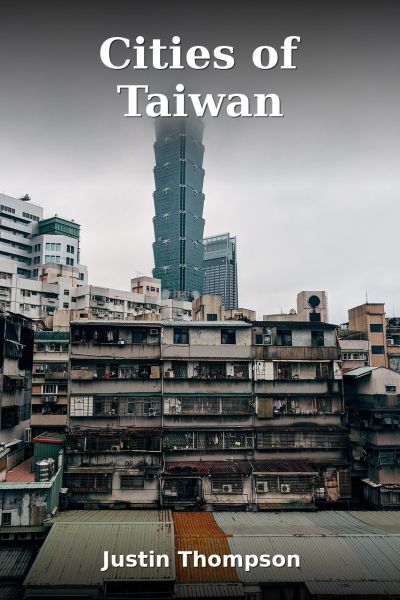
Taiwan's cities don't just sit on the landscape; they grew from it. Justin Thompson's "Cities of Taiwan" traces how a jagged mountain spine, deep-water harbors, and tectonic restlessness directed where people settled, traded, and built — and how Dutch forts, Japanese boulevards, and semiconductor campuses later rewrote those same streets. The result is a book that reads like a conversation between a geographer, a historian, and a very well-fed traveler.
What the book is about
"Cities of Taiwan" spans 25 chapters organized as a layered atlas. The first four chapters establish the physical and administrative scaffold: the island's east-west divide, the six Special Municipalities (Taipei, New Taipei, Taoyuan, Taichung, Tainan, Kaohsiung) plus smaller cities and counties, and a chronological sweep from indigenous settlements through Dutch, Qing, Japanese, and post-war eras. Chapters 5–21 then devote focused sections to each major city — two or three chapters apiece for Taipei, New Taipei, Taoyuan, Taichung, Tainan, Kaohsiung, Hsinchu, Keelung, and Chiayi — covering landmarks, districts, food, and cultural rhythms. Chapter 22 surveys lesser-known cities and counties (Changhua, Pingtung, Miaoli, Yilan, Hualien, Taitung, Nantou). The final three chapters zoom out to night-market culture, urban sustainability and smart-city initiatives, and practical itineraries with transport tips. The intended reader is someone who wants both context and coordinates: enough history to understand why a temple sits where it does, plus the MRT stop to reach it.
Geography as the first urban planner
Thompson opens with a clear thesis: "The majority of Taiwan's major cities and its densest populations are, quite logically, concentrated in the more accessible western part of the island." Chapter 1 walks through the central mountain range — peaks over 3,500 meters — as a barrier that funneled settlement onto western coastal plains and river valleys. The Tamsui River enabled Taipei's early trade; the Love River shaped Kaohsiung's industrial core; the Zhuoshui and Zengwen rivers fed the Chianan Plain that sustains Tainan and Chiayi. Climate splits north (humid subtropical) from south (tropical savanna), influencing everything from building materials to night-market seasons. The book returns to this geographic determinism in later city chapters, showing how Taichung's "mild year-round climate" earned its "most livable city" reputation and how Hsinchu's northeastern monsoons — the "Windy City" nickname — once dried rice and now cool semiconductor campuses.
Colonial layers written into street grids
Chapter 3 and Chapter 4 together read like an archaeological cross-section. The Dutch built Fort Zeelandia and Fort Provintia in Tainan on a "grid-like layout" that became the city's nucleus. Koxinga's Kingdom of Tungning added Confucian axial planning. The Qing shifted the capital north to Taipei, laying "wider streets" and formal government buildings. But the Japanese era (1895–1945) left the deepest structural imprint: "72 cities and towns across the island underwent significant planning and redevelopment," including the "Taichung City Design Plan" whose "chessboard-like street grid" still defines downtown. Japanese planners introduced "wide boulevards, public parks, and a rational organization of land use" plus railway and port infrastructure that Kaohsiung and Keelung still rely on. Post-war急速 urbanization then overlaid organic sprawl onto these grids, a tension visible today in Taipei's contrast between "labyrinthine narrow streets" of Wanhua and the "gleaming skyscrapers" of Xinyi.
Administrative lines vs. lived metropolitan regions
Chapter 2 makes a distinction that matters for any visitor: the six Special Municipalities are first-level divisions with "greater budgetary independence and broader administrative authority," while cities like Hsinchu, Keelung, and Chiayi and the 13 counties operate under a different framework. Yet daily life ignores these lines. The "Taipei–Keelung metropolitan area" functions as a single urban entity of nearly 7 million; the "Taoyuan–Zhongli region" and "Taichung–Changhua area" similarly bleed across borders. Thompson notes that "the daily commute for millions of Taiwanese often involves traversing these administrative boundaries, underscoring the functional unity of these larger metropolitan zones." This matters practically: MRT lines, bike-share systems, and bus networks integrate across city lines, and the book's itineraries in Chapter 25 are built around these functional regions rather than administrative ones.
Night markets as civic infrastructure
Chapter 23 treats night markets not as tourist attractions but as "vibrant cultural institutions, essential to the rhythm of urban life." Thompson traces their evolution from temple-adjacent peddlers to post-war worker canteens to today's "unique cultural characteristic of people's nightlife." He catalogs the taxonomy: "over 70 across the island, with more than 30 in Taipei alone." Each city's markets reflect local identity — Taipei's Shilin for scale, Raohe for pepper buns, Ningxia for oyster omelets; Taichung's Fengjia for student energy; Tainan's Flower Night Market for "dan zi mian" and "coffin bread"; Kaohsiung's Liuhe for seafood and Ruifeng for carnival games; Yilan's Luodong for green onion cakes; Hualien's Dongdamen for indigenous flavors. The chapter argues that the "snacking culture" of small, affordable portions encourages sharing and makes markets "communal feast[s]" rather than mere commerce.
Smart cities and sustainability as the next planning chapter
The book's final act pivots from heritage to forward-looking policy. Chapter 4 introduces the "smart cities" concept as "a holistic approach to accelerate the application of digital services and improve the overall quality of life." Chapter 11 details the Taoyuan Aerotropolis — 4,564 hectares around Taiwan Taoyuan International Airport planned with "5G and IoT to create a smart operations management platform," "smart streetlights," and "common utility tunnels." Chapter 17 describes Kaohsiung's "city-built AI platform in collaboration with international partners to enhance digital governance and technological resilience" and its Net-Zero Urban Development Ordinance targeting 2050. Chapter 24 synthesizes these into a national framework: the Urban Planning Act now mandates "sustainable land use, the creation of green spaces, disaster mitigation, and urban-rural integration." Thompson is clear-eyed about persistent gaps — housing affordability, traffic in less-served areas, industrial pollution in older zones — but presents the trajectory as deliberate: "The trajectory of urban sustainability in Taiwan is an ongoing narrative, one of constant innovation, thoughtful adaptation, and an unwavering vision for a better urban future."
Who should read this
Travelers planning a first or return trip will get the most mileage: the city-by-city chapters double as annotated guides with neighborhood breakdowns, landmark context, and food specifics. Urbanists and planning students will appreciate the comparative framework — how colonial grids, post-war sprawl, and smart-city pilots stack up across a single island. Readers who want a pure narrative history or a lightweight picture book should look elsewhere; this is a working reference that rewards dipping in by city or theme rather than cover-to-cover reading. For anyone trying to understand why Taiwan's cities feel simultaneously ancient and hyper-modern, "Cities of Taiwan" connects the tectonic plates to the bubble-tea stall.
Read “Cities of Taiwan” on MixCache.com →
Please log in or create an account to leave a comment.
No comments yet. Be the first to say something.