
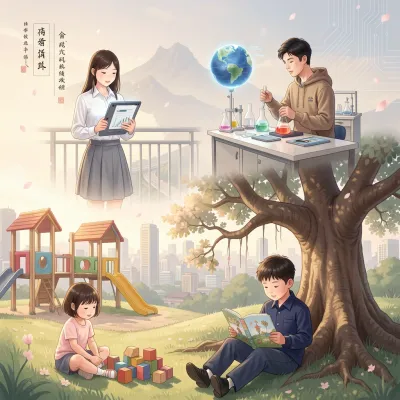
Taiwan's educational reputation often rests on its students' top-tier math and science scores, but the machinery behind those results is far more textured than test rankings suggest. David Phillips' Education In Taiwan unpacks a system shaped by Confucian ethics, Japanese modernization, KMT centralization, and now a deliberate push toward bilingualism and AI-assisted learning — all while grappling with a plummeting birth rate and the mental-health toll of relentless competition.
What the book is about
The book runs 25 chapters, moving chronologically from indigenous oral traditions through Dutch, Qing, Japanese, and KMT eras before dissecting every current tier: early childhood (Ch 3–4), six-year primary (Ch 5–6), three-year junior high (Ch 7–8), the split academic/vocational senior high (Ch 9–10), and a sprawling higher-education sector (Ch 11–14). Cross-cutting chapters cover teacher preparation (Ch 15), special and indigenous education (Ch 16–17), English/internationalization (Ch 18), ed-tech (Ch 19), private/cram-school influence (Ch 20), funding/governance (Ch 21), parent/community roles (Ch 22), reform pressures (Ch 23), global collaboration (Ch 24), and future scenarios (Ch 25). Phillips writes for policymakers, comparative-education scholars, and practitioners who want a single, evidence-rich reference rather than a polemic.
Historical layering that still drives today's classroom
Phillips shows how each regime left sediment. The Qing embedded the civil-exam meritocracy; the Japanese built the first modern school infrastructure and introduced science curricula; the KMT imposed Mandarin-only instruction and a centralized, exam-centric model that "fostered excellence and produced a highly educated workforce that would be crucial for Taiwan's economic 'miracle,'" while also cementing "significant pressure on students and a curriculum often criticized for its rigidity and rote memorization" (Ch 1). Democratization in the 1990s triggered reforms to "reduce the burden of examinations, promote a more student-centered approach, introduce a wider range of subjects, and encourage critical thinking and creativity." Understanding this palimpsest explains why today's teachers still command high respect, why parents equate schooling with family honor, and why the Ministry of Education (MOE) retains tight curriculum control even as it experiments with decentralization.
The academic/vocational split is not a dead end — it's a lattice
Chapter 9 and 10 dismantle the stereotype that vocational tracks are second-tier. After the Comprehensive Assessment Program (CAP) at the end of junior high, students choose academic senior high (university prep) or vocational senior high (industry-aligned skills). Vocational students can continue to five-year junior colleges, two-year junior colleges, or technical universities that award bachelor's through doctoral degrees. The text notes "permeability within the system challenges the traditional notion of a strict divide between academic and vocational education, providing upward mobility for those who choose a technical path" (Ch 10). Industry advisory boards shape curricula, internships are mandatory, and national skill certifications give graduates labor-market currency. Meanwhile, new "comprehensive senior high schools" let students mix academic and vocational credits before committing — a pragmatic response to the "societal preference for the academic track" that the government is actively trying to rebalance.
Entrance exams: the engine, the anxiety, and the slow redesign
The CAP (Ch 8) and the university-level GSAT/AST (Ch 12) remain the system's gatekeepers. Phillips details how the CAP moved from a single high-stakes test to a graded proficiency model (A/B/C with A++, A+ modifiers) and how universities now blend three pathways: exam-based placement, individual application (portfolios + interviews), and the "Star Plan" reserving slots for top students from underrepresented high schools. Yet the "cram school" (buxiban) ecosystem persists because "the cultural emphasis on academic success often means parents feel compelled to provide their children with extra help" (Ch 12). The book doesn't romanticize this; it lays out the trade-offs: transparency and perceived fairness versus narrowed pedagogy and adolescent burnout.
Indigenous education as self-determination, not add-on
Chapter 17 is a standout. The 2005 Indigenous Peoples Basic Law mandated mother-tongue instruction and community-controlled "indigenous experimental schools" where "traditional weaving techniques [enter] mathematics lessons by exploring geometric patterns" and elders co-teach botany via medicinal plants. Phillips emphasizes that these schools "serve as living laboratories for indigenous education" rather than token gestures. The MOE and Council of Indigenous Peoples now co-fund language revitalization, teacher scholarships, and culturally responsive materials. The chapter makes clear that success is measured not only in test scores but in "indigenous language proficiency rates, cultural engagement, and a strong sense of indigenous identity."
Bilingual nation, AI tutors, and the demographic cliff
The final chapters connect today's policy bets. The "bilingual nation" drive (Ch 18) aims to embed English in daily life and government services, not just English class — recruiting foreign teachers, funding immersive programs, and converting university courses to English-medium instruction. Simultaneously, the MOE's "Smart Learning Program" (Ch 19) is piloting adaptive AI tutors, VR science labs, and learning-analytics dashboards to personalize instruction at scale. But the demographic backdrop is stark: "Taiwan has experienced one of the lowest birth rates in the world, leading to a rapidly shrinking student population" (Ch 23). Private universities face closure; rural schools consolidate. Chapter 25 argues the system's survival hinges on redefining "student" to include lifelong learners, exporting TVET models abroad, and turning schools into community hubs that serve all ages.
Who should read this
Researchers designing cross-national studies will appreciate the granular policy timelines and statutory references. Education-technology founders can mine the ed-tech adoption history and current procurement structures. Teachers and administrators in bilingual or vocational programs will find concrete analogs for curriculum integration. General readers looking for a narrative memoir of school life should look elsewhere — this is a structural anatomy, not a classroom ethnography. For anyone needing to understand how a high-performing system attempts to rewrite its own operating system without collapsing, Phillips delivers the blueprint, tensions and all.
Read “Education In Taiwan” on MixCache.com →
Please log in or create an account to leave a comment.
No comments yet. Be the first to say something.