
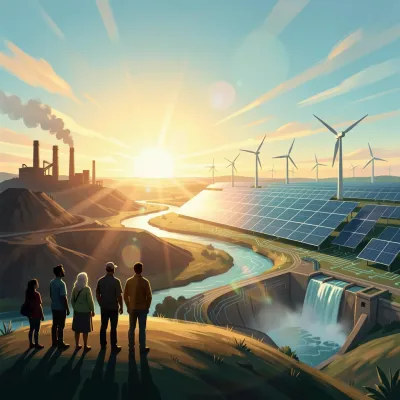
William Nichols’ The Rise of Renewable Energy Worldwide arrives at a moment when clean power is no longer a niche idea but a central force in global economics and climate policy. The book treats the transition from fossil fuels to solar, wind, and water not as a single technology story but as a sweeping reorganization of how societies produce, store, and distribute energy. Nichols avoids both hype and doom, offering instead a measured look at what the shift requires and what it can deliver. For readers trying to decide whether the transition is credible, how its pieces fit together, or what their own role might be, the book provides a roadmap built on engineering, case studies, and policy analysis.
What the book is about
Nichols organizes the book into twenty-five chapters that move from urgency to action. The subtitle, How Solar, Wind, and Water Power Are Changing the Planet, signals the scope: a global survey rather than a regional or single-technology study. The opening sections establish why the change is necessary, tracing energy history from wood and waterwheels through coal, oil, and the Industrial Revolution, then detailing the environmental and economic costs of greenhouse-gas emissions, air pollution, and energy insecurity. The middle chapters dive into the technical mechanics of solar photovoltaics and concentrated solar power, wind turbine aerodynamics, hydropower from large dams to pumped storage, and emerging sources such as geothermal, bioenergy, wave, and tidal. Later sections address integration—smart grids, demand response, virtual power plants, and storage technologies—before turning to transportation, industry, policy, economics, social equity, and environmental benefits. Global case studies, including Germany’s Energiewende, UK offshore wind, Iceland’s geothermal, China’s scale, Brazil’s bioenergy, Denmark’s wind, and Morocco’s concentrated solar power, anchor the arguments in real-world examples. The intended reader is someone who wants more than a headline: a general reader, student, or professional curious about how renewable systems actually function and what obstacles remain.
The fossil-fuel inheritance and the case for urgency
Nichols does not treat renewables as merely a nicer alternative; he frames them as a response to what he calls a “Faustian bargain” with coal, oil, and gas. Chapter One lays out the climate, health, and security costs in concrete terms: melting glaciers, ocean acidification, extreme weather, and volatile fossil-fuel markets. The text emphasizes that burning fossil fuels releases particulate matter, sulfur dioxide, nitrogen oxides, and carbon dioxide, with direct links to respiratory illness and cardiovascular disease. Chapter Two then provides the historical arc, noting that Svante Arrhenius theorized as early as the late 19th century that burning coal could warm the planet, and that the 1970s oil crises first exposed the geopolitical risks of import dependence. Nichols also points to “externalities”—the healthcare costs of air pollution, the expenses of oil-spill cleanup, and the long-term societal costs of climate adaptation—that are rarely reflected in the price at the pump. The takeaway is that the renewable shift is not optional lifestyle tweaking but a structural response to finite resources and accumulating hidden costs. Readers come away with a clear framework for why the transition matters beyond abstract environmentalism.
How solar, wind, and water actually work
The technical core of the book occupies Chapters Three through Eight, and Nichols avoids hand-waving. He explains that every day, the sun showers the Earth with more energy than humanity could consume in an entire year if it captured just a fraction, and he details how photovoltaic cells rely on p-n junctions in doped silicon to turn photons into electrons. Wind power is described through blade aerodynamics, pitch and yaw control, gearboxes, and the shift from small “wind chargers” to offshore turbines exceeding fifteen megawatts. Hydropower is covered from conventional dams with Francis, Kaplan, and Pelton turbines to run-of-river, small hydro, and pumped storage, which Nichols emphasizes for its “dispatchability and role as a grid-scale battery.” Emerging sources such as geothermal, bioenergy, wave, and tidal receive dedicated chapters as well, rounding out a portfolio that Nichols presents as complementary rather than competitive. These sections give a reader enough detail to understand capacity factors, intermittency, and why no single renewable source can carry the load alone.
Storage, smart grids, and making variable power reliable
A central argument is that generation is only half the battle. Chapter Eleven presents the smart grid as a “two-way digital network” that enables distributed generation, demand response, and real-time balancing between supply and consumption. Chapter Twelve examines storage solutions—lithium-ion batteries, flow batteries, compressed air, hydrogen, and thermal storage—emphasizing that without them, “the ambitious dream of a truly renewable-powered planet would remain just that: a dream.” Pumped hydro storage gets particular attention for its round-trip efficiency and ability to shift energy across hours or days, while green hydrogen is positioned as a long-duration storage medium and industrial feedstock. The book also covers vehicle-to-grid technology, where electric vehicles can feed power back into the grid during peak demand. The practical takeaway is that renewables succeed not because solar panels are cheap in isolation, but because the system around them—storage, transmission, and software—is becoming intelligent enough to manage variability.
Policy, jobs, equity, and the just transition
Nichols devotes substantial space to the human and political dimensions. Chapter Fifteen surveys renewable portfolio standards, feed-in tariffs, tax incentives, carbon pricing, and international agreements, noting how policy has shifted from subsidies toward competitive auctions as costs fall. Chapter Sixteen cites the International Renewable Energy Agency’s finding that the global renewable sector employed over 12 million people in 2020, framing clean energy as an engine of green growth and price stability. Chapter Seventeen stresses that the transition must be just: retraining fossil-fuel workers, community ownership, Indigenous rights, and equitable access to clean energy. The book does not romanticize the shift; it acknowledges land-use conflicts, wildlife impacts, and material supply chains as genuine challenges that require planning, transparent siting, and inclusive decision-making. The result is an argument that the renewable transition is as much a social and economic project as a technical one.
Future scenarios and the role of the individual
The final chapters look toward a 100 percent renewable future and ask what each person can do. Nichols envisions expanded storage, smart-grid intelligence, intercontinental transmission, sector-wide electrification, and sustainable fuels as the backbone of a fully renewable system. Chapter Twenty-Four turns to individual action, listing rooftop solar, electric vehicles, energy efficiency, community solar, and advocacy as concrete steps that maintain momentum. He also notes the rise of “prosumers”—households that both consume and produce electricity—and the potential for vehicle-to-grid technology to turn parked cars into mobile storage. The tone is realistic rather than utopian: the path forward depends on sustained R&D, adaptive policy, and broad public engagement, not on waiting for a single breakthrough. Readers finish with a sense of the scale required and the specific levers available to households and communities.
Who should read this
This book will reward readers who want a comprehensive, chapter-by-chapter survey of the renewable energy landscape rather than a polemic or a purely technical manual. It suits nonfiction readers interested in climate policy, energy economics, or sustainable technology, as well as professionals looking for context outside their own specialty. Readers seeking deep mathematical modeling of grid integration or a narrative-driven environmental story may find it too broad, but anyone trying to decide whether the renewable transition is credible, how its pieces fit together, and what individual actions can do will find it a solid, well-sourced starting point. The ebook is available on MixCache.com under Book ID 17766.
Read “The Rise of Renewable Energy Worldwide” on MixCache.com →
Please log in or create an account to leave a comment.
No comments yet. Be the first to say something.