
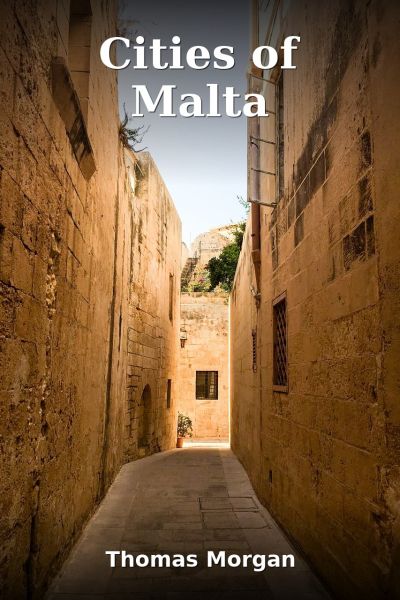
Malta's cities are not just places people live; they are arguments made in limestone about survival, faith, and power. Thomas Morgan's Cities of Malta treats the archipelago's urban landscape as a single, continuous document — one written by Phoenician traders, Roman administrators, Arab planners, Norman lords, the Knights of St. John, French revolutionaries, British engineers, and the Maltese themselves. The result is a rare guidebook that reads like a history of the Mediterranean told through its most contested crossroads.
What the book is about
Cities of Malta spans 25 chapters, moving chronologically from prehistoric temple builders to a practical visitor's guide for modern travelers. The first half traces urbanization across eras — Phoenician Melite (Chapter 2), Roman Maleth (Chapter 3), Arab Medina and Norman transitions (Chapter 4), medieval town life (Chapter 5) — before pivoting to the Knights' transformation of the Grand Harbour (Chapters 6–8) and the planned creation of Valletta (Chapter 7). Individual cities then receive dedicated chapters: Mdina and Rabat (9–10), Żabbar (11), Siġġiewi (12), Qormi (13), Żejtun (14), Victoria on Gozo (15), and a survey of other towns (16). Thematic chapters cover the Baroque flourishing (17), British infrastructure (18), religious influence (19), local governance (20), daily urban culture (21), preservation efforts (22), modern challenges (23), tourism pressures (24), and a visitor's guide (25). The book assumes no prior knowledge but rewards readers who want to connect specific streets, churches, and fortifications to the forces that built them.
Geography as urban destiny
The book's opening chapter makes a thesis that echoes through every subsequent page: Malta's cities exist because of where the islands sit. "Its geographical coordinates alone tell a compelling story: approximately 93 kilometers south of Sicily, 288 kilometers east of Tunisia, and 333 kilometers north of Libya," Morgan writes. "This isn't just a cluster of rocks; it's a natural stepping stone." The Grand Harbour and Marsamxett Harbour offered shelter for entire fleets, making the islands a "choke point" and "geographical leverage point" for Phoenicians, Romans, Arabs, Normans, Knights, French, and British alike. This strategic imperative dictated where cities formed — Mdina on a defensible hilltop, Birgu and Senglea on harbour peninsulas, Valletta on the Sciberras peninsula commanding both harbours — and why each new ruler rebuilt rather than relocated. The urban map is, in essence, a military map.
Layers visible in the street plan
One of the book's quiet pleasures is showing how different eras left their street grids intact. The Arab period "reduced its footprint, creating a more compact, intensely fortified core" at Mdina, giving it "its characteristic labyrinthine street plan – narrow, winding alleys designed not just for defence but also to provide shade and a sense of intimate enclosure" (Chapter 9). Valletta, by contrast, was "planned on a strict grid system, a hallmark of Renaissance urban design" where "the straight, wide streets would allow for the rapid movement of troops and artillery" (Chapter 7). Rabat grew organically outside Mdina's walls as a market suburb, its name itself deriving from the Arabic for "suburb" (Chapter 10). The British later "upgraded existing roads, and new ones were laid, often using stone and macadam surfacing" and even built a railway connecting Valletta to Mdina via Birkirkara and Mosta (Chapter 18). Walking any Maltese city today means moving through multiple centuries' logic simultaneously.
The Knights as city-builders, not just fortress-builders
Chapters 6 and 7 reframe the Knights of St. John from military order to urban visionaries. After the Great Siege of 1565, Grand Master Jean de Valette recognized that "the existing fortifications were insufficient. A new, grander, and even more formidable city was needed." The result was Valletta, designed by Pope Pius V's military engineer Francesco Laparelli with "the latest principles of Renaissance military architecture" — a star-fort city whose bastions "were designed to withstand the heaviest artillery bombardments and provide overlapping fields of fire." But the Knights also built "a city of God": St. John's Co-Cathedral, the Auberges for each Langue, the Grand Master's Palace, and a network of churches that made the capital "a bastion of Catholicism, a visual sermon in stone" (Chapter 19). Their governance introduced "a more centralized administration" replacing feudal systems, and their patronage "fostered a period of prosperity and stability that allowed for the growth of smaller towns and villages" (Chapter 6). The book makes clear that the Knights' urban legacy is both the walls and the life within them.
Religion as the organizing principle of every town
Chapter 19 argues that the parish church is "the undeniable focal point for every Maltese town and village. Its sheer physical prominence, with its towering dome and bell towers, often dominating the skyline, made it an unmistakable landmark." This pattern begins early: the prehistoric temples were "monumental architectural achievements that represent the earliest forms of organized community and belief" (Chapter 19), and St. Paul's shipwreck around 60 AD "laid the most enduring religious foundation for Malta's urban development" with the grotto and catacombs in Rabat becoming "cities of the dead" that "offered refuge for worship" (Chapter 3). Under the Knights, Valletta became "a city of God" with St. John's Co-Cathedral as its epitome. Even today, the annual festa — "intense, months-long preparations culminating in days of spectacular street decorations, band marches, processions, and dazzling fireworks displays" — "transforms the urban landscape" and serves as "powerful expressions of communal identity, spiritual devotion, and cultural heritage" (Chapter 21). The church square remains the social nucleus, whether in Mdina's cathedral forecourt or Żejtun's dual churches of St. Gregory and St. Catherine (Chapter 14).
Modern pressures on an ancient framework
The final chapters confront the tension between Malta's density — "one of the highest car ownership rates in Europe" on narrow medieval streets — and its heritage. Chapter 23 notes that "villages that once maintained distinct boundaries are increasingly merging into continuous urban conglomerations," while "the visual impact of this development is undeniable, with cranes dominating many skylines." Tourism, analyzed in Chapter 24, brings "immense opportunities for economic prosperity" but also "significant pressures on infrastructure, heritage, and the very fabric of local life." Valletta's cruise-ship days swell the population for hours; Mdina's "silent" atmosphere strains under tour groups; the Three Cities balance regeneration with "the unique charm and community spirit of these cities." Preservation efforts (Chapter 22) rely on EU-funded projects, the Cultural Heritage Act (2002), and adaptive reuse — "old palazzi in Valletta might become boutique hotels, or former warehouses in the Grand Harbour might be transformed into cultural centres" — but "the balance between conservation and development is a constant point of contention." Climate change adds rising seas and heatwaves to the calculus. The book ends not with solutions but with a clear-eyed assessment of the stakes.
Who should read this
Readers planning a trip to Malta will find the visitor's guide (Chapter 25) practical and the historical context enriching, but the book's real value is for anyone interested in how cities accumulate history in visible form. Urban historians, architecture enthusiasts, and students of Mediterranean geopolitics will appreciate the way Morgan connects strategic geography to street plans, building types, and civic rituals across millennia. Those seeking a light travelogue or coffee-table photo book should look elsewhere — this is a dense, text-driven narrative that demands attention to detail. For the reader willing to follow its layered argument, Cities of Malta offers a master class in reading a landscape as a historical document.
Read “Cities of Malta” on MixCache.com →
Please log in or create an account to leave a comment.
No comments yet. Be the first to say something.