
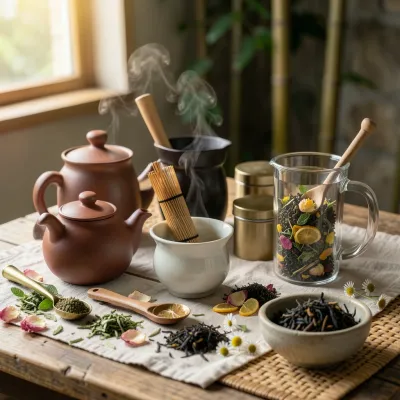
Most tea books split neatly into history or how-to guides. Carolyn Anderson’s Tea Craft: Traditional Methods and Modern Infusions refuses that division, treating the leaf as both a botanical subject and a live ingredient in the kitchen and behind the bar. Spanning twenty-five chapters, the manual moves from plant biology to gongfu cha, from water chemistry to tea cocktails, all with an emphasis on repeatable technique over dogma.
What the Book Is About
Tea Craft is organized as a progressive manual rather than a reference encyclopedia. It opens with the biology of Camellia sinensis and the processing steps—withering, oxidation, firing—that produce green, white, oolong, black, yellow, and pu-erh teas. From there it drills into water chemistry, temperature control, leaf-to-water ratios, and infusion timing—the variables the book returns to again and again. The middle chapters tour living traditions, including Chinese gongfu cha, Japanese chanoyu, British afternoon tea, and Moroccan, Middle Eastern, and Central Asian practices, while also covering sensory training, comparative flights, storage and aging, and blending theory. Later sections treat tea as a culinary ingredient, with dedicated chapters on cold brewing, concentrates, syrups, milk teas, kitchen applications, desserts, and low-ABV mixology. The book closes with wellness and caffeine guidance followed by sourcing, ethics, and sustainability. The intended reader is anyone moving beyond the teabag: a home brewer picking up a first gaiwan, a café staffer dialing in a variable-temperature kettle, or a blender developing a signature house blend.
Water, Heat, and Extraction as Learnable Skills
Anderson treats water not as a neutral background but as an active collaborator. Chapter 5 opens with the observation that “Water looks like the simplest part of tea, and that is exactly why it likes to cause trouble.” The text walks through hardness, alkalinity, total dissolved solids, and filtration, explaining that calcium and magnesium can mute flavors while bicarbonate in excess may darken teas and make them taste papery. It notes that two waters with identical mineral readings can still produce different cups depending on which ions dominate, and it offers practical steps from carbon filtration to building brewing water with Epsom salt and baking soda. Chapters 6 and 7 connect water to heat and time, explaining that temperature accelerates extraction selectively: amino acids and delicate aromatics emerge at lower temperatures, while tannins and robust flavors need more heat. Rather than handing down rigid rules, Anderson presents ratios, timing, and extraction science as “a practical way to understand why tea behaves as it does and how to steer it toward the cup you want.” The result is a framework a brewer can adjust on the fly instead of memorizing temperature charts.
Tradition as a Lens, Not a Rulebook
The chapters on global tea cultures avoid ceremonial preciousness in favor of practical function. Chapter 9 defines gongfu cha literally as “making tea with skill,” describing small vessels, many short infusions, and the fairness pitcher that equalizes extraction across cups. Chapter 10 covers Japanese steaming and shade cultivation, while Chapters 11 and 12 trace British colonial service and the strong, sweetened practices of Morocco, the Middle East, and Central Asia. Throughout, teaware is described as a precision tool: a Yixing clay pot holds heat for roasted oolongs, a bamboo whisk suspends matcha, and a gaiwan lets the brewer watch a leaf unfold across successive pours. Chapter 8 surveys vessels from zisha clay to porcelain, cast iron, and glass, noting that each material quietly steer how heat moves, how leaves open, and how flavor arrives on your tongue. Anderson’s point is that tradition offers proven parameters, but the brewer should know when to bend them based on the leaf in front of them.
Blending, Cooking, and Modern Infusions
Where many tea manuals stop at the teapot, Anderson continues into blending theory and the kitchen. Chapter 16 frames blending as “an act of intentional creation,” building from a base tea through accents and structure, and warns that a broken-leaf black tea will extract faster than a tightly rolled oolong and can muddy a blend if proportions are ignored. Chapters 17 through 21 extend tea into spices, herbs, flowers, broths, marinades, baked goods, custards, and confections. The text notes that tea’s tannins and aromatics can complement complex menus or stand in for spirits in low-ABV drinks, while cold brewing selectively extracts sweetness and body while leaving harsh tannins behind. Chapters 18 through 22 cover cold brew, flash chilling, sparkling infusions, concentrates, syrups, milk teas, and tea cocktails, treating tea as a versatile ingredient rather than only a beverage. These sections offer concrete guidance on syrups, milk teas, and flash-chilled infusions without promising miracle cures or wellness shortcuts.
Wellness, Ethics, and the Long View
The final chapters ground the craft in physical and ethical reality. Chapter 24 covers caffeine metabolism, tannins, iron absorption, and safe serving temperatures, emphasizing that tea contributes to hydration despite caffeine’s mild diuretic effect. Chapter 25 turns to sourcing, defining it simply as “knowing where your tea comes from and how it got to you.” Anderson discusses transparency, certifications, direct trade, cooperatives, climate change, labor practices, gender equity, and packaging waste. She argues that price often reflects labor and care rather than hype, and that sustainability is not optional but necessary for the long-term viability of tea gardens. The book’s concluding position is that mindful consumption connects the health of the tea garden to the experience of the drinker, and that ethical sourcing recognizes human capital is as important as terroir.
Who should read this: This manual suits readers who want to understand why a cup tastes the way it does and how to adjust variables to get a better result. Home brewers, café staff, and anyone developing house blends will find repeatable methods and troubleshooting logic. Readers looking for a purely historical survey, a coffee-table book on tea aesthetics, or a medical guide to herbal remedies may find the focus too technical and practice-oriented. For the curious brewer willing to treat tea as both craft and science, Tea Craft offers a substantial, grounded resource worth keeping within reach of the kettle.
Read “Tea Craft: Traditional Methods and Modern Infusions” on MixCache.com →
Please log in or create an account to leave a comment.
No comments yet. Be the first to say something.