
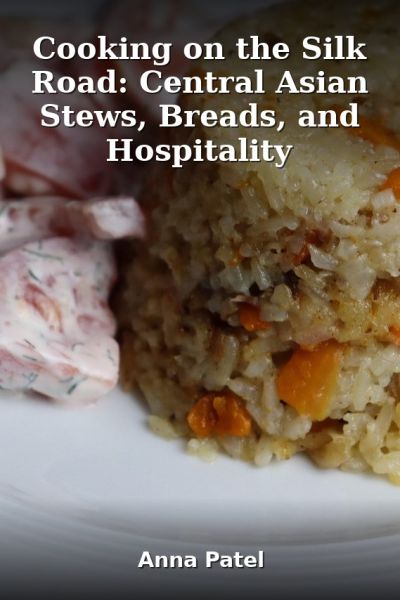
Along the ancient arteries of the Silk Road, food traveled as surely as silk and stories. In Cooking on the Silk Road: Central Asian Stews, Breads, and Hospitality, Anna Patel invites readers into a world where a shared pot of plov and a stack of warm non bread are the currency of welcome, and where the rhythm of a meal is set by endless cups of green tea poured from a height.
What the Book Is About
The book spans 25 chapters, moving from pantry staples and equipment adaptations through regional plov variations, soups, noodles, dumplings, flatbreads, pastries, pickles, dairy, tea culture, sweets, and practical menus for everything from weeknight dinners to wedding feasts. Patel structures the work as both a technical manual and a cultural immersion: early chapters establish the "Silk Road larder" — rice varieties, lamb tail fat, cumin, carrots — while later chapters translate the heavy kazan and clay tandyr into Dutch ovens and baking steels. The intended reader is a curious home cook who wants authentic flavor without romanticized difficulty; Patel provides smart substitutions (aged basmati for Devzira rice, crème fraîche for qaymaq, feta-yogurt brine for qurut) and streamlined weeknight methods alongside the traditional, labor-intensive versions. Essays between recipe chapters trace the cultural threads — the etiquette of the dastarkhan, the role of tea as social contract, the communal labor of celebrations — so the recipes land with context, not just instruction.
The Dastarkhan as Social Contract
Chapter Two reframes the low-spread table not as furniture but as a promise: "that a guest will be fed, that conversation will have a place to land, and that time will move at a pace set by tea and appetite." Patel details the choreography — elders seated first, bread broken by hand never cut with a knife ("at this table, we do not sever, we share"), tea poured to honored guests before anyone else, dishes arriving in layers rather than all at once. The host's role is presence over performance: "design your menu around presence, not performance. You want to be at the table, not imprisoned by the stove." This framework recurs throughout the book; even the weeknight plov chapter reminds readers that the goal is a meal that lets the cook sit down with guests.
Plov as Regional Dialect, Not Monolith
Rather than presenting a single canonical recipe, Patel devotes three full chapters to plov variations across Uzbekistan (Samarkand, Fergana, Tashkent), Tajikistan, and Kazakhstan. Samarkand plov prizes distinct layers and visual drama, often including chickpeas and whole garlic heads; Fergana plov pursues deep caramelization, with onions cooked "until they become very dark brown, almost black, but without actually burning"; Tashkent plov aims for a lighter, balanced profile with thinner julienne carrots. Tajik pilaf leans into seasonal herbs and tomatoes, while Kazakh versions incorporate potatoes and horse meat. Patel writes, "The pantry is the same orchestra; the conductor changes with region and season." This approach teaches the cook to understand the "why" behind each choice — why a shorter soak for basmati, why a tighter lid seal — so they can adapt confidently.
Translating the Kazan and Tandyr Without Losing Their Spirit
Chapters Three and Twelve are essentially engineering guides for home cooks. The kazan's rounded bottom and heavy walls create even heat and steam circulation; Patel identifies a wide, heavy Dutch oven (five to seven quarts) as the closest stand-in, noting that a tight-fitting lid is nonnegotiable for the steaming phase — foil or a kitchen towel can seal a loose lid. For the tandyr's radiant, all-around heat, a baking steel or stone preheated 45–60 minutes at maximum temperature mimics the hearth, while a pan of boiling water on the lower rack or a covered Dutch oven creates the steam burst that gives non its blistered crust and airy crumb. Patel emphasizes sensory cues over timers: "Learn the sound of your oil when it's ready for onions — a soft, steady hiss rather than a frantic crackle. Notice the way your lid sits when the seal is perfect; a faint hum of steam is good, a loud rattle means you need a tighter fit."
Dumplings and Noodles as Communal Labor
Chapters Ten, Eleven, and Fifteen reveal that manti, chuchvara, lagman, and beshbarmak are rarely solitary projects. The dough for hand-pulled lagman noodles requires kneading until it passes the windowpane test, then coiling and resting — "a performance, and while it can be intimidating, it's also deeply satisfying." Manti shaping is "a small ritual of pinching and folding" often passed down generations; chuchvara-making becomes a family assembly line. Patel notes that even in Central Asia, not every cook pulls noodles perfectly every time: "If your dough is tearing, it may be under-kneaded, under-rested, or the gluten may have been overworked during pulling. Simply gather the torn pieces, knead them back into a ball, let it rest again, and start over. There is no failure, only another opportunity to practice." For weeknight cooks, she offers pragmatic shortcuts — fresh lasagna sheets for beshbarmak, store-bought noodles for lagman — without apologizing for them.
Brightness and Balance Through Pickles, Herbs, and Dairy
Chapter Seventeen argues that the "vibrant chorus of sharp, tangy, and spicy flavors" is not garnish but architecture. Paper-thin raw onions with salt provide a "powerful, cleansing jolt that slices through the richness of the meat and oil." Torshi (pickled vegetables) and lighva (chopped tomato-pepper-garlic relish preserved in oil and vinegar) are made in bulk during harvest to "capture the peak of the summer and extend its welcome through the colder months." Fresh herb bowls — dill, parsley, cilantro — are "not a garnish; they are an essential, functional part of the meal." Dairy completes the balance: qaymaq melting into shurpa, katyk stirred into mastava, qurut dissolved into brine for qurutob. Patel gives workable substitutes for each (Greek yogurt for katyk, crème fraîche for qaymaq, feta-yogurt brine for qurut) while explaining the flavor logic so the cook knows what the substitute must achieve.
Who Should Read This
This book rewards the cook who wants to understand a cuisine's internal logic — why the rice is rinsed, why the onions are sliced half-moon, why the bread is broken by hand — and who appreciates that hospitality is a set of repeatable gestures, not a performance. Readers seeking only quick-fix recipes or glossy plating shots will find the pace too deliberate; the weeknight chapter exists but sits alongside 24-hour sumalak stirring and all-night wedding plov vigils. For anyone willing to stock whole cumin seeds, invest in a baking steel, and accept that the first loaf of non may not look like the one in Samarkand, Patel offers a reliable, generous map. The Silk Road's generosity, she suggests, is portable: "May these pages help you bring the generosity of the Silk Road to your own table — one pot of rice, one round of bread, and one shared cup of tea at a time."
Read “Cooking on the Silk Road: Central Asian Stews, Breads, and Hospitality” on MixCache.com →
Please log in or create an account to leave a comment.
No comments yet. Be the first to say something.