
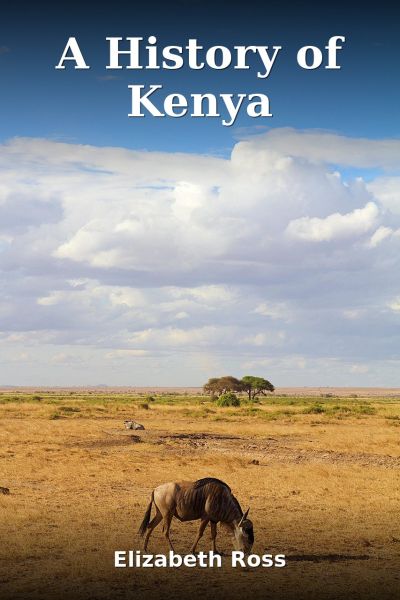
Few countries compress as much human history into their borders as Kenya. The same Rift Valley that preserved Homo erectus fossils from 1.5 million years ago later became the corridor for the Uganda Railway, the engine of colonial extraction, and eventually the backbone of a modern economy. Elizabeth Ross's A History of Kenya takes on the entire arc — geological, archaeological, political, and cultural — without flattening the complexity that makes the place distinct.
What the book is about
The book moves chronologically across 25 chapters, beginning with the paleoanthropological sites of Koobi Fora and Olorgesailie (Chapters 1–2) and ending with a survey of contemporary culture, inequality, and the Vision 2030 development plan (Chapter 25). In between, it covers the Pastoral Neolithic and the arrival of Cushitic herders (Chapter 3), the Nilotic and Bantu migrations that formed Kenya's ethnic mosaic (Chapter 4), the rise of Swahili city-states and Indian Ocean trade (Chapters 6–7), Portuguese and Omani interventions on the coast (Chapters 8–9), and the pre-colonial societies of the interior (Chapter 10). The colonial era occupies Chapters 11–14: European exploration, the Scramble for Africa, the British East Africa Protectorate, the Uganda Railway, and the settler economy with its land alienation and forced labor. African and Asian political activism gets its own chapter (15), followed by the growth of nationalism, KAU and KANU (16), the Mau Mau Uprising (17), and the negotiated road to independence (18). Post-independence Kenya unfolds across seven chapters: Kenyatta's republic (19), the centralized state and KADU's absorption (20), Moi's authoritarian decade and the 1982 coup attempt (21), the 1990s transition to multipartyism (22), the Kibaki years including the 2007–2008 post-election violence and the 2010 Constitution (23), and the Kenyatta–Ruto era with the Standard Gauge Railway, the Building Bridges Initiative, and the 2022 election (24). Ross writes for a general reader who wants a single, reliable narrative; she assumes no prior specialist knowledge but rewards it with archaeological detail, legislative dates, and the names of lesser-known actors like Harry Thuku, Manilal Desai, and the Mazrui family.
The Rift Valley as a continuous stage
Ross uses the Great Rift Valley not just as scenery but as a structural through-line. The same geological forces that created fossil-preserving basins at Koobi Fora and Olorgesailie later dictated the route of the Uganda Railway — "ascend from the coast to the high altitude of the Rift Valley, then descend dramatically into the valley floor, and finally climb again towards Lake Victoria" (Chapter 13). The valley's ecology shaped the pastoralist economies of the Maasai, Samburu, and Turkana; its soils attracted European settlers to the "White Highlands"; and its escarpments became Mau Mau forest strongholds in the 1950s. By returning to the landscape repeatedly, the book resists the temptation to treat geography as a static backdrop and instead shows how each epoch reconfigures the same physical constraints.
Trade as a catalyst for cultural synthesis, not just exchange
The Swahili coast chapters (6–7, 9) argue that Indian Ocean commerce produced a "unique Swahili culture and language" through "centuries of intense contact" rather than simple borrowing. Ross notes that "around 15-40% of Swahili vocabulary comes from Arabic, particularly words related to religion, trade, law, and administration" and that the name Swahili itself derives from the Arabic sawahil, "coasts." The synthesis extended to architecture (coral stone, arched doorways), music (taarab's oud and kanun alongside African rhythms), and cuisine. Crucially, she emphasizes that Islam spread "primarily a gradual process of interaction, intermarriage, and assimilation rather than conquest," and that the resulting identity was "not about being solely Arab or Persian, but about being a dynamic blend." This framework helps explain why coastal society could absorb Omani political dominance (Chapter 9) while retaining a distinct African character — a pattern that recurs when the book examines later Asian and European arrivals.
Land alienation as the engine of colonial Kenya
Chapter 14 makes the case that the "settler economy" was not an organic outgrowth of the protectorate but a deliberate policy choice. The administration declared vast tracts "Crown Land," ignoring "traditional systems" where "land was typically held communally or managed through kinship and customary rights," and leased it to Europeans on 999-year terms at "remarkably low prices." The consequences were structural: Kikuyu cultivators were confined to "Native Reserves" with "overcrowding in increasingly restricted areas"; the Maasai were pushed into "smaller, less fertile reserves" through treaties "often made under duress"; and a hut tax payable only in cash forced African men into wage labor on the very farms that occupied their former fields. Ross connects these policies directly to the Mau Mau Uprising two chapters later, showing how the "systematic injustices of the colonial system" — not atavistic tribalism — fueled the rebellion.
The Mau Mau Uprising as both military defeat and political catalyst
Chapter 17 refuses the binary of "savage eruption" versus "liberation war." Ross details the oathing ceremonies that bound fighters through "powerful cultural and spiritual ties," the forest guerrilla campaign in the Aberdares and Mount Kenya, and the British response: mass detention camps where "conditions were often harsh and reports of mistreatment and torture were widespread," plus the forced villagization of "millions of people" behind "trenches, barbed wire, and watchtowers." She records the staggering asymmetry — "estimates of African deaths running into the tens of thousands, far exceeding the casualties among Europeans and Asians" — and the civil-war dimension as African Home Guard units fought Mau Mau. Yet the chapter concludes that the uprising "brought the injustices of colonial rule in Kenya to international attention" and "convinced many in London that a political solution was necessary," accelerating the constitutional conferences that produced independence.
Constitutional engineering as a recurring drama
From the 1962 Lancaster House compromise (Chapter 18) through the 2010 Constitution (Chapter 23) to the failed Building Bridges Initiative (Chapter 24), Kenya's history is punctuated by negotiated legal frameworks. Ross shows how each constitution reflected the power balance of its moment: the 1962 document included regional assemblies (Majimbo) to appease KADU and settlers; the 1964 republican amendment concentrated executive power and enabled KANU's de facto one-party state; the 1982 Section 2A made single-party rule de jure; the 1991 repeal opened multipartyism but left the electoral commission weak; the 2010 Constitution — born from the 2007–2008 post-election violence mediation — introduced devolution, a Bill of Rights, and a Supreme Court; and the BBI proposals sought to restructure the executive again before the courts declared them unconstitutional. The pattern suggests that Kenya's political struggles are often fought through constitutional text as much as through streets or ballots.
Who should read this
Readers who want a single-volume narrative that respects both the deep-time archaeological record and the granular politics of the 2022 election will find the book thorough and balanced. It works well as a first serious history of Kenya — Ross defines terms like kipande, Harambee, and Majimbo when they appear — but also serves as a reference for specialists who need a clear chronology of constitutional milestones, land-policy shifts, and the interplay of coastal and interior dynamics. Those looking for a thematic argument (e.g., a Marxist reading of class formation or a focused study of gender in nationalism) will not find one; the book's strength is synthesis, not advocacy. Anyone planning to travel, work, or study in Kenya will come away with a usable mental map of how the past shapes today's devolved counties, debt debates, and ethnic arithmetic.
Read “A History of Kenya” on MixCache.com →
Please log in or create an account to leave a comment.
No comments yet. Be the first to say something.