
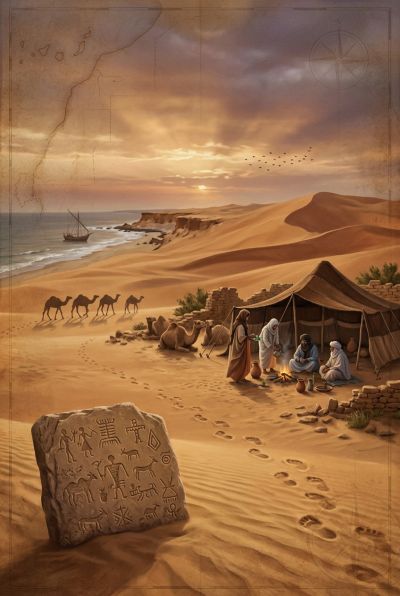
Western Sahara is often called "Africa's last colony," but that label barely captures the complexity of a territory where ancient rock carvings depict giraffes and hippos, where a 1975 "Green March" of 350,000 civilians redrew the map, and where a sand berm longer than the U.S.-Mexico border has frozen a war for three decades. Karim Bensalem's A History of Western Sahara does not just recount events; it explains how a desert the size of Italy became the stage for a clash between territorial integrity and self-determination that still has no resolution.
What the book is about
The book spans 25 chapters, moving chronologically from the Neolithic "Green Sahara" through the Almoravid empire, the Maqil Arab migrations that forged Hassaniya culture, Spanish colonization, and the 1975 Green March that triggered a sixteen-year war. Bensalem devotes equal attention to the diplomatic labyrinth — the ICJ advisory opinion, the failed UN referendum, the two Baker Plans — and to the human reality: the refugee camps at Tindouf, the Moroccan-built Berm, the phosphate mines at Bou Craa, and the cultural resistance sustained through poetry, music, and the melhfa. The intended reader is anyone who wants a single, coherent narrative that connects deep history to current headlines, without assuming prior expertise in Maghreb politics.
The deep history that shaped Sahrawi identity
Bensalem begins not with politics but with geology and archaeology. Chapter 1 describes a Sahara that was savanna 10,000 years ago, evidenced by rock art at Tifariti and Erqueyez showing "herds of giant buffalo, elephants, rhinoceroses, and giraffes." The arrival of the camel transformed the desert from barrier to highway, enabling the Sanhaja Berbers to dominate trans-Saharan trade. Chapter 3 details the centuries-long fusion of Sanhaja Berbers and Maqil Arabs, culminating in the Char Bouba War (1644–1674), which produced the rigid social hierarchy — Hassan warriors, Zawaya clerics, Znaga tributaries — and the Hassaniya dialect that still defines Sahrawi identity. This long view matters because, as Bensalem writes, "the deep Islamic identity they had forged in the western desert would endure" long after empires fell.
From peaceful protest to armed struggle: The Polisario's emergence
One of the book's most gripping sequences covers the late 1960s and early 1970s. Chapter 7 introduces Muhammad Sidi Brahim Bassiri, a Quranic teacher influenced by Gandhi, who founded the Harakat Tahrir and organized a peaceful demonstration in El Aaiún's Zemla neighborhood on June 17, 1970. The Spanish Foreign Legion opened fire; Bassiri disappeared into custody, never to be seen again. Chapter 8 shows how that massacre birthed the Polisario Front. Ten days after its founding at Ain Bentili on May 10, 1973, El-Ouali Mustapha Sayed led a raid on the Spanish post at El Khanga with "just a few old rifles." The contrast is deliberate: Bassiri's petition versus El-Ouali's gun, the "dream of a peaceful path to independence died with the demonstrators in the dust of El Aaiún."
The Berm: Engineering a stalemate
Chapter 14 explains how Morocco turned military frustration into a facts-on-the-ground strategy. After Mauritania withdrew in 1979, the Polisario's mobile columns — "like a school of piranhas, endlessly nipping at a lumbering whale" — overran major garrisons. Morocco responded by building the Berm in six phases between 1980 and 1987: a sand-and-rock wall "typically two to three meters in height" flanked by "vast, dense minefields" and studded with electronically monitored observation posts. The result: Morocco secured the "useful triangle" (El Aaiún, Smara, Bou Craa) while the Polisario was confined to the "Liberated Territories" east of the wall. The Berm "had not won the war for Morocco, but it had ensured that Morocco could not lose it by military means alone," creating the frozen conflict that persists today.
Resources as both prize and curse: Phosphates, fish, and the legal battle
Chapter 19 makes the economic stakes unavoidable. The Bou Craa phosphate deposit, discovered in 1947, is "one of the world's largest, richest, and most easily accessible" — a 100-kilometer conveyor belt carries rock to the coast. Offshore, the Canary Current upwelling creates "one of the world's most productive fishing grounds." Bensalem traces how the 1975 Madrid Accords secretly guaranteed Spain 35% of phosphate revenue and fishing rights, and how the European Court of Justice later ruled that EU-Morocco fisheries agreements were "legally void insofar as they applied to Western Sahara" because the "people of Western Sahara are a third party" whose consent was never obtained. The resource fight has moved beyond extraction: "greenwashing the occupation" via wind and solar farms now powers the very mines and conveyor belt that activists call conflict minerals.
Culture as resistance in exile
Chapter 23 argues that culture is "the intangible territory that could not be walled off, mined, or annexed." In the Tindouf camps, the FiSahara film festival turns a refugee camp into an open-air cinema; the Abidin Kaid Saleh Audiovisual School trains Sahrawi filmmakers. Music evolved from traditional Haul — accompanied by the tbal drum and tidinit lute — into the electric desert blues of Mariem Hassan and Aziza Brahim, whose lyrics address "the pain of exile, the memory of her three brothers killed in the war, and an unshakeable belief in her people's right to return." Even the melhfa, the colorful wrap worn by Sahrawi women, becomes "a kind of living flag" during protests where the actual flag is banned. Poetry, once the domain of tribal griots, now chronicles "the trauma of the exodus, the harshness of life in the camps, and the brutality of the conflict."
Who should read this
Readers who want a single volume that connects the Neolithic rock art of Tifariti to the 2020 Guerguerat blockade and the 2024 French policy shift will find it indispensable. The book rewards those comfortable with diplomatic detail — voter-identification criteria, Security Council resolutions, the nuances of the Baker Plans — but never loses the human thread: the refugee mother rationing water in a khaima, the poet memorizing verses in a sandstorm, the soldier baking in a Berm observation post. If you prefer narrative-driven history with a clear protagonist, this may feel diffuse; its protagonist is a people, not a person. For anyone trying to understand why a territory most maps show as part of Morocco remains a UN-listed non-self-governing territory, Bensalem provides the evidence, the arguments, and the context to form your own judgment.
Read “A History of Western Sahara” on MixCache.com →
Please log in or create an account to leave a comment.
No comments yet. Be the first to say something.