
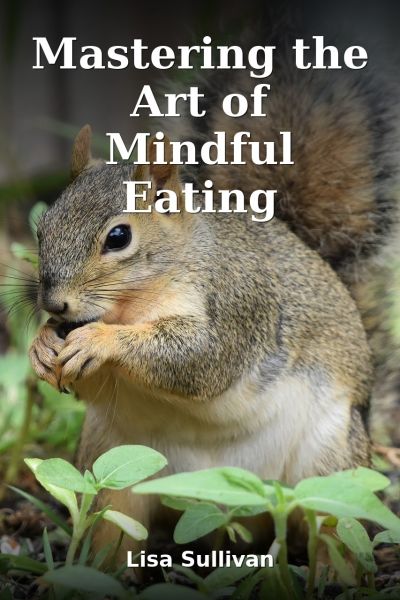
Most books about food promise transformation but deliver restriction. Mastering the Art of Mindful Eating takes the opposite tack: it treats eating as a practice of attention rather than a problem of control. Across 25 chapters, Lisa Sullivan builds a case that the way back to a peaceful relationship with food isn't through stricter rules but through slower, more curious engagement with what's already happening on your plate and in your nervous system.
What the book is about
The book moves chronologically from foundations to daily integration. Early chapters trace mindfulness from Buddhist roots through Jon Kabat-Zinn's clinical definition — "on purpose, in the present moment, and nonjudgmentally" — and into the laboratory, where fMRI studies show mindfulness increases prefrontal cortex activity linked to impulse control. Middle chapters (5–10) function as a workbook: food journals, the hunger-fullness scale (1–10), the raisin exercise, and gratitude pauses. Later sections tackle emotional eating, cravings, social pressure, weight management, and finally the ripple effects of mindfulness beyond meals. The intended reader is anyone who has cycled through diets, eats while distracted, or feels guilt around food — no clinical diagnosis required. Sullivan writes for the busy professional eating lunch at a desk, the parent navigating family meals, and the chronic dieter ready to stop counting calories.
Ancient practice meets modern physiology
Chapter 1 grounds mindful eating in a lineage that predates wellness trends by millennia, then Chapter 4 validates it with digestive science. Sullivan explains that rushed, stressed eating activates the sympathetic "fight or flight" system, diverting blood from the gut and suppressing enzyme release. Mindful eating — slowing down, breathing, sensing — switches on the parasympathetic "rest and digest" mode. She cites the cephalic phase of digestion: merely seeing and smelling food triggers salivary and gastric secretions. The raisin exercise (Chapter 6) isn't just a party trick; it trains the sensory attention that primes this physiological cascade. The result is a framework where spirituality and biology reinforce each other rather than compete.
The hunger-fullness scale as daily compass
Chapter 8 introduces a 10-point scale that becomes the book's most practical tool. At 1 you're ravenous, dizzy, nauseous; at 4 you're "ready to eat, with a slight empty feeling… but not urgent" — the ideal starting point. At 7 you're "content and satisfied, but not stuffed" — the ideal stopping point. Sullivan emphasizes this isn't a rigid rule but a feedback loop: check in before eating, halfway through, and after. She also distinguishes physical hunger (gradual, flexible) from emotional hunger (sudden, specific, insistent) and sensory hunger (triggered by sight or smell). The scale gives readers a shared vocabulary for sensations that diet culture taught them to ignore or override.
Emotional eating and the S.T.O.P. method
Chapters 16 and 17 treat emotional eating not as weakness but as a learned coping loop: trigger → behavior → temporary relief. Sullivan offers a concrete interruption protocol — S.T.O.P.: Stop, Take a breath, Observe ("What am I feeling? Where in my body? What thoughts?"), Proceed mindfully. She pairs this with "urge surfing" — watching a craving rise, crest, and fade like a wave over 5–10 minutes without acting. The approach reframes cravings as physiological events (ghrelin spikes, dopamine-driven reward memories) rather than moral failings. Readers get permission to eat the craved food mindfully if they choose, or to deploy a non-food alternative from a pre-made list — walk, call, journal, stretch — without self-judgment either way.
Dismantling the diet mentality
Chapter 11 names the "diet mentality" explicitly: binary food labels (good/bad), all-or-nothing thinking, weight as sole success metric, and erosion of body trust. Sullivan contrasts this with intuitive eating principles — unconditional permission to eat, reliance on internal cues, and self-compassion over self-policing. She describes a client who discovered that restrictive meals triggered obsession, while allowing a wider variety with attention to fullness actually reduced cravings. The chapter reframes nutrition not as compliance but as personal data collection: noticing which foods leave you energized versus sluggish, then choosing accordingly. This shifts the locus of authority from external plan to internal experience.
Social pressures without isolation
Chapter 18 acknowledges that eating is rarely solitary. Holiday tables, office lunches, and family traditions carry expectations that can override fullness cues. Sullivan offers practical scripts: "It's delicious, but I'm comfortably full" or "I'll enjoy a small portion to savor it." She suggests pre-event strategies — a protein snack beforehand, a mental intention, a visual survey of options — and mid-meal tactics like fork-down pauses between conversation turns. The guidance respects cultural foods ("savor a small slice of your grandmother's famous pie") while maintaining boundaries. The goal isn't perfection but participation: "choosing connection over compulsion, and enjoyment over obligation."
Who should read this
This book fits readers who want structure without rigidity — people willing to journal, pause before meals, and experiment with chewing counts and breath pauses. It's less suited for those seeking a prescriptive meal plan, macro targets, or quick weight loss. The 25-chapter breadth means some sections (meal prep, family dynamics, financial mindfulness) may feel peripheral if your primary struggle is, say, nighttime bingeing. But for anyone exhausted by the restrict-binge-guilt cycle and ready to treat eating as a relationship worth repairing, Sullivan offers a thorough, compassionate, and scientifically grounded roadmap.
Read “Mastering the Art of Mindful Eating” on MixCache.com →
Please log in or create an account to leave a comment.
No comments yet. Be the first to say something.