
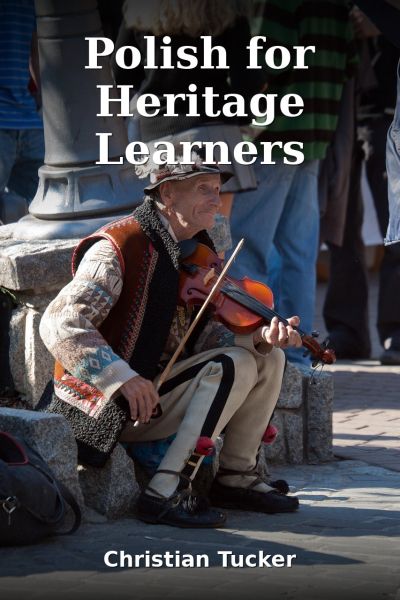
If you grew up answering your babcia in English while understanding every word she said, this book was written for you. Polish for Heritage Learners does not treat you like a beginner; it treats you like someone who already carries the language in your ear, your muscle memory, and your family stories — and shows you how to turn that inheritance into fluent, flexible speech.
What the book is about
The book is a 25-chapter curriculum designed specifically for heritage speakers of Polish — people who heard the language at home but never developed full grammatical control or speaking confidence. Rather than starting from zero, it maps the reader's existing "islands of fluency" (family terms, holiday foods, household routines) and builds bridges to the structures that usually remain opaque: verb aspect, case endings, formal registers, and the nuances of diaspora Polish. Each chapter opens with a diagnostic to surface what is passive, partial, or active, then moves through layered exercises: listen-and-point, shadow-and-repeat, prompt-and-respond, and finally mini-tasks to try with relatives. The three guiding threads — repair-first conversation strategies, family-first vocabulary, and document-reading skills for personal archives — run through the entire program, making the work feel less like study and more like reconnection.
Sound before grammar: the phonetic reset
Before any grammar drills, Chapter 2 devotes itself to "Sound Reset." The premise is straightforward: your mouth remembers sounds like ł, ś, and the nasal vowels ą and ę, but years of English-dominant speech have rusted the articulatory habits. The chapter walks through Polish phonetics not as abstract IPA charts but as physical sensations — feeling the nose vibration on kąt versus kant, the tongue arch on ś versus s, the dark w-like quality of ł. Warm-up exercises use minimal pairs (będę/bede, szum/sum) and shadowing with family recordings so that "the motivation to decipher each syllable is higher, and the emotional connection reinforces retention." By the end of the chapter, the learner has a personal sound inventory — cue words like rąk for ą and łódź for ł — that make new vocabulary easier to pronounce and spell.
Conversational repair as a fluency engine
Chapter 4 reframes the moment a word disappears not as failure but as a routine part of speaking. It equips learners with a toolbox of repair moves: asking for a hint ("Jak to się mówi?"), describing around the gap ("To jest część ptaka, która pozwala mu latać"), substituting a broader category, using generic verbs like robić, buying time with fillers ("No wiesz…", "Chwilkę…"), and confirming understanding ("Czy dobrze zrozumiałem, że…?"). The chapter insists these are not crutches; they are what native speakers do constantly. Practicing them in low-stakes role-play makes the strategies automatic, so that when you're on the phone with a cousin and the word for "wrench" vanishes, you stay in Polish, keep the flow, and often get the word fed back to you — reinforcing it for next time.
Grammar anchored in kitchen-table life
Instead of paradigm tables, the book teaches case endings and verb aspect through the sentences you actually say at home. Chapter 10 starts with nominative and accusative using objects from Chapter 6's "Home Life Lexicon": "Widzę lampę" (feminine -ę), "Widzę stół" (inanimate masculine, no change), "Widzę kota" (animate masculine -a). Chapter 11 introduces genitive through negation ("Nie mam chleba") and possession ("dom babci"), Chapter 12 teaches dative via giving and helping ("Daję prezent mamie," "Pomagam dziadkowi"), and Chapter 13 covers instrumental ("z bratem," "ołówkiem") and locative ("w kuchni," "na stole") through location and tools. Verb aspect in Chapter 9 is taught through daily tasks: "Robiłem herbatę" (process) versus "Zrobiłem herbatę" (completed), with the future forms "Będę robić" and "Zrobię" mapped to the same distinction. The learner internalizes patterns through high-frequency frames — "Chcę + accusative," "Nie mam + genitive," "Pomagam + dative" — rather than memorizing charts.
Reading family documents as ancestral detective work
Chapters 18 and 19 turn language learning into archival practice. Chapter 18 guides the reader through handwritten letters and postcards: spotting formulaic greetings ("Kochana Aniu," "Całuję"), using kinship terms and dates as anchors, identifying verbs to grasp the narrative engine, and slowly building a personal lexicon of family-specific phrases. Chapter 19 applies the same lens to birth, marriage, and immigration records — recognizing the predictable fields ("Akt Urodzenia," "Mąż," "Żona," "Data Ślubu"), navigating Latin insertions in older partitions-era documents, and cross-referencing multiple records to resolve ambiguities. The payoff is framed explicitly: "Each deciphered word, each understood date, is a step closer to reconnecting with the tangible evidence of your heritage." The book even suggests bringing these documents to conversations with elders (Chapter 20) as memory triggers: "Czy pamiętasz to zdjęcie?"
Diaspora Polish honored, not corrected
Chapter 16 names the calques and code-switching habits that heritage speakers absorb — "robić sens" for "mieć sens," "pracuję na" for "pracuję w" — and offers a three-step process to spot and replace them without shame. Chapter 17 expands this into a discussion of registers and regional varieties: the Kresy Polish of eastern borderland ancestors, the English-influenced "Amerpol" of American communities, and the Brazilian, Canadian, or British Polish of other diasporas. The guidance is pragmatic: "Embrace your family's usage first… Be aware of the standard… Adapt to your audience." The book treats the hybrid language of the diaspora as a legitimate linguistic heritage, a "living archive" that deserves respect, while giving the learner the tools to shift toward standard usage when speaking with elders in Poland or consuming contemporary media.
Who should read this
This book is for anyone who grew up with Polish in the background — understanding more than they can say, freezing when a grandparent asks a follow-up question, or staring at a great-grandparent's letter without the confidence to read it. It will not suit a true beginner looking for a step-by-step textbook from zero, nor a highly advanced speaker polishing academic register. But for the heritage learner who wants a structured, emotionally grounded path from passive recognition to active, proud use — whether the goal is telling a family story, reading immigration papers, or simply staying in Polish through a Sunday dinner — it offers a clear, compassionate, and remarkably complete toolkit.
Read “Polish for Heritage Learners” on MixCache.com →
Please log in or create an account to leave a comment.
No comments yet. Be the first to say something.