
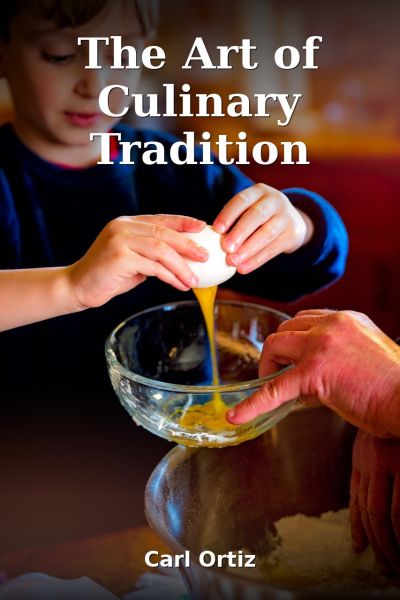
Food does more than nourish. It carries stories, marks seasons, and anchors communities to place. In The Art of Culinary Tradition, Carl Ortiz builds a wide-ranging argument that culinary heritage is a living archive — one we can actively shape, not just passively inherit. The book moves fluidly between anthropology, practical guidance, and global case studies, making the case that preserving foodways is both urgent and entirely doable.
What the book is about
Organized into 25 chapters, the book progresses from foundational concepts — food as cultural identity, culinary memory, the family table — through technical and environmental dimensions like geography, seasonality, and classic techniques. The middle chapters tackle preservation methods: written recipes, oral storytelling, anecdotes, and the practical work of documenting dishes and building archives. Later sections examine digital tools, media, online communities, museums, and the pressures of globalization. The final five chapters offer deep dives into Italy, Mexico, India, Japan, and West Africa. The intended reader is anyone who cooks, remembers, or wonders how to keep a family's food stories alive — home cooks, genealogists, food historians, and cultural preservationists will all find relevant material.
Food as living archive, not static relic
Ortiz opens with a central thesis: culinary tradition is "a vibrant tapestry woven from the threads of history, culture, and personal stories" rather than a fixed canon. Chapter 1 argues that "every dish that graces a family table carries with it the echoes of ancestors, the textures of lived experience, and the flavors of a place and time." Chapter 2 expands this into "culinary memory" — the way a handwritten recipe card, with its "smudges of flour or splashes of sauce," becomes "evidence of a dish made with love, shared around a table, and passed down as a tangible piece of heritage." Chapter 3 situates these artifacts at the family table, where rituals like the Sunday roast or communal tamale-making transform cooking into "a social ritual, fostering bonds and passing on practical skills alongside cultural knowledge." The takeaway: tradition lives in repetition and relationship, not in perfection.
The geography of taste and the stakes of seasonality
Chapters 4, 8, and 9 ground abstraction in ecology. Ortiz introduces terroir beyond wine: "A tomato grown in mineral-rich soil under a hot sun… will develop a different sweetness and acidity than one from a cooler, wetter region." Chapter 8 traces heirloom ingredients — Cherokee Purple tomatoes, Carolina Gold rice, Mexican landrace corn — as "tiny time capsules, holding generations of agricultural wisdom." Chapter 9 frames seasonality as sustainability: "Fruits and vegetables harvested at their peak ripeness are often at their most flavorful and nutrient-rich," and eating locally reduces "the carbon footprint associated with long-distance transportation." The book connects biodiversity loss directly to flavor loss: "Imagine a world where all tomatoes taste the same… a culinary landscape stripped of its rich, nuanced diversity." These chapters give readers a framework for evaluating ingredients not just by price or convenience, but by provenance and resilience.
Oral tradition and written record as complementary, not competing
Chapters 11 through 13 form a trio on transmission. Chapter 11 treats written recipes as "certificates of love" and "foundational blueprints," noting the shift from Mesopotamian clay tablets to Fannie Farmer's standardized measurements. Chapter 12 elevates oral storytelling: "You'll know it's ready when it smells like this," an elder might say, offering "a sensory cue that no written recipe can fully capture." Chapter 13 argues that anecdotes — the dry turkey, the lucky penny in bread dough — "transform a simple dish into a cherished memory, binding it to specific people, places, and moments in time." Ortiz doesn't privilege one mode; he shows how a scanned recipe card (digital), a grandmother's verbal tip (oral), and the story of why the dish matters (anecdotal) together create a fuller record than any single format.
Technology as bridge, not barrier
Chapters 16 through 18 make a pragmatic case for digital tools. Chapter 16 walks through scanning, OCR, recipe apps, cloud storage, and video capture — "creating a digital safety net" for fragile originals. Chapter 17 examines cooking shows, blogs, and social media as "powerful avenues for documenting techniques, exchanging recipes, and telling the rich stories that breathe life into our edible heritage." Chapter 18 highlights online communities like Reddit's r/heirloomrecipes and the app Heirloom, where "questions about obscure ingredients or forgotten techniques can be crowdsourced." The consistent message: technology amplifies reach and redundancy without replacing the tactile, sensory core of cooking.
Five case studies in resistance and adaptation
The final chapters demonstrate the book's themes in specific cultures. Italy's pasta shapes reflect "meticulous attention to form and function" passed through nonnas teaching grandchildren to knead "until it feels right." Mexico's nixtamalization of corn and collaborative mole-making reveal "a labor of love, a profound act of culinary dedication." India's regional thali system and festival foods show how "food transforms from sustenance into a celebration of faith, family, and community." Japan's kaiseki and shun (seasonality) embody "a dedication to one's craft that goes beyond mere skill, encompassing a spiritual commitment to perfection." West Africa's oral history, communal feasts, and jollof debates illustrate how "food is not merely a collection of ingredients and techniques; it is a powerful conduit for ancestral memory." Each case study resists homogenization while adapting — proving tradition survives through deliberate practice.
Who should read this
This book rewards readers who want both conceptual depth and actionable steps. If you have a box of recipe cards you've been meaning to organize, Chapter 14's interview templates and Chapter 15's archive-building tools will feel immediately useful. If you're interested in food sovereignty, biodiversity, or the ethics of cultural appropriation in cuisine, Chapters 20 and 25 provide concrete language and examples. Casual foodies looking only for recipes or pretty photos will find this denser than expected — it's a working reference, not a coffee-table book. For anyone serious about understanding why their grandmother's soup matters and how to ensure their great-grandchildren can taste it, Ortiz delivers a thorough, respectful, and practically grounded roadmap.
Read “The Art of Culinary Tradition” on MixCache.com →
Please log in or create an account to leave a comment.
No comments yet. Be the first to say something.