
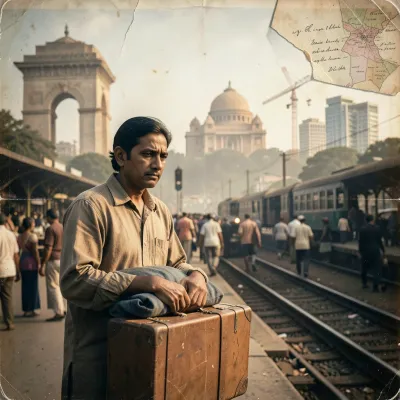
In August 1947, New Delhi's broad imperial avenues became corridors for a human tide no planner had anticipated. Half a million refugees arrived in weeks, doubling the city's population and overwriting its demographic, linguistic, and spatial logic. Patricia Jenkins's New Delhi Through Partition follows that rupture across twenty-five chapters, showing how emergency camps hardened into permanent colonies, how evacuee property laws seeded a contentious housing market, and how the city's Muslim minorities became "pocketed survivals" in a capital remade around Punjabi Hindu and Sikh life.
What the Book Is About
Jenkins structures the book as a layered investigation rather than a linear narrative. The introduction frames Partition as "a structure of experience that reframed urban possibility," and the chapters move from railheads and refugee camps (Chapters 2–4) into property law (Chapter 5), cartography (Chapter 6), neighborhood case studies (Chapter 7), markets (Chapter 8), women's labor (Chapter 9), language and schooling (Chapter 10), sacred space (Chapter 11), policing (Chapter 12), infrastructure (Chapter 13), entrepreneurship (Chapter 14), cinema (Chapter 15), planning institutions (Chapter 16), electoral politics (Chapter 17), caste dynamics (Chapter 18), Muslim Delhi's persistence (Chapter 19), the consolidation of a "Punjabi capital" (Chapter 20), memory ethics (Chapter 21), lifeworld maps (Chapter 22), family photographs (Chapter 23), war-era aftershocks in 1965 and 1971 (Chapter 24), and a final chapter extracting lessons for twenty-first-century cities (Chapter 25). The intended reader is anyone interested in urban history, forced migration, or South Asian studies who wants a granular, evidence-rich account that refuses to treat 1947 as a closed episode.
From Railway Platforms to Permanent Colonies
The book's early chapters reconstruct the physical choreography of displacement. Old Delhi Station received "packed beyond sight" trains carrying Hindu and Sikh refugees, while Lodhi Colony Station dispatched Muslim families toward Pakistan. Purana Qila and Humayun's Tomb became camps holding 150,000–200,000 people at their peak. Jenkins notes that "those who made it to the camp had escaped 'sudden death' only to be 'buried in a living grave'" — a line from Zakir Husain, later India's third president. Chapter 4 traces how Kingsway Camp, once a ceremonial processional route, evolved into Hudson Lines, Outram Lines, and Vijay Nagar, while Lajpat Nagar was planned as a model colony with markets, schools, and dispensaries. The transition was incremental: "plots were allocated, often with small loans or building materials provided, enabling refugees to construct their own homes."
Evacuee Property and the Making of a Housing Market
Chapter 5 offers one of the book's most consequential arguments: the Administration of Evacuee Property Act (1950) turned abandoned Muslim homes and shops into a state-managed pool that was allotted, auctioned, or informally occupied by refugees. This created a "dynamic, often cutthroat, housing market out of the ashes of displacement." The Custodian of Evacuee Property became a powerful figure, and the allocation system "often meant a family that lost a large house in Lahore might be allotted a smaller one in Delhi." Disputes lasted decades; the Act was not repealed until 2005. The process also reshaped Old Delhi's fabric: "many of the older, larger havelis and courtyard houses … were subdivided to accommodate multiple refugee families," straining infrastructure designed for single households.
Women's Labor as the Invisible Infrastructure
Chapter 9 centers women's work — domestic, economic, and communal — as the substrate of resettlement. In camps, women "improvised kitchens with rudimentary stoves, scrounged for clean water, and fashioned private spaces out of shared misery." They ran community kitchens, stitched for piece rates, managed savings groups, and later staffed the garment workshops that powered Lajpat Nagar's market. Jenkins writes that "their unacknowledged labor was a foundational element of Delhi's economic rebuilding." The chapter also documents the gendered violence of Partition — abductions, forced conversions, stigma — and the state's fraught recovery efforts, noting that "the very act of recovering women across borders highlighted the deep-seated trauma and the complexities of belonging."
The Making of a Punjabi Capital
Chapter 20 synthesizes the demographic and cultural transformation. Nearly half a million Punjabi Hindu and Sikh refugees "didn't just find a new home in Delhi; they fundamentally remade it." Punjabi became the dominant spoken language across new colonies, displacing Urdu's public presence. The culinary map shifted: "roadside eateries serving chole bhature, sarson ka saag, makki di roti, and tandoori chicken became immensely popular." Entrepreneurial networks from Lahore and Rawalpindi revived markets like Sarojini Nagar and Gaffar Market. Politically, refugees became a decisive voting bloc; Chapter 17 shows how the Jana Sangh (later BJP) "appealed to the grievances of many Hindu and Sikh refugees" and how refugee associations morphed into lobbying groups. The result is a city where "the grand imperial design of Lutyens [is] overlaid by the vibrant, tenacious, and ultimately transformative spirit of its Punjabi citizens."
Infrastructure Debt and Lessons for the Twenty-First Century
Chapter 13 documents how water, power, and sanitation systems — designed for a smaller population — collapsed under the 90 percent population surge between 1941 and 1951. "No extra housing, water supply, sewage, or transport was available," Jenkins writes, and the Delhi Jal Board "today still falls short of meeting the city's water demand." Chapter 25 distills this into a framework for contemporary cities facing mass migration: leverage informal networks rather than suppress them; invest in scalable infrastructure before crisis hits; enfranchise newcomers quickly so they become stakeholders; settle property rights transparently to avoid decades of litigation; protect minority cultural spaces against majoritarian erasure; and recognize that displacement has a "long tail" — the 1965 and 1971 wars reactivated anxieties and brought new refugee waves (Bengali settlers in Chittaranjan Park). The book argues that Delhi's experience is not a historical curiosity but a template for urban resilience.
Who Should Read This
Scholars of Partition studies, urban historians, and policy makers working on refugee integration will find the book's archoral rigor and comparative framing immediately useful. General readers interested in Delhi's neighborhoods — why Karol Bagh smells of spices, why Lajpat Nagar's markets feel distinct from Old Delhi's, why certain colonies still lack reliable water — will get concrete answers grounded in specific chapters and primary sources. Readers looking for a fast-paced narrative or a focus on high politics may find the detail density slow going; the book's strength is its street-level granularity, not dramatic storytelling. For anyone willing to follow Jenkins through municipal minutes, property ledgers, family albums, and oral testimonies, the payoff is a Delhi that makes sense in ways no guidebook explains.
Read “New Delhi Through Partition” on MixCache.com →
Please log in or create an account to leave a comment.
No comments yet. Be the first to say something.