
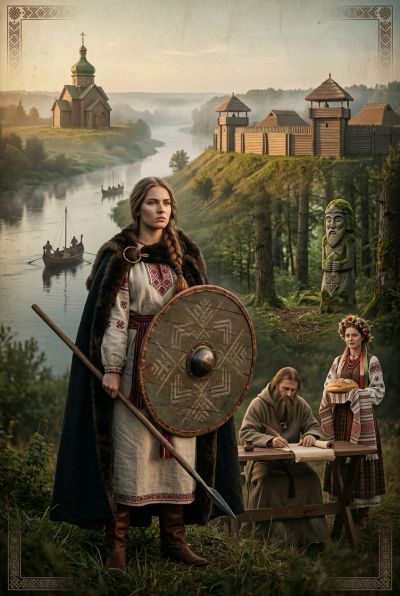
Spanning twenty-five chapters and over a millennium, A History of the Slavs refuses the easy narrative of a unified Slavic destiny. Instead, Silvio Trapani shows how a common linguistic root fractured into distinct political cultures shaped by religion, empire, and geography — a divergence that explains today's headlines as much as yesterday's battles.
What the book is about
The book moves chronologically from the shadowy Urheimat between the Vistula and Dnieper to the 2022 invasion of Ukraine. Its structure follows the three traditional branches — West, East, and South Slavs — while tracing their intersections: the missions of Cyril and Methodius, the rise and fall of Great Moravia and Kievan Rus', the Polish-Lithuanian Commonwealth, the Ottoman and Habsburg rules, the Soviet experiment, and the post-1989 divergence. Trapani writes for the general reader but doesn't flatten complexity; he names the sources (Procopius, the Primary Chronicle, Gallus Anonymus), flags scholarly debates (Normanist vs. anti-Normanist, the location of the Urheimat), and lets primary voices — Byzantine chroniclers, Hussite pamphlets, Solidarity declarations — carry the texture.
The linguistic detective work that opens the story
Before the Slavs enter written history in the sixth century, Trapani spends two chapters reconstructing them from the outside in. Roman authors like Tacitus mention the Venedi east of the Vistula; Byzantine writers Procopius and Jordanes describe the Sclaveni and Antes as "tall and strong, with ruddy complexions" living in "miserable huts" hidden in forests. Linguistic paleontology fills the gaps: shared Proto-Slavic words for linden, elm, swamp (bolto), and freshwater fish point to a temperate forest homeland, while loanwords from Gothic (tools, social terms) and Iranian (bog for god, rai for paradise) map their neighbors. Archaeology adds the Prague-Korchak and Penkovka cultures — sunken huts, cremation burials, undecorated pottery. The picture that emerges is not a nation but a "world without cities, without stone monuments, and without a powerful ruling class," organized around the rod (clan) and governed by what Procopius called a "democracy" of elders.
Religion as the great structural fault line
The 1054 Schism did more than split churches; it gave the Slavic world two distinct alphabets, two legal traditions, and two cultural orbits. Trapani returns to this divide repeatedly. In Chapter 4, Rastislav of Great Moravia invites Byzantine missionaries precisely to escape Frankish bishops using Latin liturgy as a tool of control. Cyril and Methodius invent Glagolitic, translate the Gospels, and create Old Church Slavonic — a literary language that outlives their Moravian mission. Expelled disciples carry it to Bulgaria, where Cyrillic emerges, and from there to Kievan Rus'. Meanwhile, the West Slavs (Poles, Czechs, Slovaks, Croats, Slovenes) adopt Latin script and Roman Catholicism, embedding them in the Renaissance, Reformation, and Enlightenment. The South Slavs add a third layer: Bosniaks become Muslim under Ottoman rule. As Trapani puts it, "This intricate layering of linguistic unity and profound cultural and religious diversity is a central theme in Slavic history. It has been a source of both strength and immense conflict."
State-building as improvisation, not inevitability
Three early states — Great Moravia, Kievan Rus', and Poland — illustrate how contingent Slavic statehood was. Great Moravia rises under Mojmir and Rastislav, peaks under Svatopluk, and vanishes within decades of his death, crushed by Magyars. Kievan Rus' begins with Varangian warriors (Rurik, Oleg) ruling a Slavic population, adopts Byzantine Christianity under Vladimir, codifies law under Yaroslav the Wise, then fractures under a rota succession system that "created a constant, destabilizing rotation of rulers." Poland's Piast dynasty follows a different arc: Mieszko I's baptism in 966 is a diplomatic masterstroke, Bolesław Chrobry wins a crown at the Congress of Gniezno (1000), but the kingdom collapses into a "Pagan Reaction" and Bohemian invasion by 1038, requiring Casimir the Restorer to rebuild from Kraków. None of these trajectories was preordained; each depended on a ruler's choices, a marriage alliance, or a neighbor's distraction.
The Mongol rupture and the Muscovite pivot
Chapter 8 delivers the book's most violent caesura. The 1223 Battle of the Kalka River is a reconnaissance; the 1237-1240 invasion is annihilation. Ryazan falls in five days; Vladimir's royal family burns in the Dormition Cathedral; Kiev is sacked, its Church of the Tithes collapsing on defenders. The Golden Horde rules indirectly through the yarlyk (patent) and baskaki (tax collectors), turning princes into supplicants at Sarai. Yet this catastrophe reshapes the East Slavic map: Kiev declines, Galicia-Volhynia drifts toward Poland and Lithuania, and the northeastern forests — especially Moscow — become the new center. Chapter 12 traces how Ivan Kalita ("Moneybag") turns tax-farming for the Khan into land purchases and the Metropolitan's seat, how Dmitry Donskoi wins a psychological victory at Kulikovo (1380), and how Ivan III ends tribute at the Ugra River (1480), marries a Palaiologos princess, and adopts the double-headed eagle. The "gathering of the Russian lands" is framed as "more of a hostile takeover" than a reunion.
From Solidarity to the fracturing of the Slavic world
The final chapters argue that the 1989 revolutions were a Slavic event — Polish, Czech, Slovak, Slovene, Bulgarian — but their aftermath split the Slavic world anew. Chapter 22 details how John Paul II's 1979 pilgrimage ("Be not afraid") and the Gdańsk shipyard strikes created a "parallel society" that forced the regime to negotiate. The 1989 Round Table talks and June elections become the template for peaceful transitions across the bloc. But Chapter 24 shows the Soviet dissolution as a Slavic divorce: Yeltsin, Kravchuk, and Shushkevich sign the Belovezha Accords in a hunting lodge, ending the USSR. Chapter 25 brings the argument to the present: West Slavs join NATO and the EU; Ukraine's Orange Revolution (2004) and Euromaidan (2014) pull it westward; Putin's 2022 invasion frames Ukraine as an artificial nation. The book closes on the irony that the largest Slavic war since 1945 is fought between "the two largest and most historically intertwined of all the Slavic nations."
Who should read this
Readers who want a single volume that connects medieval chronicles to modern geopolitics without sacrificing either will find this book rewarding. It assumes no prior knowledge but respects the reader's intelligence — explaining terms like veche, yarlyk, mir, and szlachta when they first appear. Those looking for a celebratory Pan-Slavic narrative will be disappointed; Trapani's thesis is that unity was always more rhetorical than real. Specialists may quibble with compression in later chapters, but the bibliography and chapter notes point toward deeper study. For anyone trying to understand why the Slavic map looks the way it does — and why it's burning in places — this is the clearest, most balanced guide available.
Read “A History of the Slavs” on MixCache.com →
Please log in or create an account to leave a comment.
No comments yet. Be the first to say something.