
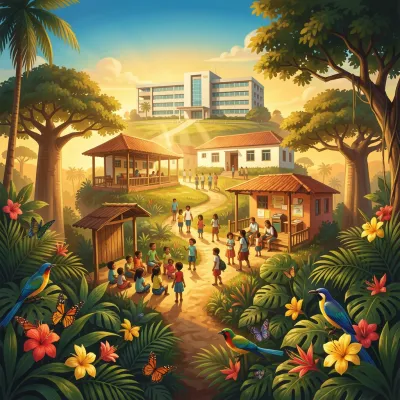
Equatorial Guinea presents one of Africa's most striking development contradictions: a nation with sky-high GDP per capita that still allocates only 2-3 percent of its budget to education, far below the Sub-Saharan average. Gregory Martin's exhaustive study traces how this paradox shapes every level of learning, from preschool play corners to university lecture halls. The result is a rare, data-driven portrait of an education system caught between colonial legacies, oil-fueled infrastructure booms, and persistent human-capital neglect.
What the Book Is About
The book spans 25 chapters organized chronologically and thematically, beginning with pre-colonial oral traditions and moving through Spanish missionary schooling, the catastrophic Macías Nguema dictatorship (when Catholic schools were banned and "military education became mandatory in all schools by 1972"), and the post-1995 oil boom. Martin structures the work around the Ministry of Education, Science and Sports' four-tier system—preschool, primary, secondary, higher education—while devoting full chapters to cross-cutting issues: language policy, rural-urban divide, gender disparities, special needs, teacher training, vocational pathways, funding mechanics, international aid, NGO initiatives, technology integration, adult literacy, brain drain, and future reform scenarios. The intended audience is broad: policymakers, development practitioners, researchers, and students of comparative education will all find granular, citation-ready analysis rather than broad advocacy.
The Spanish Colonial Classroom as Blueprint
Martin shows that today's system is essentially a Spanish colonial architecture with the roof patched but the foundation unchanged. The Claretians and other Catholic orders built the first schools, made Spanish the sole medium of instruction, and achieved "one of the highest literacy rates in Africa at the time of independence." Yet the curriculum "neglected indigenous knowledge systems and cultural heritage," a design choice that still forces rural Fang- or Bubi-speaking children into Spanish-only classrooms. Chapter 15 details how French was added as a second official language in 1998 for regional integration, but indigenous languages remain "acknowledged as part of the national culture rather than as mediums of instruction in formal schooling." The book quotes the 2007 General Education Law's prohibition of discrimination on "tribal, ethnic, gender, religious, social, or political grounds" while noting the law never mandated mother-tongue instruction—a gap that still shapes early-grade repetition rates.
Oil Money That Never Reaches the Chalkboard
Chapter 11 is the financial spine of the book. Despite "massive oil reserves" discovered in the mid-1990s, education's share of the national budget "remained remarkably low, typically around 2-3 percent of the annual budget." Martin documents how Horizon 2020 infrastructure projects built roads and government buildings while "primary and secondary schooling often receive less investment, creating an imbalance in the system." The volatility of oil prices makes long-term planning nearly impossible: "A downturn in oil prices can quickly translate into budget cuts, impacting educational programs and development plans." The author also traces how household costs—uniforms, supplies, transport—effectively make "free" education unaffordable for poor families, especially in rural areas where "the economic utility of a girl's labor at home or in the market can sometimes outweigh the long-term benefits of her completing primary school."
Rural Schools, Urban Dreams
The urban-rural chasm runs through Chapters 4, 16, and 19. In Malabo and Bata, schools have "better facilities, smaller class sizes, and more qualified teachers"; in remote Río Muni villages, children walk hours to "dilapidated buildings, lack basic amenities like clean water and sanitation, and suffer from overcrowded classrooms where a single teacher might be responsible for multiple grade levels." Martin notes that "multi-grade classrooms where a single teacher is responsible for instructing children of different ages and learning levels" are common, and that "linguistic barriers can be more pronounced in rural classrooms" where Spanish is barely spoken at home. The book connects these conditions to hard outcomes: "high attrition rates and low completion rates are also more prevalent in rural areas," feeding a cycle where "the educational divide mirrors the economic divide."
Vocational Training as the Missing Bridge
Chapters 7, 8, and 9 argue that vocational and technical education (VTE) is the system's most underleveraged asset. The academic *Bachillerato* track dominates prestige, yet "critics argue that it may not adequately equip those who do not pursue higher education with practical skills for immediate employment." Martin highlights a Bata training center that partnered with construction and hospitality firms to co-design curricula, mandate internships, and add "soft skills and entrepreneurial training." The result: "a high employment rate for graduates, demonstrating a direct and tangible return on educational investment." The catch? Such models remain islands. Most VTE centers suffer from "outdated curricula, a lack of modern equipment in training centers, and insufficient linkages with the private sector," leaving graduates trained on "obsolete technologies or in fields that are no longer in demand."
Brain Drain and the Hollowed-Out University
Chapter 20 frames the National University of Equatorial Guinea (UNGE) as both a symbol of progress and a leaky vessel. Established in 1995 with campuses in Malabo and Bata, UNGE adopted the LMD (Licence-Master-Doctorat) framework, yet "low salaries, limited research opportunities, and a lack of academic freedom can deter top talent." The book describes a vicious cycle: "When experienced professors, researchers, and specialized lecturers leave, it creates significant gaps in expertise… The quality of instruction inevitably suffers, impacting the learning experience for current students and making it harder to attract new talent." Martin also notes the fiscal cost: "The public investment made in educating these individuals… represents a significant financial loss when they emigrate and contribute their skills and taxes to other economies." Proposed remedies include diaspora engagement programs, competitive research grants, and merit-based civil-service reform—measures the book treats as necessary but politically fragile.
Who Should Read This
Development economists, education ministries, and NGO program officers working in Central Africa will find the book's granular data—enrollment tables, budget percentages, teacher-pupil ratios—immediately usable. Scholars of post-colonial language policy will appreciate the sustained analysis of Spanish dominance versus indigenous-language exclusion. General readers looking for a narrative history of Equatorial Guinea may find the textbook-style organization and policy-focus dense going; this is a reference work, not a story-driven portrait. For anyone designing education interventions in resource-rich but capacity-poor settings, however, Martin's diagnosis of the "disconnect between the nation's considerable oil wealth and limited investment in human capital" makes the volume an essential diagnostic tool.
Read “Education In Equatorial Guinea” on MixCache.com →
Please log in or create an account to leave a comment.
No comments yet. Be the first to say something.