
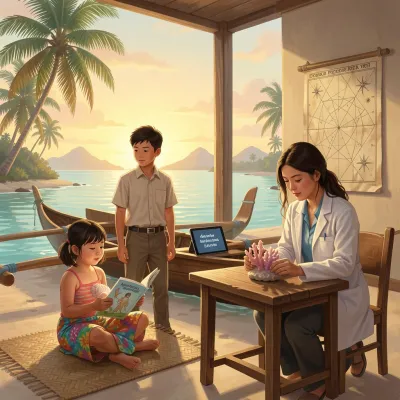
Education in the Republic of the Marshall Islands is not merely a system of schools — it is a daily negotiation between ancestral navigation and standardized testing, between rising tides and rising expectations. Gloria Baker's Education In The Marshall Islands maps this negotiation across 25 chapters, offering the most complete picture to date of a system striving to honor its past while securing its future.
What the book is about
The book moves chronologically and thematically from pre-contact learning through contemporary reforms. Early chapters reconstruct traditional education — navigation by swell patterns, oral genealogies, communal apprenticeship — before tracing how German, Japanese, and American administrations each imposed their own curricula and languages. The middle sections examine each formal stage: early childhood (Chapters 4–5), primary (6–7), secondary (8), vocational (9), and higher education (12–13), with dedicated chapters on language policy (10), teacher training (11), and distance learning (14). Cross-cutting issues — special education (15), sustainable development (16), health (17), community roles (18), funding (19), governance (20), assessment (21), climate change (22), technology (23), and international partnerships (24) — receive sustained treatment. The final chapter synthesizes reform directions. The intended audience includes educators, policymakers, researchers, and anyone studying small island developing states; the tone is analytical but accessible, with extensive context for readers unfamiliar with the Pacific.
Traditional knowledge as intellectual infrastructure, not folklore
Baker refuses to relegate Marshallese indigenous knowledge to cultural color. Chapter 2 demonstrates that navigation using rebbelib stick charts required "an understanding of abstract concepts and a keen ability to visualize complex environmental data." Chapter 1 argues this system "ensured the survival and cultural continuity of the Marshallese people for millennia." The book shows how mission and colonial schools positioned this knowledge as inferior, yet also how Marshallese educators quietly sustained it alongside formal schooling. This framing shifts the conversation from "cultural preservation" to "epistemic equity" — a distinction that matters for curriculum design today.
The bilingual tightrope: Marshallese and English in the classroom
Chapter 10 provides the clearest analysis of the language-in-education dilemma. The system aims for "additive bilingualism," where English adds to rather than replaces Marshallese, but the reality is messier. Baker notes the "almost exclusive use of English as the language of instruction created a linguistic divide, potentially alienating students from their mother tongue and cultural heritage." Teachers must code-switch fluently while teaching academic content in both languages — a demand that outpaces training, especially on outer islands. The chapter also highlights a practical consequence: standardized tests in English "may not accurately reflect the knowledge and abilities of students whose primary language is Marshallese," making assessment reform inseparable from language policy.
Climate change as curriculum, infrastructure, and pedagogy
Chapter 22 makes clear that climate change is not a unit in science class — it shapes whether the classroom exists. Schools on low-lying atolls face "king tides, storm surges, and coastal erosion" that can render buildings unusable for months. The crisis also rewrites what gets taught: "Climate change education is no longer an abstract topic but a deeply personal one, interwoven into science, social studies, and even Marshallese language arts." Vocational programs now include "sustainable construction techniques, renewable energy technologies, or climate-smart agriculture." Teacher training adds "disaster preparedness, first aid, and how to maintain learning continuity in emergency situations." The book positions education as both a victim of and a response to climate collapse.
Geography as educational destiny — and the partial promise of technology
Across multiple chapters, the dispersed atoll geography emerges as the system's defining constraint. Chapter 5 describes outer island children for whom "a dedicated ECE center with trained teachers and age-appropriate materials might be a distant dream." Chapter 7 notes teachers on remote atolls "often miss out on these crucial opportunities to update their skills." Chapter 14 and 23 explore distance learning and technology as bridges, but Baker is candid: "Many outer island schools rely on expensive satellite internet or have no connectivity at all." Offline solutions — USB drives, solar-powered tablets, local networks — become essential. The digital divide here is not metaphorical; it is measured in bandwidth costs and generator fuel.
Community as the system's hidden backbone
Chapter 18 elevates community from stakeholder to infrastructure. The principle of mantin kōpaj — "shared responsibility and communal care" — manifests in volunteer school maintenance, elders teaching navigation and weaving in classrooms, churches providing meeting spaces and moral frameworks, and schools doubling as cyclone shelters. Baker writes, "In many remote outer islands, where government resources might be stretched thin, this community self-help is absolutely indispensable for keeping schools operational." This insight reframes equity debates: resource allocation must account for what communities already contribute, not just what they lack.
Who should read this
Education researchers, development practitioners, and policymakers working in small island states will find a rigorous, data-informed case study with transferable lessons on bilingual policy, climate-resilient schooling, and community-governed systems. Scholars of post-colonial education will appreciate the nuanced tracing of missionary, German, Japanese, and American layers. General readers seeking a human portrait of Marshallese life may find the institutional focus dense; the book prioritizes systemic analysis over narrative anecdote. For anyone asking how a nation educates its children when the classroom itself may vanish beneath the waves, this is an essential reference.
Read “Education In The Marshall Islands” on MixCache.com →
Please log in or create an account to leave a comment.
No comments yet. Be the first to say something.